
Competitive ad tracking shows you what your competitors are running on Meta, Google, and TikTok and finds out what's actually working for them right now.
I tested over 30 tools built for this exact job: everything from Meta's own free library to paid platforms built for agencies managing dozens of accounts. Many did one thing well and fell flat everywhere else.
These are the 14 tools that earned a top spot, picked for what they actually do well and who they're built for. By the end, you'll know exactly which of these fits how you track competitors.
14 best competitive ad tracking tools: TL;DR
- Atria: Best for turning competitor ad intel into your next campaign.
- Meta Ad Library: Best for free, official tracking of every active ad running on Facebook and Instagram.
- Google Ads Transparency Center: Best for free tracking of competitor ads on Search, Display, and YouTube.
- Panoramata: Best for automated tracking across ad networks in one dashboard.
- Atria: Best for turning competitor ad intel into your next campaign.
- Adbeat: Best for display and programmatic spend intelligence at scale.
- SpyFu: Best for tracking competitor PPC keywords and ad copy history.
- GetHookd: Best for fast, high-volume ad spying across platforms.
- LinkedIn Ad Library: Best for tracking B2B competitor ads.
- TikTok Ad Library: Best for free TikTok ad transparency in the EEA, UK, and Switzerland.
- Madgicx Ad Library: Best for organizing Meta ad inspiration into boards.
- Foreplay: Best for building a swipe file from competitor ads.
- Motion: Best for detailed creative-level ad analytics.
- AdCreative.ai: Best for generating ad variations from competitor patterns.
- Similarweb: Best for benchmarking competitor site traffic behind the ads.
How I researched and tested these competitive ad tracking tools
I worked through demos, documentation, and user reviews on G2, Capterra, and Reddit for every tool on this list. I then ran the tools myself against a handful of direct-to-consumer (DTC) and agency accounts I had access to.
Here's what I looked at:
- Coverage across platforms: Whether a tool tracks Meta, Google, TikTok, and LinkedIn, or sticks to just one.
- How fresh the data actually is: Some tools update in real time, others lag by days or only show what's currently live.
- Depth beyond the surface: Whether you get spend estimates, ad longevity, and creative history, or just a static screenshot of an ad.
- Ease of use at scale: How painful it gets once you're tracking more than one or two competitors at a time.
- Value for the price: Whether a paid tool earns its cost over the free official libraries, or whether it's solving a problem you don't actually have.
The free libraries are great for a quick gut check on one brand, but they fall apart the moment you're trying to track five or ten competitors over months. Once you're at that scale, a paid tool starts to makes sense.
Top 14 competitive ad tracking tools: quick comparison
| 💻 Tool | 🎯 Best for | 🔥 Starting price (billed annually) | ⚡ Strengths |
|---|---|---|---|
| Atria | Turning ad intel into new campaigns | $129/month | Ad library access, AI-generated briefs, and built-in creative production |
| Meta Ad Library | Free Meta ad tracking | Free | Official Meta data, no account needed, and full ad creative visibility |
| Google Ads Transparency Center | Free Search and YouTube ad tracking | Free | Official Google data, broad format coverage, and accurate creative detail |
| Panoramata | Automated multi-network tracking | $990/year | Multi-channel dashboard, real-time alerts, and landing page tracking |
| Adbeat | Display and programmatic spend data | $200/month | Network-level placement data, spend estimates, and creative history |
| SpyFu | PPC keyword and ad copy history | $29/month | Long-term keyword data, ad copy timelines, and budget-friendly pricing |
| GetHookd | Fast, high-volume ad spying | $19/month | Large ad database, AI script generation, and brand-specific tracking |
| LinkedIn Ad Library | Tracking B2B ads | Free | Official LinkedIn data, free access, and targeting detail for EU ads |
| TikTok Ad Library | Free TikTok ad tracking (EEA, Switzerland, and UK) | Free | Official TikTok data, unique-view counts, and free access |
| Madgicx Ad Library | Organizing Meta ad inspiration | $32/month | Pinterest-style boards, industry filters, and team collaboration |
| Foreplay | Building a competitor swipe file | $49/month | Ad saving tools, brief templates, and Chrome extension access |
| Motion | Creative-level ad analytics | $750/month, billed monthly | Visual reporting, AI tagging, and weekly creative leaderboards |
| AdCreative.ai | Generating ad variations | $20/month | Fast image generation, performance scoring, and multiple ad formats |
| Similarweb | Benchmarking competitor site traffic | $125/month | Traffic source data, audience insights, and market-level benchmarking |
1. Atria: Best for turning ad intel into new campaigns
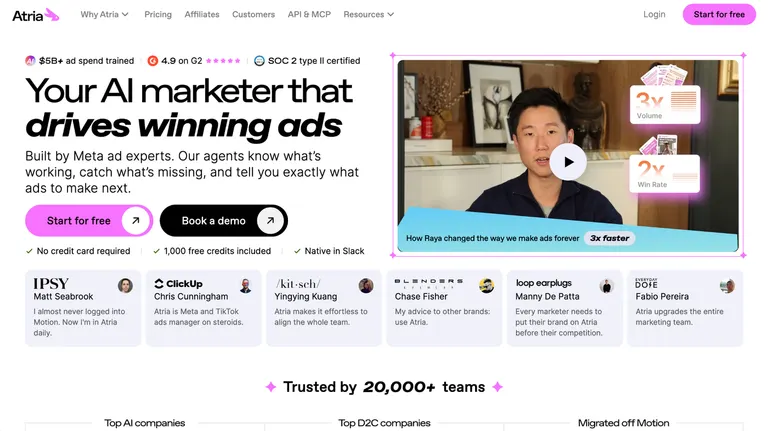
- What it does: Atria is a creative intelligence platform built for Meta ads, pulling competitor research, ad grading, and creative generation into one workflow.
- Best for: Performance marketers who want competitive ad tracking to feed directly into their next brief instead of sitting in a separate research tool.
We designed Atria so competitor research doesn't stop at a screenshot. Follow a brand, and its top hooks, angles, and personas come from a library of over 100 million ads, ready to shape your next brief.
Run your own ads through Atria, and each gets a plain-English grade with a specific fix attached. Radar, Atria's monitoring feature, flags an ad the moment it starts losing steam.
Atria's library spans Meta and TikTok ads, so you'll still want a separate tool for Google or LinkedIn campaigns.
Key features
- Competitor research: Follow any brand and pull its top hooks, angles, and personas from a library of over 100 million ads.
- Slack-native workflow: Atria lives inside Slack, so competitor research, briefs, and creative updates show up where your team already works.
- Ad grading: Every ad gets a plain-English grade with a specific fix attached, based on how it's performing.
Pros and cons
| ✅ Pros | ❌ Cons |
|---|---|
| Keeps research and creative production in one workflow instead of two separate tools | Built around Meta, so other platforms need a separate tool |
| Radar catches a fading ad early enough to rotate in something fresh before it drags down ROAS | Newer to the category than dedicated ad-spy tools like Adbeat or GetHookd |
| Briefs pull from your own account's performance data |
What users say
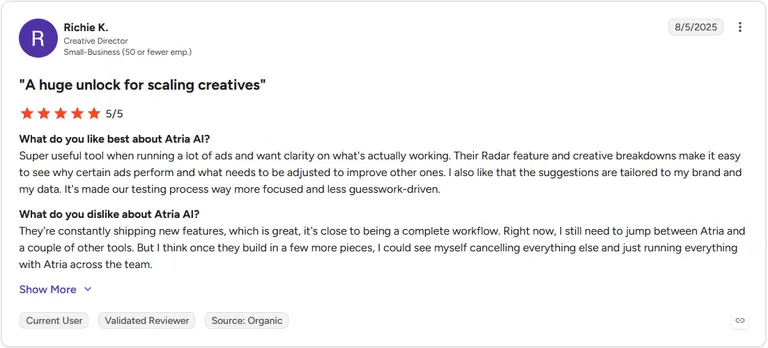
Pro: "Super useful tool when running a lot of ads and want clarity on what's actually working. Their Radar feature and creative breakdowns make it easy to see why certain ads perform and what needs to be adjusted to improve other ones." (Richie K., G2)
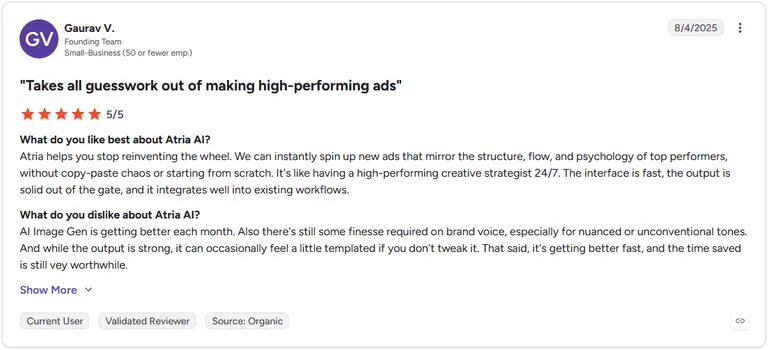
Con: "AI Image Gen is getting better each month. Also there's still some finesse required on brand voice, especially for nuanced or unconventional tones. ... That said, it's getting better fast, and the time saved is still [very] worthwhile." (Gaurav V., G2)
Pricing
Atria starts at $129 per month.
Bottom line
Atria works best if you’re already running Meta ads and want competitor research to end in a new ad instead of a research doc. If you need free coverage on the Google side too, Google Ads Transparency Center might be what you need.
2. Google Ads Transparency Center: Best for free Search and YouTube ad tracking
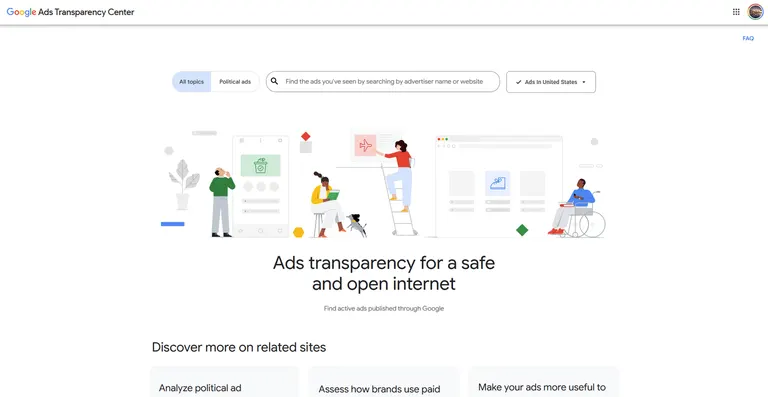
- What it does: Google Ads Transparency Center is Google's official ad transparency tool, letting anyone search and view verified advertisers' active and past ads across Search, Display, and YouTube.
- Best for: Anyone who wants a free, official look at a competitor's Google ad activity without paying for a spend-estimate tool.
I wanted to see whether Google Ads Transparency Center worked like Meta's, so I ran the same competitors through it.
Searching by advertiser name pulled up their Search, Display, and YouTube ads, along with how long each had run. The creative detail looked sharper than paid tools like SpyFu, which lean on estimates instead of the real thing.
Keep in mind a smaller or newer advertiser can vanish from a search if Google hasn't verified them, so an empty result doesn't always mean they're not advertising.
Key features
- Cross-format search: Look up any verified advertiser to see their Search, Display, and YouTube ads together in one result.
- Date range filtering: Check how long a specific ad has been running and when it first appeared.
- Format and region filters: Narrow results by country and by ad format to focus on the exact market you're researching.
Pros and cons
| ✅ Pros | ❌ Cons |
|---|---|
| Creative detail comes through sharper and more reliably than the estimates paid tools provide | Unverified advertisers can be missing from search results entirely |
| Doubles as a keyword research tool, since ad copy often reveals what a competitor is bidding on | No spend, CPA, or performance data anywhere in the tool |
| Backed directly by Google, so there's no risk of outdated or scraped information |
What users say
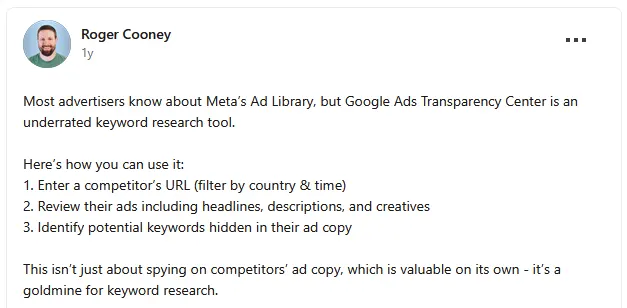 Pro: "Google Ads Transparency Center is an underrated keyword research tool. ... it's a goldmine for keyword research." (Roger Cooney, LinkedIn)
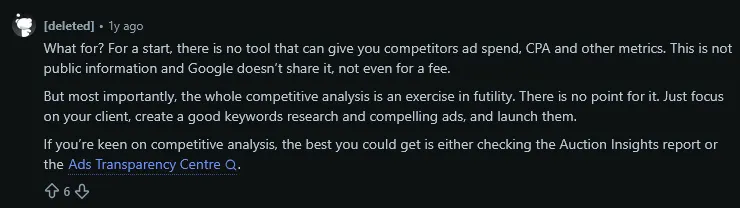
Con: "There is no tool that can give you competitors ad spend, CPA and other metrics. This is not public information and Google doesn't share it. ... the best you could get is either checking the Auction Insights report or the Ads Transparency Centre." (u/[deleted], Reddit)
Pricing
Google Ads Transparency Center is free to use, with no account or subscription required.
Bottom line
Google Ads Transparency Center works well for spotting exactly what a competitor's Google ads say, though it doesn’t tell you how well those ads are performing. If you need spend estimates alongside the creative, SpyFu could be worth considering.
3. Panoramata: Best for automated multi-network tracking
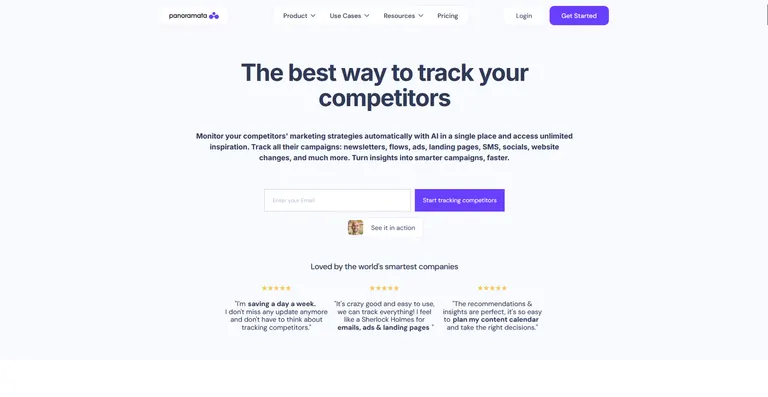
- What it does: Panoramata is a competitor tracking platform that pulls ads, emails, and landing pages from thousands of brands into one searchable dashboard.
- Best for: Teams that need to monitor several competitors across multiple ad networks without checking each platform's library separately.
To see how much Panoramata consolidates, I loaded a handful of competitor accounts into its dashboard.
Within minutes, Meta, Google, and TikTok ads from every account showed up side by side, along with each ad's landing page. Alerts also hit my inbox whenever a competitor published something new, so I never had to recheck a library manually.
The downside of watching this many networks at once is that Panoramata can't match a single-platform tool for depth.
Key features
- Multi-network ad tracking: Pull ads from Meta, Google, TikTok, LinkedIn, and Pinterest into a single dashboard.
- Real-time alerts: Get notified when a tracked competitor publishes a new ad.
- Landing page tracking: View the landing page tied to each ad to see the full funnel a competitor is running.
Pros and cons
| ✅ Pros | ❌ Cons |
|---|---|
| Cuts out the back-and-forth of checking Meta, Google, and TikTok libraries separately every week | Setup takes longer than a free library, since you're building out tracked competitor lists |
| Scales well past a handful of competitors, where free libraries start to feel unmanageable | Depth on any single platform doesn't match a dedicated tool built just for that network |
| Comparing your own ad performance against a competitor's benchmark is a real time-saver for reporting |
What users say
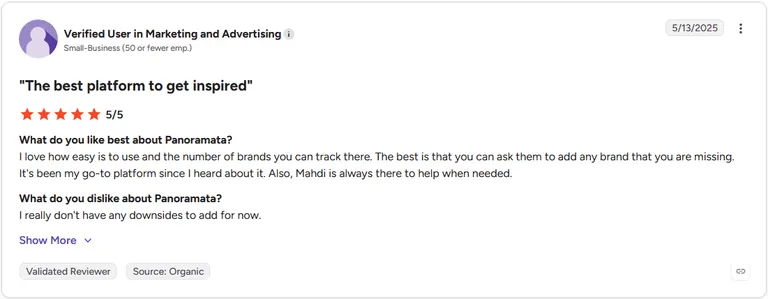
Pro: "I love how easy [it] is to use and the number of brands you can track there. The best is that you can ask them to add any brand that you are missing." (Verified User, G2)
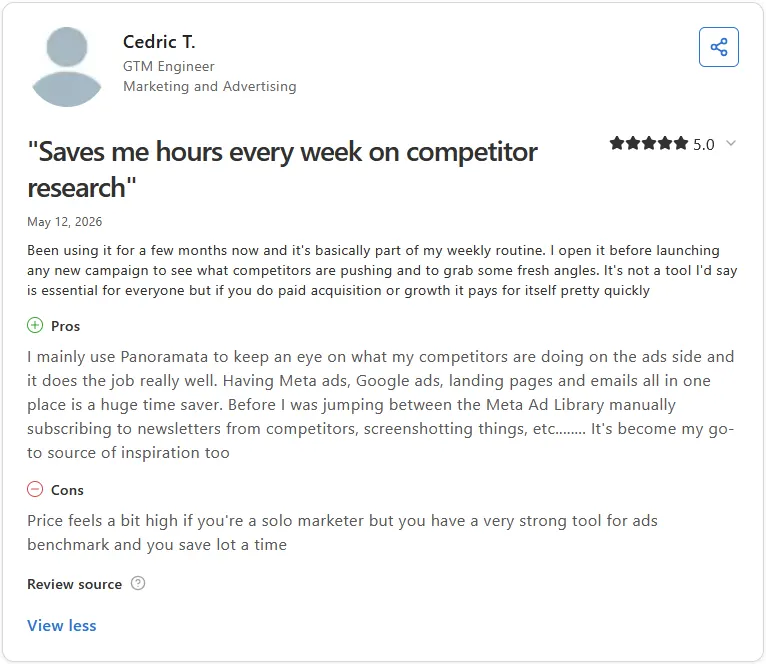
Con: "Price feels a bit high if you're a solo marketer but you have a very strong tool for ads benchmark and you save a lot of time." (Cedric T., Capterra)
Pricing
Panoramata starts at $990 per year when you pay annually.
Bottom line
Panoramata earns its price once you're tracking enough competitors that manually checking each library would eat up real time every week. For deeper display and programmatic spend data specifically, Adbeat is worth a look.
4. Meta Ad Library: Best for free Meta ad tracking
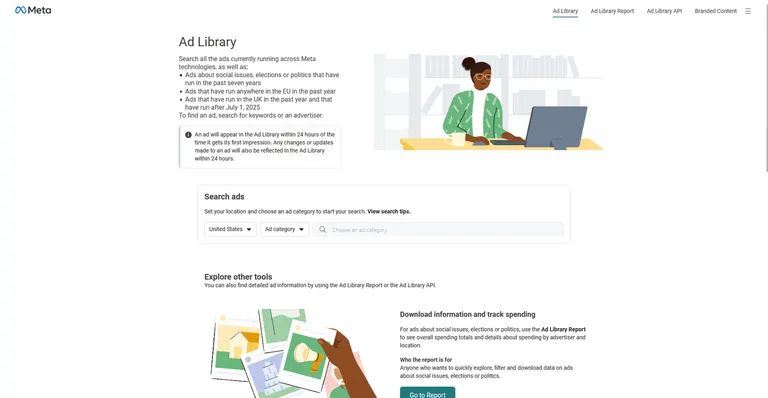
- What it does: Meta Ad Library is Meta's official ad transparency tool, and it lets anyone search and view every active ad running on Facebook, Instagram, Messenger, and Audience Network.
- Best for: Anyone who needs a free, official look at what's currently running on Meta without paying for a third-party tool.
I pulled up a handful of DTC competitors in the Meta Ad Library to see how much I could learn from a single search. We cover the search itself in more depth in 10 ways to use the Facebook Ad Library.
Typing in a brand name found every active ad they were running, with launch dates and creative variations sitting right next to each other. I switched on the Active Status filter and the inactive ads showed up too.
Here's the catch: outside political and special-category campaigns, you lose the deeper detail like spend and audience breakdown.
Key features
- Search by advertiser or keyword: Look up ads by page name, business, or keyword to surface everything currently running that matches.
- Filter by country and platform: Narrow results down to a specific region or to just Facebook, Instagram, Messenger, or Audience Network.
- Ad detail view: See the launch date, platforms an ad is running on, and every creative variation tied to a single ad.
Pros and cons
| ✅ Pros | ❌ Cons |
|---|---|
| Trusted as the source of truth, since spy tools scrape and estimate what this tool shows directly | Comparing more than two or three competitors simultaneously gets tedious fast |
| Works well as the starting point most competitive research workflows eventually build on | No way to save a search or get notified when a competitor launches something new |
| Costs nothing to check as many competitors as you want, with no seat limits or usage caps |
What users say
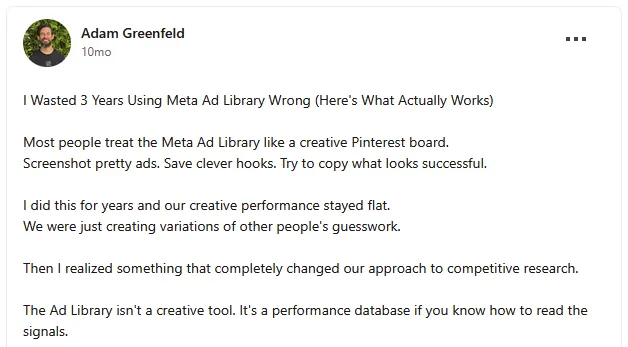 Pro: "The Ad Library isn't a creative tool. It's a performance database if you know how to read the signals." (Adam Greenfeld, LinkedIn)

Con: "Fine for basic research but if you're trying to track patterns over time or compare multiple competitors, it gets tedious fast." (u/I_am_RedJohn_, Reddit)
Pricing
Meta Ad Library is free to use, with no account or subscription required.
Bottom line
Meta Ad Library works best as a starting point for one-off checks, since there's no way to save searches or get alerted to new activity. If you need to monitor several competitors on autopilot, Panoramata might be a better fit.
5. Adbeat: Best for display and programmatic spend data
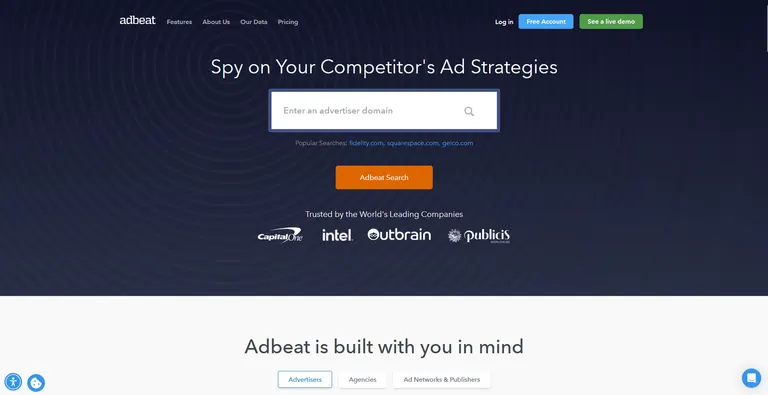
- What it does: Adbeat is a display and programmatic ad intelligence platform, tracking where competitor ads run, which networks carry them, and how long each creative stays live.
- Best for: Teams that need spend estimates and placement data for display and programmatic campaigns specifically.
I picked a handful of advertisers running heavy programmatic campaigns and ran them through Adbeat to see how deep its spend data goes.
I didn't have to convert spend numbers while comparing advertisers, since Adbeat already showed everything in local currency. I traced one ad's run time across placements and found records reaching back months further than any tool I'd tested so far.
The gap shows up on the Meta side, where Adbeat's Facebook and Instagram data doesn't go nearly as deep.
Key features
- Network-level placement data: See which ad networks and publisher sites are running a competitor's display ads.
- Spend estimates: View estimated ad spend in your local currency for easier comparison across advertisers.
- Creative history tracking: Check how long a specific ad creative has been running and where it's appeared over time.
Pros and cons
| ✅ Pros | ❌ Cons |
|---|---|
| Built for programmatic and display specifically, where most ad-spy tools stay shallow | Facebook and Instagram data is noticeably thinner than the display and programmatic side |
| Useful for spotting when a competitor is shifting budget from one network to another | Pricing sits higher than tools built for a single platform |
| Works well for teams that already have a media strategy and want sharper data to refine it |
What users say
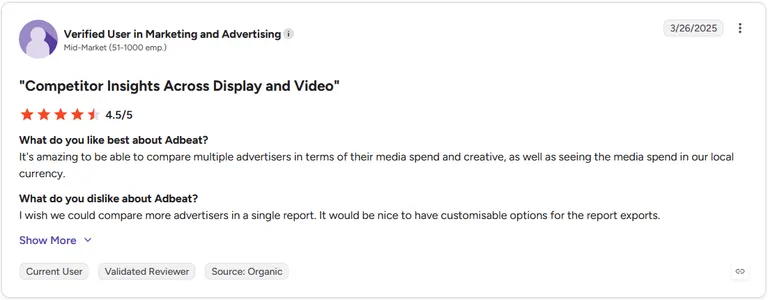
Pro: "It's amazing to be able to compare multiple advertisers in terms of their media spend and creative, as well as seeing the media spend in our local currency." (Verified User, G2) 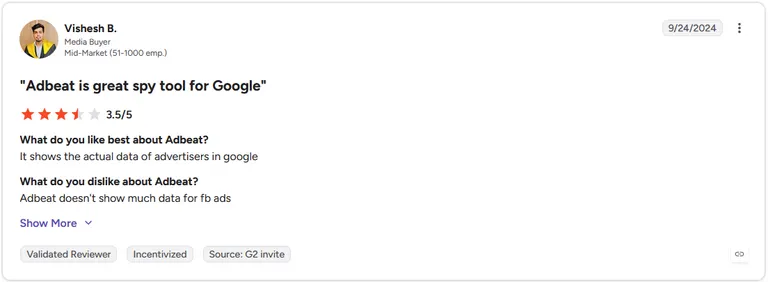
Con: "Adbeat doesn't show much data for FB ads." (Vishesh B., G2)
Pricing
Adbeat starts at $200 per month.
Bottom line
Adbeat works best once display and programmatic spend actually matters to your competitor research instead of just Meta creative. If you need deeper Facebook and Instagram data specifically, GetHookd might suit you better.
6. SpyFu: Best for PPC keyword and ad copy history
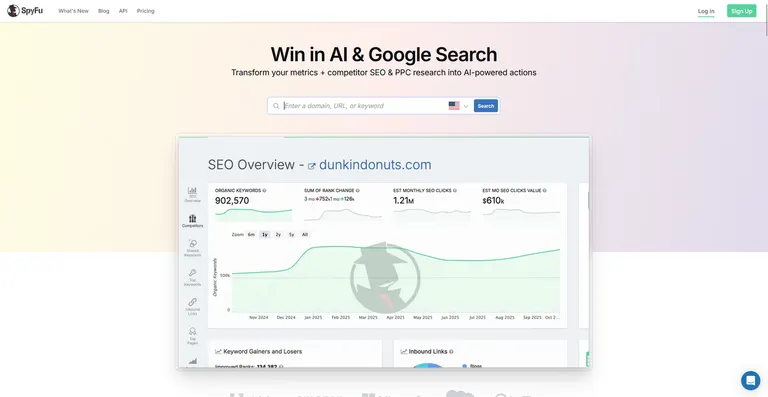
- What it does: SpyFu is a competitor research tool built around search marketing, tracking the keywords, ad copy, and PPC history behind a competitor's Google campaigns.
- Best for: Teams that need a budget-friendly way to track competitor keywords and paid search strategy over time.
Testing on a few competitors running active Google Ads campaigns showed me how far back SpyFu's history goes.
I found keyword rankings and ad copy changes spanning years, which revealed how a competitor's messaging shifted alongside their bidding strategy. Pairing a keyword search with its matching ad copy made it easy to spot which terms a competitor backed with their budget.
Search volume is the only thing SpyFu shows right away. Keyword difficulty or CPC means an extra click per term, adding up across several keywords.
Key features
- Keyword and domain history: Track how a competitor's keyword rankings and ad campaigns have changed over time.
- PPC ad copy tracking: See the exact ad copy tied to specific keywords a competitor has bid on.
- Competitor comparison tools: Compare organic and paid visibility side by side across multiple competitors at the same time.
Pros and cons
| ✅ Pros | ❌ Cons |
|---|---|
| Useful for spotting long-term shifts in a competitor's messaging instead of just a snapshot of today | Upfront data is thinner than Ahrefs or SEMrush, requiring extra clicks to get the same detail |
| Costs a fraction of what pricier keyword research suites charge for similar competitor depth | Backlink data doesn't hold up as well as tools built specifically for SEO |
| Makes it easy to tell which keywords a competitor is actually backing with budget, not just ranking for organically |
What users say
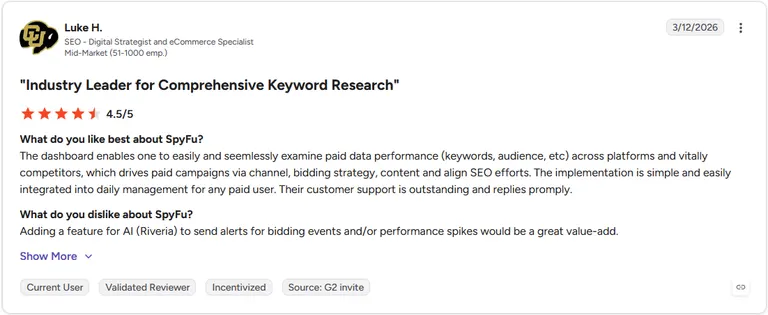
Pro: "The dashboard enables one to easily and seamlessly examine paid data performance (keywords, audience, etc) across platforms and. ...competitors, which drives paid campaigns via channel, bidding strategy, content, and align SEO efforts." (Luke H., G2)
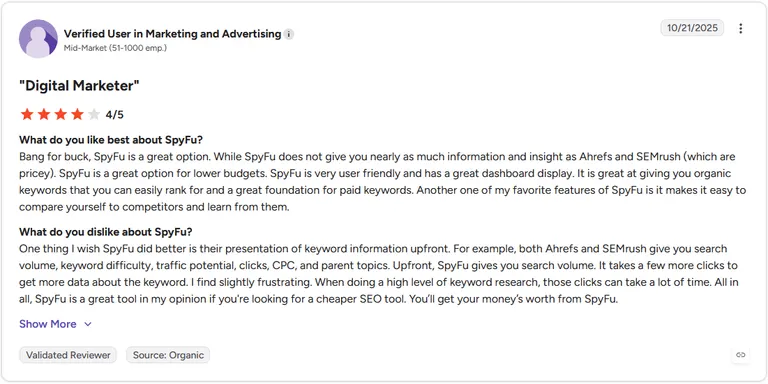
Con: "SpyFu gives you search volume. It takes a few more clicks to get more data about the keyword. I find [that] slightly frustrating." (Verified User, G2)
Pricing
SpyFu starts at $29 per month when billed annually.
Bottom line
SpyFu works best when Google Ads and organic search matter more to your research than Meta creative. If Meta is where your competitors spend most of their budget, Meta Ad Library is a better starting point.
7. GetHookd: Best for fast, high-volume ad spying
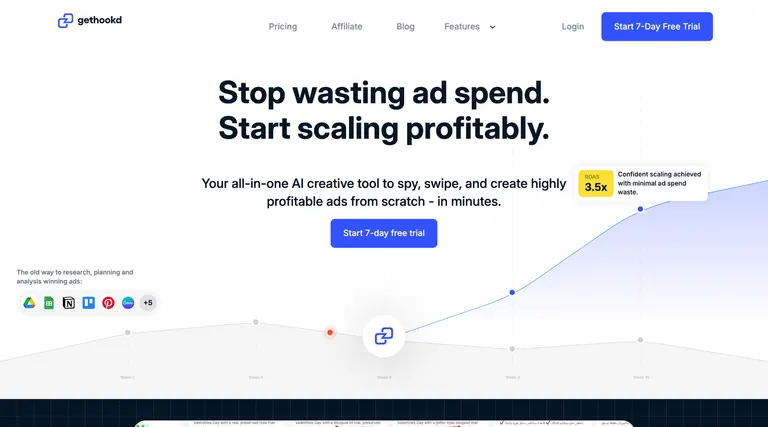
- What it does: GetHookd is an AI-powered ad spy tool that lets you search a library of over 23 million ads across Facebook, TikTok, and Google to find what's working in a specific niche.
- Best for: Ecommerce brands and agencies that want to move quickly from finding a competitor's ad to producing their own version of it.
I ran a Brand Spy search on a handful of competitors to see how fast GetHookd could surface their best creative, and it moved pretty fast.
Each ad came with its own performance signals, so spotting a competitor's longest-running creative took a quick scan instead of a manual hunt. Feeding one into the AI generator handed back several fresh variations, no designer required.
The script tone gives away that it's AI-written, so anything pulled straight from GetHookd needs a pass before it sounds like your brand.
Key features
- Brand Spy: Track a specific competitor's top-performing ads, landing pages, and traffic sources.
- AI ad generator: Turn a saved ad into new image variations in different colors, styles, and formats.
- AI script generator: Generate ad copy and hooks based on a winning ad and your own product details.
Pros and cons
| ✅ Pros | ❌ Cons |
|---|---|
| Moving from a saved ad to a usable variation takes minutes instead of a full design brief | AI-generated scripts need editing before they sound like your own brand |
| A library of over 23 million ads makes it easy to find creative in a specific niche fast | Mobile experience lags behind the desktop version |
| Performance signals on each ad help you spot a competitor's longest-running creative without guessing |
What users say
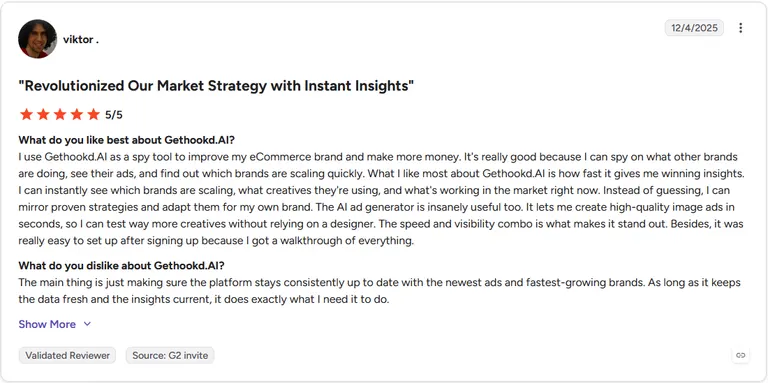
Pro: "I use Gethookd.AI as a spy tool to improve my eCommerce brand and make more money. … I can instantly see which brands are scaling, what creatives they're using, and what's working in the market right now." (Viktor, G2)
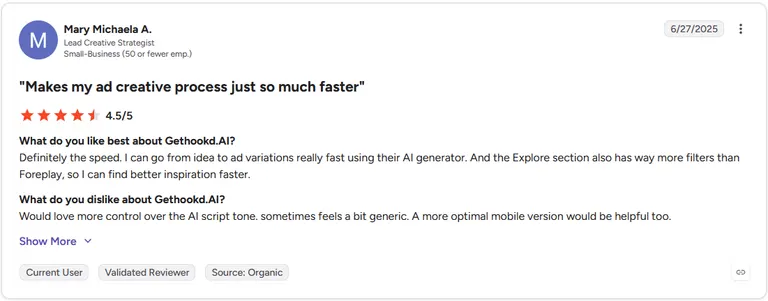
Con: "Would love more control over the AI script tone. Sometimes feels a bit generic." (Mary Michaela A., G2)
Pricing
GetHookd starts at $19 per month, billed annually.
Bottom line
GetHookd works best when speed matters more than depth, since finding an ad and producing a variation takes minutes. If you want that research tied to your own ad performance data, Atria is a better match for that workflow.
Special mentions
Seven more tools came up constantly in my research, and each one earned its spot for a specific job even though none of them cracked the top 7.
Here are 7 more competitive ad tracking tools worth considering:
8. LinkedIn Ad Library
LinkedIn Ad Library is LinkedIn's own ad transparency tool, free to search by company name or keyword.
I ran a few B2B accounts through this tool to see how usable it actually was. Filtering by country turned out to be worth the extra click every time, since it narrowed a crowded results page down to something I could scan in under a minute.
Outside the EU, the tool gets noticeably quieter. Impressions and targeting detail disappear, leaving you with just the ad creative itself, which is still useful but thinner than what a B2B researcher in Europe gets to see.
9. TikTok Ad Library
TikTok Ad Library is TikTok's answer to the same idea, showing active ads alongside reach estimates and creative previews.
The unique-view count sitting right next to each ad caught my attention immediately. It's a small detail, but it told me how far a competitor's ad had actually traveled.
Coverage stops at the EEA, UK, and Switzerland, so if your competitor set skews US or APAC, you'll come up mostly empty. It’s worth bookmarking anyway if any part of your research touches Europe.
10. Madgicx Ad Library
Madgicx Ad Library (part of the wider Madgicx platform) is built for saving and organizing Meta ad inspiration into boards you can revisit later.
I filtered by industry while testing it, and the results loaded fast enough that I ended up with three separate boards before I'd meant to build even one.
This isn't a tracking tool in the way Panoramata or Adbeat are. There's no alert system, no history log, and nothing chasing a specific competitor for you. It's built for browsing and saving, and it does that job well, but don't expect it to do the other one.
11. Foreplay
Foreplay is a swipe file and creative briefing tool, built so you can turn saved competitor ads into briefs your team can work from.
I installed the Chrome extension, and saving an ad mid-scroll took almost no effort after that. It honestly felt closer to bookmarking a tweet than doing research.
Foreplay won't go find new competitor activity for you, so the hunting still falls on you. It just makes what you save afterward far more useful.
12. Motion
Motion is a creative analytics platform built mainly to analyze your own ad performance, with a newer Inspo feature bolted on for competitor research.
The AI tagging is the part that actually impressed me. It correctly spotted which hooks in my own account were carrying results, faster than I'd have picked them out by eye.
On the other hand, competitor tracking felt like an afterthought. If that's specifically what you're after, Motion’s reads more like a bonus feature than the reason you'd sign up in the first place.
13. AdCreative.ai
AdCreative.ai is an AI tool that spins up new ad variations and scores each one for predicted performance before you spend a dollar testing it live.
I fed it a competitor's top-performing angle, and it handed back usable variations within minutes. It was quick enough that I used it more as a warm-up exercise than a finished deliverable.
For niche products specifically, the output can be generic. I'd treat anything it generates as a starting point worth editing more than a final ad ready to launch.
14. Similarweb
Similarweb is a traffic intelligence platform, showing you where a competitor's visitors come from and how they behave once they land on the page.
When I ran a handful of DTC competitors through it, it gave me a clearer read on their traffic sources than I expected. Direct, paid, and referral each showed up as their own line, instead of one combined number.
Ad creative isn't part of the picture here, so pairing it with an actual ad library gets you the fuller story.
Which competitive ad tracking tool should you choose?
The right tool depends on which platforms you're watching, how many competitors you're tracking, and how deep you want the data to go.
Choose Meta Ad Library if you:
- Want a free, official look at exactly what's running on Facebook and Instagram right now
- Need to check one or two competitors occasionally
- Are just starting out with competitive research and don't need spend or performance data yet
Choose Google Ads Transparency Center if you:
- Need to see what a competitor is running on Search, Display, and YouTube
- Want accurate creative detail without paying for a spend-estimate tool
- Use the data for keyword research as much as creative research
Choose Panoramata if you:
- Track multiple competitors across ads, email, and landing pages in one place
- Want automated alerts instead of manually checking libraries every week
- Need to benchmark your own ad performance against what competitors are running
Choose Atria if you:
- Want competitor research to feed directly into new briefs and ad concepts
- Run Meta ads specifically and need the workflow to stay inside one platform
- Are tired of pulling insights from one tool just to build creative in another
Choose Adbeat if you:
- Track display and programmatic ads across a wide network of publisher sites
- Need spend estimates alongside placement and creative history
- Already have a media strategy in place and want deeper data to refine it
Choose SpyFu if you:
- Care most about competitor keywords, PPC ad copy, and search strategy over time
- Want a budget-friendly alternative to pricier keyword research suites
- Are optimizing search campaigns more than social creative
Choose GetHookd if you:
- Want a high-volume ad database to pull inspiration from quickly
- Need AI-generated scripts or ad variations built from what you find
- Run an ecommerce brand and want to move fast from research to new creative
Skip this category entirely if you:
- Need a tool for your own ad performance
- Are only interested in organic content or influencer research
- Want a single dashboard for internal reporting rather than external ad research
Do more than track your competitors' ads
Competitive ad tracking always feels useful until you're staring at a dozen screenshots wondering what to do with them. Many tools stop at showing you what's out there and leave the next step entirely up to you.
Atria is a creative intelligence platform that pulls competitor research directly into your next ad instead of another tab full of screenshots.
Here's what that looks like in practice:
- Competitor research: Follow a brand and see its strongest hooks, angles, and personas pulled straight from a database of over 100 million ads, giving you a running start instead of a blank page.
- Creative generation: Take a competitor's winning angle and rebuild it as your own concept, shaped by your account's actual performance data instead of a generic template.
- Ad grading: Every ad you run gets scored in plain English, with a specific fix attached to whatever's holding it back, so you're not left guessing why something underperformed.
- Creative performance tracking: Radar watches your ads around the clock and catches the early signs of a creative losing steam, so fatigue shows up on your radar before it shows up in your ROAS.
Curious what Atria would find in your account? Try Atria for free today.
Frequently Asked Questions
What is the best competitive ad tracking tool?
Some of the best competitive ad tracking tools include Meta Ad Library and Google Ads Transparency Center for free options, and Panoramata for tracking multiple competitors and channels automatically.
Paid tools like Panoramata or Adbeat can make more sense once you're tracking five or more competitors on an ongoing basis.
Is it legal to track competitor ads?
Yes, tracking competitor ads is legal as long as you use public or approved tools like Meta Ad Library, Google Ads Transparency Center, or third-party platforms pulling from public data.
These tools show ads already visible to anyone. Scraping outside these channels is usually still legal, but it can violate a platform's terms of service.
What's the difference between ad tracking and ad spying?
There’s no functional difference between ad tracking and ad spying, just different branding, since both describe monitoring competitors' active ads.
Ad spying is the more casual term, often used by tools like GetHookd, while ad tracking is the more formal framing used by platforms like Panoramata or Adbeat. Both rely on publicly visible ad data and are legal.