
Your ROAS was strong last week. Now it's sliding, and nothing in your targeting has changed. The culprit, in most cases, is Meta creative fatigue: the performance drop that occurs when the same audience sees the same ad too many times and stops responding.
This guide covers how to identify creative fatigue, how Meta shows it in Ads Manager, a five-step framework to diagnose it, and strategies to prevent creative fatigue before it drains your budget. You’ll also learn how Atria eliminates the guesswork for good.
What Is Meta Creative Fatigue?

Meta creative fatigue is worth understanding precisely, because misdiagnosing it as an audience problem or a bidding problem leads to the wrong fix.
Meta creative fatigue is the decline in ad performance that occurs when the same audience is repeatedly exposed to the same creative elements, causing engagement to fall and costs to rise.
It's not an algorithm penalty. It's a psychological response: once an ad becomes familiar, the brain filters it out, a pattern sometimes called ad blindness.
The process is a gradual decline, not a sudden cliff. When a creative is fresh, it interrupts attention. As the same people see the same ad across multiple ad impressions, recognition kicks in and clicks drop off.
Meta’s auction system may deliver ads less efficiently as engagement drops, which can lead to higher CPMs and worse cost per result.
Creative fatigue occurs faster today than it did two years ago.
Meta’s automation and Advantage+ delivery can concentrate spend on responsive users, which may make some creatives fatigue faster in practice.
Broad delivery doesn't mean infinite reach. It means the same types of people experience creative fatigue sooner, even when frequency numbers still look acceptable on paper.
Creative Fatigue vs Ad Fatigue vs Audience Saturation
These three terms get used interchangeably in most articles. They describe different problems, and treating the wrong one wastes the budget.
| Term | What It Means | How to Identify It |
|---|---|---|
| Creative fatigue | The specific creative asset has lost novelty for the audience | CTR drops on one specific ad; performance recovers when a new creative is swapped in |
| Ad fatigue | A broader slowdown from delivery issues, objective mismatches, or outdated campaign structure | Declining performance across all ads in an ad set simultaneously, including new ones |
| Audience saturation | The available audience pool is exhausted; no fresh users left to reach | Reach declining despite stable budget; new creatives fail immediately on launch |
The distinction drives the fix. Replacing creative when the problem is audience saturation means the new ad will fatigue just as fast. Expanding audiences when a single fatigued asset is the cause means scaling a problem rather than solving it.
Creative ad fatigue is the most common cause of declining Meta performance for accounts with established audiences.
The same dynamic appears on Google Ads and other ad platforms, but on Meta, where the same people can be reached across Facebook, Instagram, and Messenger simultaneously, audiences experience creative fatigue faster than on most other channels. Identify the correct cause first, then act.
How Ads Manager Shows Creative Fatigue
Meta Ads Manager won't usually label an ad as "creative fatigue" in a standard, universal way.
Instead, you diagnose fatigue by looking at ad-level performance trends in the Ads view, especially when one creative's CTR drops, frequency rises, and cost per result worsens while other variables stay stable.
One thing to watch: Creative Limited can also appear on new ads that are still ramping up delivery. If you see it within the first 48 hours of launching an ad, wait before acting.
| Delivery Column Status | Threshold | What It Means | Recommended Action |
|---|---|---|---|
| Active | Normal cost per result | The ad is performing as expected | Monitor; no action needed |
| Creative Limited | Cost per result higher than past ads, but less than 2x | This creative is beginning to lose efficiency | Prepare a replacement; don't pause yet |
| Creative Fatigue | Cost per result 2x or more than past ads | Confirmed fatigue: this specific creative is underperforming | Pause the ad; deploy a replacement |
Meta may also show creative-fatigue-related recommendations in some reporting or optimization views, but these are not best described as a single, publicly available “creative fatigue score.”
Similarity between ads can matter because highly repetitive creatives can split results across multiple near-duplicate ads, but this is better understood as a testing and delivery issue than as a standard visible Meta metric.
A cleaner practical takeaway is this: use Ads Manager to compare performance at the individual ad level, watch for worsening trends over time, and confirm fatigue by swapping in a new creative and seeing whether results recover.
Note that the Creative Limited and Creative Fatigue labels appear most reliably for ad sets running a single creative or Advantage+ catalog ads, so don't rely on them alone if you're running multiple creatives per ad set.
Meta Creative Fatigue Early Warning Signs and Key Metrics
Waiting for the Delivery Column to show "Creative Fatigue" means the damage is already done. These early signs appear before the label does, giving you time to act.
| Metric | Warning Threshold | What It Signals |
|---|---|---|
| Click-through rate (CTR) | Consistent drop over 7 days | The hook is losing traction; the creative is becoming invisible |
| Ad frequency | Above 2.5 to 3.0 for top-funnel campaigns | Overexposure building; fatigue sets in for cold audiences |
| Cost per result / CPA | Trending upward with no targeting changes | Delivery system compensating with higher CPMs |
| ROAS | Plateauing or declining with stable budget | Creative effectiveness eroding before costs spike |
| Negative comment volume | Visible increase in dismissal comments | Creative being seen by the same people too many times |
Declining engagement is the earliest signal and the easiest to miss. It looks like normal variance in the first few days. Watch for a consistent, directional drop, not a one-day dip. If CTR falls for five consecutive days while frequency climbs, creative fatigue is the likely cause.
Thumbstop ratio, the percentage of users who pause on your ad rather than scrolling past, is a relevant metric not visible in standard Ads Manager views.
A falling thumbstop ratio is one of the clearest early signs that creative repetition has made the opening frame invisible. It's a direct signal that creative performance is eroding before your CPA numbers catch up.
Staying ahead of this signal is how strong teams prevent creative fatigue from becoming a performance crisis.
Manual Diagnostic Framework for Creative Ad Fatigue
Image source: Unsplash
When performance drops, most teams pause campaigns or refresh everything at once. This disrupts learning and wastes creative production budget. The five-step framework below identifies the specific cause before any changes.
Step 1: Check the Delivery Column
Add the Delivery Column to your Ads view in Meta Ads Manager. Look for ads labeled "Creative Limited" or "Creative Fatigue." This confirms whether Meta has already flagged a fatigued asset, and takes two minutes.
Step 2: Isolate the specific creative asset
Break down ROAS, CPA, and spend at the individual ad level, not at the campaign or ad set level. Aggregated data masks the problem. One fatigued ad pulling an ad set's average down looks like a campaign-wide issue at the top level. At the individual creative level, it's immediately visible.
Step 3: Check frequency by placement
Confirm that ad impressions aren't clustering in a single placement. If Facebook Feed is receiving the majority of impressions while Stories and Reels remain under-served, the frequency problem is concentrated, even if overall account frequency looks acceptable.
Step 4: Rule out non-fatigue causes
Before acting, check four alternative explanations:
- Seasonality: A calendar event or economic shift affecting purchase intent
- Audience targeting changes: A recent update that changed who is seeing the ad
- Competitive pressure: A new competitor or a significant increase in rival spend
- Meta algorithm changes: What changed with the Andromeda update can affect delivery efficiency independently of creative quality
Step 5: Confirm with a creative swap test
Pause the suspected fatigued creative and introduce a new variant in the same ad set. If performance, CTR, CPA, ROAS, recovers within three to five days, creative fatigue was the cause. If it stays flat, the problem is structural and requires a different fix.
Strategies to Combat Creative Fatigue
A strong creative strategy rotates fresh assets, reaches new audiences consistently, and manages fatigue before it hits your performance metrics. The following strategies work across social platforms, with tactics tuned specifically for Meta. Building one from scratch is covered in our guide to creative strategy.
Build a creative rotation system
Running multiple creatives per ad set can help Meta distribute delivery more effectively, though the ideal number depends on budget, audience size, and objective. This is the single most reliable way to combat creative fatigue without constant manual intervention.
Rotation cadence depends on the objective:
- Direct response objectives (purchase, lead): rotate every one to two weeks
- Brand awareness campaigns: rotate every three to four weeks
- Retargeting ad sets with limited audiences: rotate more aggressively; smaller pools saturate faster
The top AI tools built for Meta advertising can significantly reduce the production overhead of keeping a full creative rotation running.
Refresh creative elements strategically
Not every component of an ad fatigues at the same rate. A targeted refresh of the elements that wear out fastest keeps things fresh without a full rebuild.
Refresh in this order:
- Hook or opening three seconds (video) or headline (static): Once the hook triggers recognition, the rest of the ad never gets seen. New creative ideas here extend the life of the whole concept.
- Visual styles and color treatment: Same creative elements repeated across campaigns create visual shortcuts that the brain skips. Changing the shot style or color palette resets novelty.
- CTA copy and overlays: These fatigue the slowest and need the least frequent attention.
Expand and segment audiences
When similar ads continue to underperform even after refreshing creative elements, the issue may be the same users seeing the ad in an exhausted pool, not the creative itself. Expanding the target audience resets effective frequency for your existing assets.
Tactics to manage fatigue through audience expansion:
- Remove exclusions that are unnecessarily restricting reach
- Expand custom audience windows to increase pool size
- Create new lookalike audiences from recent purchasers
- Test broad delivery for top-funnel campaigns
Use dynamic ads and creative automation
Dynamic ads serve different creative combinations automatically, distributing ad impressions across more visual permutations and slowing the fatigue rate for any single combination. Carousel ads behave similarly. Users interact with different cards on different exposures, extending effective novelty across multiple sessions.
AI-powered tools built for Facebook ads optimization can automate creative variation at a scale that manual production can't sustain.
Quick Fixes for Fatigued Ad Creatives
When performance is declining now, and a full creative production cycle isn't an option, these actions can reduce fatigue and refresh creatives within 24 to 48 hours.
- Pause the specific fatigued ad, not the campaign or ad set. Pausing the entire ad set resets campaign learning. Identify the fatigued asset from the Delivery Column and pause only that ad.
- Swap the thumbnail or cover image on video ads. Changing the cover image without re-editing the video can restore CTR quickly for an asset that's still strong in its main content.
- Add a new static image variant to the ad set. A new image based on the same offer but with different visual elements enters the rotation immediately and takes a fraction of the time a new video requires.
- Update the hook copy on a static ad. Headline and primary text can often be updated without creating a new ad from scratch. A new opening line changes the first impression.
- Reduce the budget for the fatigued ad set. Reallocate it to better-performing creatives. This limits ongoing spend on a high-cost-per-result ad while new creatives are built.
- Exclude recent engagers from the fatigued ad set's audience. Users who have already clicked or engaged in the last 30 days are the highest-frequency segment. Excluding them immediately lowers the effective frequency for everyone else.
The best AI options for generating Facebook ad creative compress the time between identifying a fatigued ad and having a replacement ready to launch.
Measurement, Testing, and Creative Optimization
Consistent measurement is how you stay ahead of creative fatigue rather than constantly chasing it. Without a testing cadence and per-ad performance metrics, fatigue is always a surprise.
Set up a creative testing cadence
An account with challenger creatives always in test against a control never goes dark when the control fatigues. A functional cadence looks like this:
- Keep one to two challenger creatives in active test per ad set against the current control
- Test one variable at a time: hook, visual style, format, or offer
- Use the learning phase signal in Ads Manager to confirm an ad set has exited learning before drawing conclusions
- Treat data-driven decisions as the output of every test cycle, not gut feeling
Track performance at the individual creative level
Campaign-level data masks which specific ads are driving results. You need visibility at the individual ad level: ROAS, CPA, CTR, frequency, and ad impressions per creative.
Tag each asset at launch with concept type, hook style, and format. Over eight to twelve weeks, patterns in engaging content become visible. The same hook style repeatedly outperforms. The same format consistently underperforms in a specific audience segment.
These patterns, shown through the leading AI tools for creative analysis, replace guesswork with a clear picture of what to produce next.
How Atria Fixes Meta Creative Fatigue
Every strategy in this article depends on one thing: knowing which specific creative is the problem. Without per-ad visibility, you're guessing. You pause the wrong asset, rebuild things that didn't need rebuilding, and miss the one ad quietly draining ROAS while others hold.
Atria is the ad engine built for performance teams who need creative volume, velocity, and repeatable results. Trusted by 20,000+ teams and rated 4.9 on G2, Atria gives media buyers and creative strategists the per-ad data and AI-generated recommendations to manage Meta creative fatigue systematically.
Per-ad performance dashboard
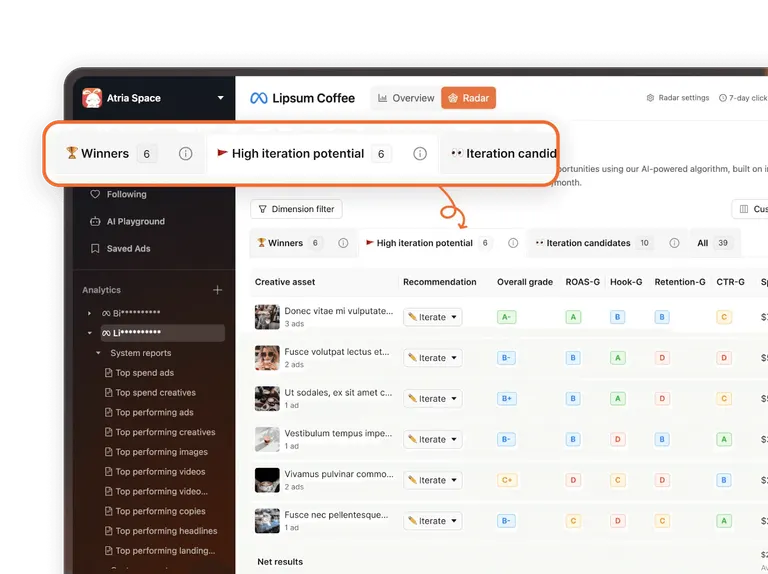
Atria's analytics break down ROAS, CPA, and spend at the individual creative level. You see which specific ad is fatiguing, how much it's costing, and exactly when performance started to drop. The diagnostic work that takes an experienced buyer 30 to 45 minutes shows up in seconds.
Raya: your AI creative strategist
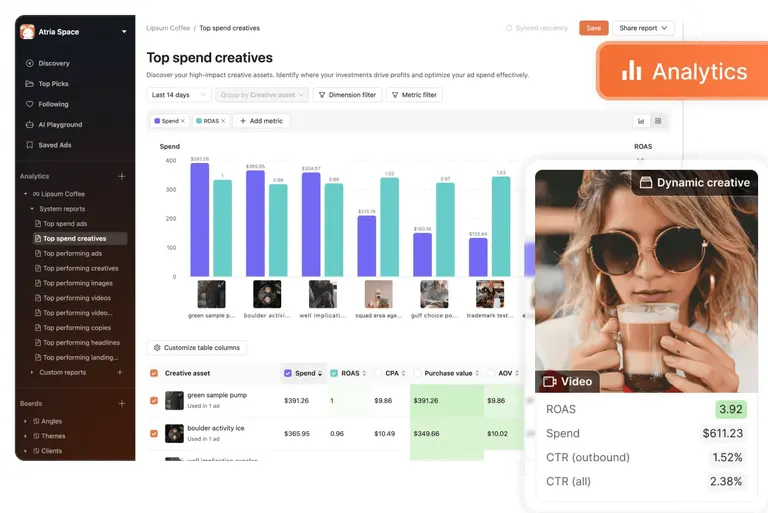
Raya is Atria's AI creative strategist trained on $9B+ in ad spend data. She doesn't just flag a fatigued ad. She generates a per-ad fix recommendation: what to change, why, and what creative ideas to test next.
Here's what Raya does in practice:
- Tags and analyzes your top creatives to find the hooks, personas, and messages actually driving results
- Analyzes competitor creatives to show their top hooks, landing pages, and target personas across your category
- Mines customer reviews to identify what buyers love and what's blocking their next purchase
- Generates new ad creatives based on what's winning weekly, without manual research
- Builds visual performance reports customized to your account
Teams currently spending 30 to 40 hours per week on creative research, competitive analysis, and reporting bring that down to a fraction. Raya handles the operational work. Your team makes the calls.
The best tools for Facebook ads competitor analysis are built into Atria's workflow, so competitive creative intelligence feeds directly into what Raya recommends next.
Atria closes the gap between seeing a performance drop and knowing exactly what to do about it.
Conclusion About Meta Creative Fatigue
Meta creative fatigue is diagnosable and fixable, but only at the right level of data. Campaign averages hide the problem. Per-ad visibility shows it immediately.
The five-step framework in this article helps you confirm fatigue, distinguish it from audience saturation and structural issues, and apply the right fix.
Pair it with a consistent creative rotation, always-in-test challengers, and individual-asset tracking, and creative fatigue becomes a managed part of the campaign lifecycle rather than a recurring emergency.
Atria and Raya make this process systematic rather than reactive. See exactly which creatives are draining your ROAS and get the fix recommendation alongside the diagnosis.
FAQs About Meta Creative Fatigue
What is creative fatigue in Meta?
Creative fatigue in Meta occurs when the same audience sees the same ad too many times, causing engagement to drop and costs to rise. Meta flags it in the Delivery Column as "Creative Fatigue" when the cost per result reaches 2x past ads. It's different from audience saturation, which is caused by exhausting the available audience pool.
What is the Facebook 20 rule?
The Facebook 20% rule limited text overlays on ad images to no more than 20% of the image area. Meta retired this rule in 2020. Ads with minimal text still perform better in delivery because the algorithm rewards visual-forward creative.
Is A/B testing worth it on Facebook?
Yes. A/B testing on Facebook is most effective at the creative level. Test one variable at a time over a minimum of seven to 14 days. Testing multiple variables simultaneously makes it impossible to isolate which change drove the result, which is why single-variable tests produce more actionable data.
What is Facebook fatigue?
Facebook fatigue, also called Facebook ad fatigue or Meta creative fatigue, occurs when audiences become desensitized to seeing the same ads repeatedly. The result is declining CTR, rising CPMs, and falling ROAS.
It typically sets in within two to four weeks, though with Meta's current delivery systems many campaigns see fatigue in two to three weeks. Audience size, budget, and creative quality all affect the timeline.