
Your Meta ad results changed. Maybe spend held steady, but conversions dropped. Maybe ads that used to find their audience in days now take weeks to warm up. Maybe you refreshed your creative and still nothing moved.
Andromeda Meta ads are the reason. In late 2024, Meta replaced the engine that decides which ads get shown to which people. It is not a targeting update or a policy change.
It is a complete rebuild of the system that runs before your ad ever reaches an auction, and it changes what a good ad strategy looks like from the ground up.
This guide explains how Andromeda works, what it means for your campaigns, and how to adapt your creative workflow to win. By the end, you will know how to structure your campaigns, how many concepts to run, and how to identify winners before your budget runs out on losers.
What Is Meta Andromeda? (And Why It Rewrites the Rules)
Image source: Pixabay
Meta Andromeda is Meta's AI-powered ad retrieval engine, launched as part of Meta's Andromeda update in late 2024. Meta Andromeda explained simply: it is a creative-first delivery system that replaced rule-based logic with machine learning to decide which ads are eligible to be shown to a particular user before those ads ever reach the ranking auction.
How the old system worked
Before Meta's Andromeda update, the ad delivery system relied on rule-based logic and isolated model stages. You defined your targeting parameters. Meta's system checked whether a user matched them.
If they did, your ad entered the auction. Decisions happened at the audience level, not the ad level. Similar ads from the same advertiser competed independently.
What Andromeda does differently
Andromeda's algorithm replaces that logic with deep neural networks and machine learning. The new system analyzes your creative assets and a user's behavioral signals at the same time, then uses that data to match ads to a particular user based on relevance rather than audience membership.
Andromeda represents a key shift. It is a creative first system that changed how Meta sees and categorizes ads. According to Meta's Engineering Blog, it enabled a 10,000x increase in the complexity of models used for ads retrieval.
Here is what changed at a glance:
| Before Andromeda | After Andromeda | |
|---|---|---|
| Filtering logic | Rule based logic filtered ads at the audience level | Machine learning matches ads to each particular user in real time |
| Ad strategy | Centered on audience precision and targeting parameters | Creative content is now the primary signal the delivery system uses |
| Similar ads | Similar ads with previous versions of the same hook competed independently | Similar creatives are clustered together and share one retrieval entry |
The performance gains
Andromeda achieved a +6% recall improvement to Meta's retrieval system and a +8% ads quality improvement on selected audience segments. But meaningful learning only happens when your creative assets give the system enough distinct signals to work from.
The old question was: who should see this ad? Andromeda asks instead: which ad should this specific person see right now? That single shift changes your entire meta strategy.
How Andromeda's Ad Retrieval System Works
The technical details of how Andromeda operates determine every creative decision you make. Understanding this ad delivery system is the foundation of an effective Meta strategy under the new system.
Stage 1: retrieval
Every time a user opens their Facebook or Instagram feed, Andromeda scans tens of millions of eligible ads and narrows them down to roughly 1,000 candidates in under 300 milliseconds.
Meta built Andromeda on NVIDIA Grace Hopper Superchips, NVIDIA's high-performance AI inference chip co-designed with Meta's own MTIA hardware, specifically to make that speed possible at scale.
Stage 2: ranking
Those 1,000 candidates move into the familiar ranking auction, where eCPM, predicted click-through rates, and conversion probability determine which single ad wins the impression.
If your ad does not survive Stage 1, nothing in Stage 2 matters. Your bid, your targeting, and your budget all become irrelevant if Andromeda's algorithm filters you out before the auction begins.
Hierarchical indexing and Entity IDs
Andromeda organizes ads into a hierarchical tree based on semantic similarity. Similar ads and similar creatives get clustered together and assigned a single Entity ID, which is Andromeda's internal identifier for what it considers a conceptually unique ad.
If you upload 50 variations of the same ad with the same hook and the same offer, Andromeda treats all 50 as one Entity ID. You have 50 ads competing for one slot, not 50 independent entries.
Meaningful creative diversity is how you earn more entries into the retrieval system. The hierarchical structure is baked into the architecture, and it is not going away.
Why Creative Diversity Is Your New Targeting
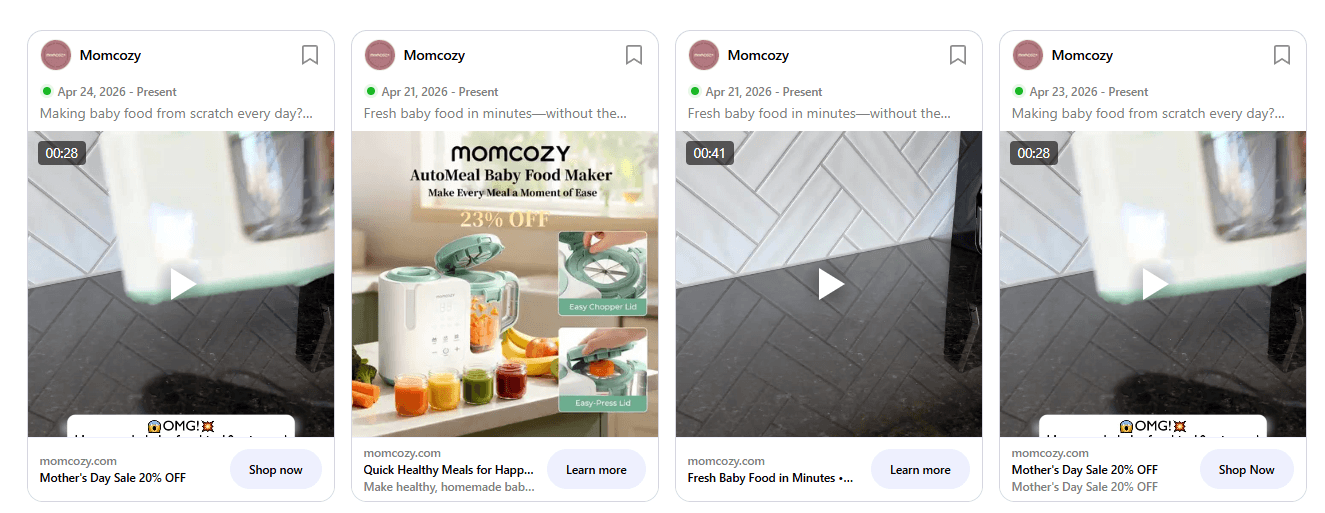
Creative diversity means building ads that are meaningfully different from each other: different pain points, customer personas, emotional triggers and formats. It does not mean minor tweaks.
Changing a headline color, swapping a single word, or adjusting background music does not create a new Entity ID. Andromeda's neural networks recognize semantic similarity at a conceptual level, not just a visual one.
Multiple creative variations of the same core idea still get one ticket to the auction. The more creative options you give the system with genuinely distinct concepts, the more retrieval entries you earn.
Concept diversity vs. creative variation
The difference between a new concept and a new variation is the most important thing to get right when running ads under Andromeda.
| Concept (new Entity ID) | Variation (same Entity ID) | |
|---|---|---|
| Definition | Distinct angle, hook, or persona | Cosmetic tweak on an existing concept |
| Examples | Pain-point ad vs. aspirational ad vs. social proof ad | Headline A vs. headline B on the same pain-point ad |
| Andromeda impact | Earns a separate retrieval entry | Competes with itself for one entry |
| What to do | Build more of these | Keep these limited; test within a concept |
Your goal is to build a library of concepts that cover multiple angles and different emotional entry points. An ad that speaks to a reader's fear of wasted spend is a different concept from one that speaks to their desire for competitive advantage, even if both promote the same product.
Without creative variety, Andromeda's algorithm has nothing meaningful to learn from.
Creative signals teach the algorithm
Every time a user interacts with your ad, Andromeda learns about that particular user's preferences and audience behaviour. A save signals one user profile. A direct click signals another. A 90% video completion signals a third.
Running diverse concepts gives Andromeda diverse behavioral data, which helps it build a more nuanced picture of who your buyers actually are.
A single creative angle produces a narrow signal. Broad concept coverage improves campaign performance over time by giving Meta's system the creative content it needs to make accurate delivery decisions.
This is why creative diversity replaces audience targeting. You are not telling Meta who to reach. You are giving Meta's system enough signals to figure it out on your behalf.
Campaign Structure in the Andromeda Era
Simplified campaign structure is not optional under Andromeda. It is a technical requirement.
Multiple ad sets split the learning signal. Each ad set is a separate learning problem for the algorithm, which means it takes longer for any one of them to accumulate enough data to perform.
Multiple ad sets competing for the same users also create auction overlap, where your own campaigns bid against each other and drive up costs.
The one-campaign default
The Andromeda-era default is one campaign per objective, with broad targeting and Advantage+, Meta's automated campaign optimization suite that handles budget allocation, audience targeting, and bid adjustments, enabled.
Broad targeting means minimal interest stacking and no tight demographic restrictions. It gives Andromeda the room to reach broader audiences and find your buyers.
The algorithm is better at identifying high-intent users than manually constructed audience segments, but only when you let it operate at scale. Tight constraints limit its ability to explore.
When multiple campaigns are justified
Multiple campaigns are appropriate when you have genuinely different objectives: prospecting vs. retargeting, different markets, or funnel stages with distinct conversion goals.
The test is whether the campaigns serve different purposes or just different audiences for the same purpose. If it is the latter, consolidate.
Account consolidation and campaign velocity are the two levers high-performing teams are pulling hardest right now, and both are covered in the sections that follow.
Creative Volume and Ad Creatives Production at Scale

More ads with distinct concepts give Andromeda more signals to work with. More ads with the same creative content are worse than a smaller set of genuinely different ones.
Running 50 near-identical ads gives you one effective retrieval entry. Running 10 distinct concepts gives you ten.
How many concepts to run
A practical starting benchmark is 5 to 10 genuinely distinct concept angles per campaign. Each concept should represent a different message strategy: one that leads with a specific pain point, one with social proof, one with a transformation outcome, and one that addresses a common objection.
Strategic clarity about what each concept is trying to prove matters from the start. Andromeda Meta ads perform best when given a wide creative variety to test against real audience behavior.
Format diversity
Within each concept, you can run multiple creative variations by format: a static image, a video ad, a carousel. Those format variations share an Entity ID but help Andromeda test delivery across placement types and user contexts.
Different formats reach users in different contexts. Advantage+ placements automatically distribute your creative assets across Meta's surfaces, but only if you provide formats for them to work with.
Atria's Meta ads templates are a fast way to build out format coverage without starting from scratch.
The creative refresh cadence
Andromeda identifies ad fatigue faster than previous versions of Meta's retrieval system because it tests more creative options simultaneously.
Plan for a refresh cycle every two to three weeks for active prospecting campaigns. Watch your First-Time Impression Ratio: when it drops, it is time to create ads with fresh angles, not just run the same ad in new variations.
The future of creative strategy is producing more distinct concepts faster, without the operational overhead that consumes most of your team's week.
Conversion Data and Measurement
Andromeda's neural networks train on conversion outcomes. If your conversion data is incomplete or inaccurate, the algorithm builds a biased model of who your buyers are and delivers your ads to the wrong people, regardless of how strong your creative is.
Conversions API setup
The Meta Conversions API (CAPI), Meta's server-side event-tracking system that mirrors pixel signals and protects against ad blockers and iOS tracking restrictions, is required under Andromeda.
Without it, a significant portion of your purchase events never reach Meta's system.
At minimum, your tracking setup should include the pixel firing on all core events (view, add to cart, initiate checkout, purchase), CAPI sending server-side mirrors of those events, and deduplication logic confirmed so events are not counted twice.
Key metrics under Andromeda
Meta's Ads Manager now includes metrics that map directly to how Andromeda performs. Creative Similarity estimates how similar your ads are within an ad set; a high score means Andromeda is likely clustering them under one Entity ID.
Ad fatigue and Creative Fatigue signals show when a creative has been shown too many times to the same users.
Top Creative Themes shows which creative types are receiving the most budget, and First-Time Impression Ratio shows the share of impressions going to users who have not seen the ad before.
Reporting tools
The 3 creative reporting tools guide covers how to surface these signals without living in Ads Manager all day.
For a more complete view, Atria's Meta ads analytics features layer your performance data against $9B+ in market spend benchmarks so you can see not just how your ads are doing, but how they compare to what is winning in your vertical right now.
Creative Testing Framework
Andromeda moves fast. That speed is an advantage if your testing is structured, and a liability if it is not.
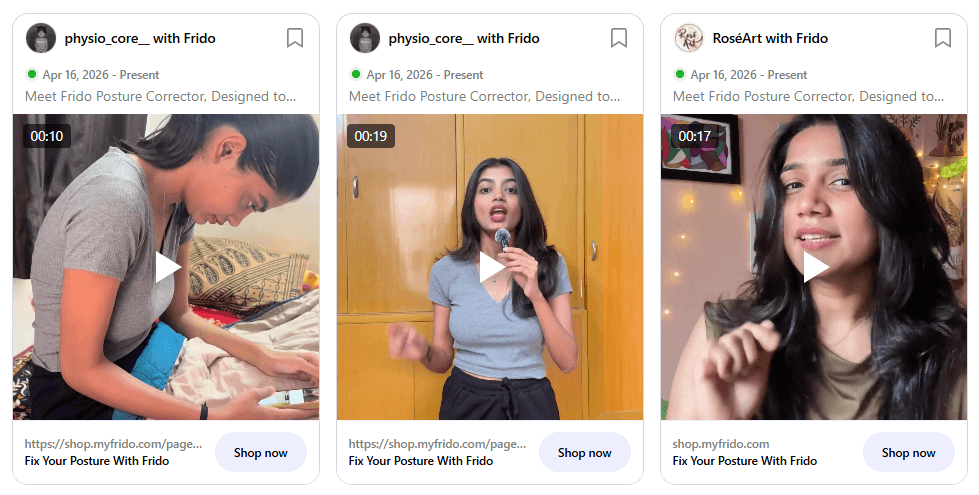
The most common mistake is testing variants instead of concepts. Running headline A against headline B on the same core message does not give Andromeda a meaningfully different signal.
It gives it two tickets to the same seat. The right level to test is the concept: distinct angle, hook, and persona.
How to structure a test
Each test should start with a clear hypothesis. Set one variable. Run with enough budget to reach statistical significance, typically at least 1,000 impressions per concept, before drawing conclusions.
Document the result in a shared log.
Andromeda's faster optimization cycle means you will see the signal earlier than with previous systems. The risk is misinterpreting early variance as insight. Let concepts run for at least five to seven days before calling a winner.
AI grading to catch winners early
The better approach is automated scoring. AI grading assigns a performance score to each live creative, flags fatigue signals as they develop, and finds the concepts worth scaling before spend is wasted on the tail.
For a practical guide on implementing this, the complete guide to scoring and turning underperforming ads into winners walks through the methodology step by step.
You can also explore ad creative automation platforms compared for 2026 if you are evaluating tooling options for your team.
How Atria and Raya Power Your Andromeda Strategy
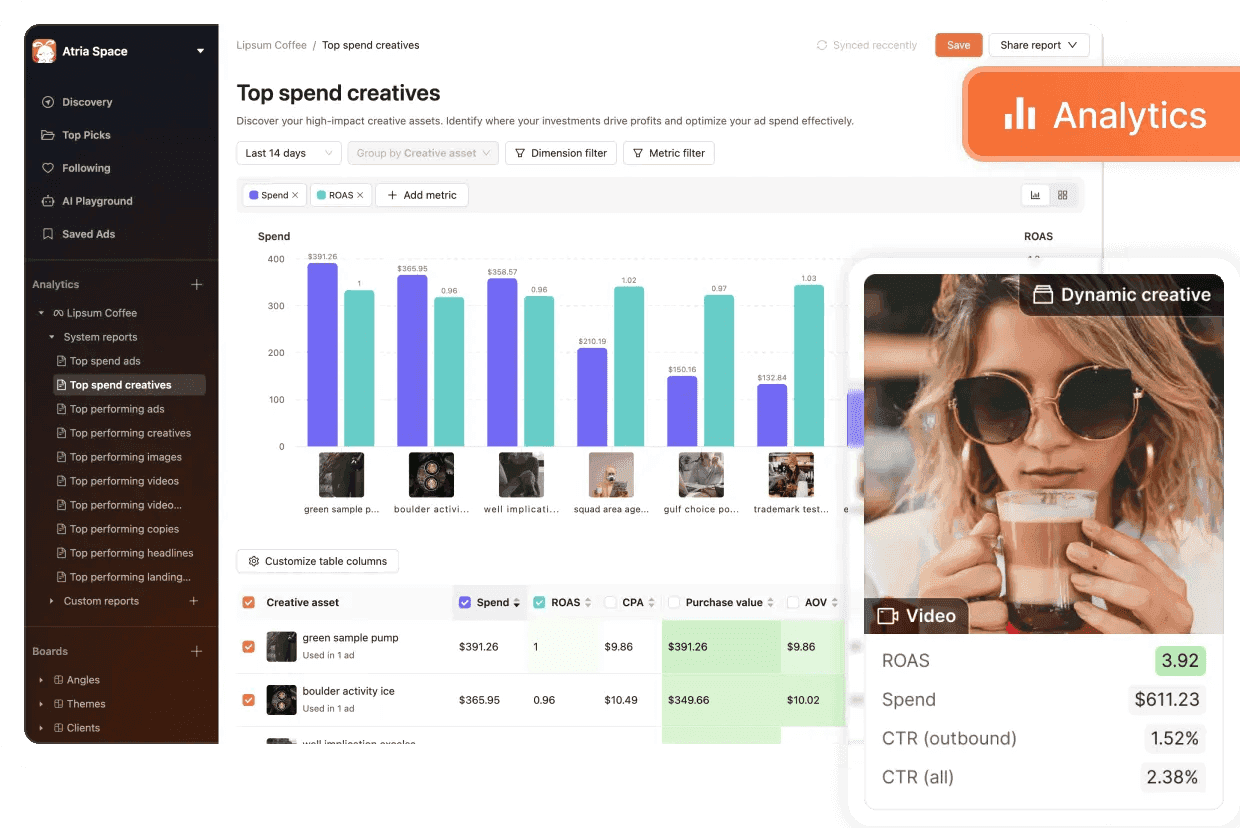
Adapting to Andromeda means solving three problems at the same time: producing enough semantically distinct concepts to avoid suppression, getting them live fast enough to stay ahead of fatigue, and knowing which ones to scale before budget is wasted on losers.
Raya, Atria's AI creative strategist trained on $9B+ in ad spend data, handles all three.
Start a free trial to see how it works.
Competitor intel and $9B in market data inform the concepts
Most creative analysis tools only show you your own performance data. Raya combines your account data with $9B+ in market spend intelligence and live competitor ad analysis to show which concept angles are winning in your vertical right now.
That means you are not generating concepts in a vacuum. You are building creative briefs based on what is already working at scale in the market, and then adding the semantic difference that earns a new Entity ID in Andromeda's retrieval tree.
Raya analyzes your competitors' top-performing hooks, landing pages, and target personas, then identifies the angles they are running hard and the gaps they are leaving open.
This is the edge that pure self-data tools cannot offer. If you want to understand the broader landscape of ad intelligence and competitor analysis tools, that comparison breaks down the key differences in approach.
Batch launch gets them live
Generating concepts is only half the problem. Getting them into Meta efficiently is the other half.
Raya's batch upload functionality pushes approved creatives directly to your Meta account in a few clicks. No manual ad set management. No repetitive settings configuration.
The Meta ads swipe file and creative inspiration library inside Atria also gives you a searchable database of 100M+ winning ads to reference when developing new concepts.
AI grading surfaces winners before the budget is wasted
Once campaigns are live, Raya monitors performance and assigns a grade to every creative.
She flags fatigue as it develops, identifies which concepts are gaining momentum, and highlights the ads worth scaling before the signal becomes obvious to everyone watching the dashboard.
Catching a winner three days earlier means three more days of efficient spend on a concept that is actually working.
Ready to win the Andromeda era?
Raya uses $9B+ in market data and competitor intel to generate distinct concepts, batch-launch them to Meta, and grade winners before your budget runs out on losers.
Prefer a live walkthrough first?Book a demo with the Atria team.
Tactical Checklist for Andromeda Era Execution
Run through this before every campaign launch and every major account review.
Campaign structure
- One campaign per conversion objective
- Broad targeting enabled with no tight interest stacking
- Advantage+ placements active
- Budget set at campaign level (CBO)
Creative setup
- Minimum 5 distinct concept angles per campaign, each with a unique hook and value proposition
- At least one video ad, one static image, and one carousel format included
- Creative Similarity score checked in Ads Manager; rebuild concepts if score is high
Conversion tracking
- Pixel firing on all core events: view, add to cart, initiate checkout, purchase
- Conversions API active with server-side event mirroring
- Deduplication logic confirmed
Refresh and scaling
- Creative review scheduled every two to three weeks
- First-Time Impression Ratio monitored; initiate refresh when ratio drops
- AI grading active to surface winners and flag fatigue before budget decisions are made
- Test concepts, not variants; one hypothesis per test, five to seven day minimum run
Conclusion About Andromeda Meta Ads
Andromeda moved the competitive edge from who you target to what you say and how many genuinely distinct ways you can say it.
The advertisers winning right now treat creative as infrastructure, not output. They build concept libraries instead of single ads. They structure campaigns to give the algorithm room to learn.
They use market-level data, not just their own account history, to decide what to build next. And they have systems, not spreadsheets, for spotting winners before the budget runs out.
That is exactly what Atria, the ad creative intelligence platform for performance teams, was built to enable.
Raya combines $9B+ in market-spend data with live competitor intelligence and AI grading, so your team produces more distinct concepts, gets them live faster, and scales winners earlier.
Start a free trial and see how Raya changes your creative workflow in the first session.
Not ready to self-serve yet?
Book a demo, and the team will walk through your current account setup and show you exactly where Andromeda is costing you reach.
FAQs About Andromeda Meta Ads
What is Andromeda on Meta ads?
Meta Andromeda is Meta's AI-powered ad retrieval engine, launched in late 2024.
It uses deep neural networks and hierarchical indexing to scan tens of millions of eligible ads and narrow them to roughly 1,000 candidates per impression, before those candidates enter the ranking auction.
Andromeda runs every time a user opens their Facebook or Instagram feed, in under 300 milliseconds.
Why did Meta create Andromeda?
Meta built Andromeda to solve a scale problem. The growth of Advantage+ automation and AI-generated creative tools pushed the number of active ad variations into the billions.
The previous rule-based retrieval system could not evaluate that volume fast enough while meeting real-time delivery requirements.
Andromeda, co-designed with NVIDIA Grace Hopper Superchips and Meta's own MTIA hardware, handles the volume through hierarchical indexing and deep neural network matching.
Is $10 a day good for Facebook ads?
A $10 daily budget can generate useful data on a small scale, but it is unlikely to give Andromeda enough signal to optimize effectively.
Meta's algorithm requires a minimum of around 50 conversion events per week to exit the learning phase. At $10 per day, most accounts will not reach that threshold fast enough to see meaningful optimization.
A budget of $30 to $50 per day per campaign is a more practical starting point for Andromeda-era learning.
How did Andromeda change Facebook advertising forever?
Andromeda shifted the primary competitive lever from audience targeting to creative intelligence. Before Andromeda, the advertiser who built the most precise audience structure had the advantage.
After Andromeda, the advantage goes to the advertiser who produces the strongest, most semantically diverse creative, because creative signals are now the primary input Andromeda uses to decide who sees your ads.
Audience targeting still matters, but creative is now the strategy.