
For media buyers and performance teams managing paid ads on Meta, the math is unforgiving: the auction is more expensive every quarter, and creative decay kills ad campaigns faster than in-platform reports can catch it.
The teams that still ship winning campaigns are the ones who stop guessing what their Facebook competitors are doing and start systematically watching them.
Facebook ads competitor analysis tools are software platforms that let advertisers search, monitor, and analyze the active and historical ads their competitors run on Facebook and Instagram.
They pull from Meta's Facebook Ad Library and third-party databases to find creative patterns, spend signals, and landing page strategies.
The best ones go further by layering competitor intelligence on top of the advertiser's own campaigns, so competitive analysis actually informs the next brief, not just the next slide deck.
This guide ranks the 9 best Facebook competitor analysis tools for 2026, with side-by-side features, use cases, and pricing.
It also explains what separates a basic ad spy database from a true creative intelligence platform, so teams can pick the right tools for their stack, not the one with the loudest homepage.
Why Facebook Competitor Analysis Matters in 2026
Image source: Unsplash
Facebook competitor analysis is no longer optional for performance teams. The ones that win it treat competitor research as an always-on workflow, not a quarterly exercise.
Meta's own Facebook Ad Library is free and useful for transparency, but it stops short of the signals media buyers actually need: creative longevity, full ad history depth, format mix, and how those choices compare to what the user's own team is shipping.
According to Meta's 2025 annual report, ad impressions rose 12% and average price per ad rose 9% year-over-year. That squeezes CPA from both sides: more impressions mean faster creative fatigue, and higher auction prices punish underperforming creatives more quickly than in 2022 or 2023.
Three practical shifts make dedicated competitor analysis tools essential now:
- Creative velocity: Industry leaders and challenger brands now ship 30–80 new creative variants per month. The only way to spot trends across competitor brands at that speed is to track them programmatically. The tools that do it are compared in competitive ad tracking.
- Post-click intelligence: Competitors' landing pages and content strategy are as informative as their ads and change just as fast.
- AI-assisted ideation: The best tools now turn raw ad libraries into usable briefs, providing insights that collapse the manual swipe-file-to-brief step from hours to minutes.
Taken together, these shifts mean that performance insights drawn from competition are no longer a research luxury. They are a direct input to every creative brief, budget allocation, and campaign launch decision a performance team makes.
What to Look For in Facebook Ads Competitor Analysis Tools
The best Facebook ads competitor analysis tools share six traits explained below. Any tool that misses more than one of these is built for a narrower use case, which is fine, as long as the buyer knows which trade-off they are making.
| Section | Content |
|---|---|
| Ad library depth | Look for coverage of at least 100 million indexed ads across Facebook and Instagram, with historical data going back two or more years, not just current active ads pulled from Meta's Ad Library API. |
| Flexible filtering | Filters for country, language, ad format, ad longevity, engagement data thresholds, and landing page URL patterns. Without these, researchers drown in irrelevant results. |
| Ad hooks and format intelligence | Automatic tagging of hooks, post types, offers, and visual elements. A tool that lets users identify winning creative patterns, not just browse screenshots, delivers deeper insights. |
| Performance overlay | The ability to compare competitor patterns against the user's own campaigns and key metrics in a single view, so Facebook insights inform the next brief, not just a report. |
| Organic + paid coverage | Tools that track competitors' organic posts and Facebook pages alongside paid ads provide a more comprehensive view of competitor content strategy. |
| Team-ready workflows | Swipe files, tagging, and creative brief handoff that multiple teammates can collaborate on, otherwise the research dies in a bookmark folder. |
No single tool is perfect on all six criteria. The comparison table below and the detailed profiles that follow are designed to help you match each tool's strengths to your team's specific use case, budget, and Meta ad volume.
The 9 Best Facebook Ads Competitor Analysis Tools Compared
The table below provides a quick overview of all nine tools on the five data points most buyers evaluate first.
It covers both free tools and premium tools so teams can compare what paid tools offer over free alternatives. Atria is listed first as the editorial pick; the other tools appear in alphabetical order.
| Tool | Best for | Top feature | Starts at | Free tier |
|---|---|---|---|---|
| Atria | Teams combining competitor + own ad data | Raya AI creative strategist + $9B+ benchmarks | $159/mo | 7-day trial |
| AdFlex | Affiliates in non-US markets | ~6M new ads/day, multi-region | €99/mo | Yes |
| AdSpy | Dropshippers needing FB search depth | 201M+ ad database with keyword search | $149/mo | No |
| BigSpy | Cross-network paid social on a budget | 1B+ creatives across 10 networks | $19/mo | Yes |
| Brandwatch | Enterprise listening + competitor tracking | Social listening + Iris AI insights | $800/mo+ | Demo only |
| Minea | Dropshippers + early DTC brands | 80M+ ads + winning-product finder | $49/mo | Yes |
| Motion | In-house creative analytics at scale | Automatic creative tagging + scoring | $250/mo | Demo only |
| Panoramata | Cross-channel ecommerce benchmarking | Tracks 100K+ brands across 7 channels | $99/mo | Demo only |
| Vaizle | Small social teams + budget agencies | Ads + organic analytics in one dashboard | $9/mo | No |
1. Atria
Atria is a creative intelligence platform. What makes Atria different from every other tool on this list is that it layers three datasets most platforms keep separate: competitor activity intelligence, the user's own ad performance, and more than $9 billion in aggregate market spend benchmarks, delivering the real insights teams need for data-driven decisions.
Atria is Meta-specific by design: the platform is built for performance marketers, creative strategists, and growth leads who brief, launch, and optimize Facebook and Instagram ad campaigns end-to-end.
In early 2025, Atria launched Raya, an AI creative strategist that turns competitor ad libraries into ready-to-brief creative concepts, removing the manual swipe-file-to-brief step that slows most creative teams.
Book a demo to see it in action.
Best for
In-house performance marketing teams and DTC brands spending $50,000+ per month on Meta ads who need competitor intelligence and their own performance data in the same workflow.
Learn more about Atria's customers.
Key features
- Competitor ad tracking: Monitor competitors' active and historical Facebook and Instagram ads across Meta's full Ad Library with saved watchlists and alerts.
- Performance data overlay: Layer competitor intelligence directly against the user's own campaign performance to identify gaps and opportunities in a single dashboard.
- Raya AI creative strategist: Turn competitor ad libraries into ready-to-brief creative concepts using AI, eliminating the manual research-to-brief bottleneck.
- $9B+ benchmark dataset: Compare any creative decision against more than $9 billion in aggregate market spend data across industries and verticals.
- Creative scoring: Automatically score and tag ads by hook, format, and visual element to identify winning patterns without manual review.
- Landing page capture: Save and organize competitors' post-click landing pages alongside their ads for full-funnel analysis.
- Team collaboration: Share swipe files, tag insights, and hand off creative briefs directly to teammates within the platform.
Pricing
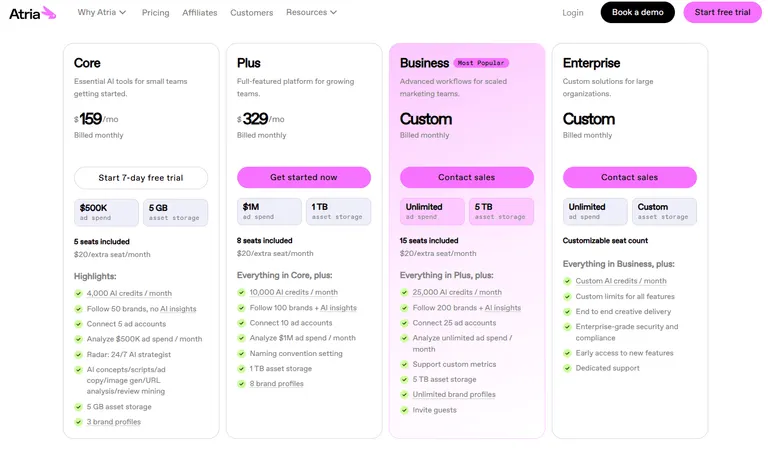
Atria gives you a 7-day free trial to test the platform, no credit card required.
You can subscribe for the Core plan at $159/month, Plus at $329/month, while Business and Enterprise tiers have custom pricing.
All plans come with a 20% discount when billed annually.
Start a free trial today.
2. AdFlex
AdFlex is an ad intelligence search engine in the broader Facebook competitor analysis tools category. Its primary purpose is keyword-level ad search with deep filtering across global markets.
What sets AdFlex apart from other tools is its coverage of non-English-language markets. The platform indexes roughly 6 million new ads daily, with strong depth in Southeast Asia, Europe, and Latin America.
AdFlex is not Meta-specific: it covers Facebook, Instagram, and display advertising across the open web.
Best for
Affiliate marketers and dropshippers running campaigns in non-US or non-UK markets who need deep regional ad coverage and more data across emerging geographies.
Key features
- Multi-region ad database: Access millions of indexed ads with ~6M new ads added daily, covering regions underserved by US-focused competitors.
- Advanced search operators: Filter ads using Boolean search across ad copy, landing page URLs, ad format, and geographic targeting.
- Landing page capture: Save competitors' landing pages alongside their Facebook ad creatives for post-click analysis.
- Product tracker: Monitor specific products across advertisers to identify trending items and competitor pricing strategies.
- Chrome extension: Capture competitor ad data on-the-fly while browsing Facebook, Instagram, or the open web.
Pricing
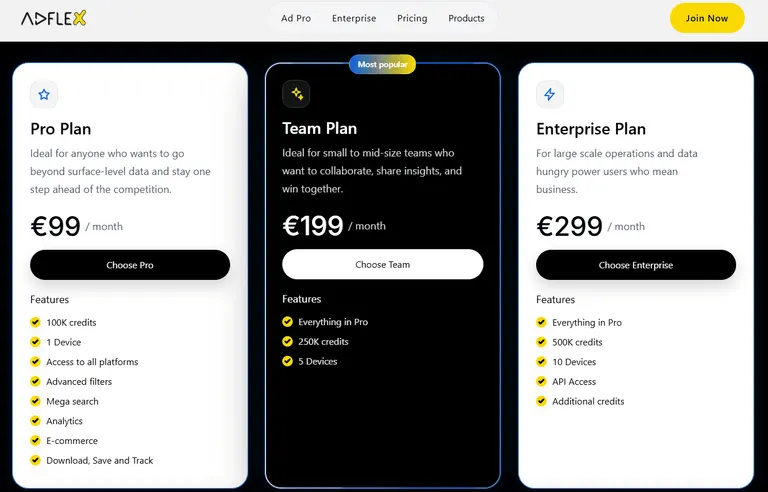
Free plan available.
Paid plans: Pro at €99/month, Team at €199/month, and Enterprise at €299/month.
All paid tiers include unlimited searches; the main differences between plans are the number of available credits, team size and export volume.
3. AdSpy
AdSpy is a dedicated ad search database focused exclusively on Facebook and Instagram, making it fully Meta-specific.
Its primary purpose is to let users search ads by keyword, advertiser, engagement signal, or landing page URL across one of the largest single-platform archives in the category: more than 201 million indexed ads from 203 countries.
What makes AdSpy different is the depth of its engagement data filtering. Users can track likes, shares, and comments at a granularity most competitors skip.
Best for
Dropshippers, affiliate marketers, and agencies that need raw Facebook ad search depth and granular engagement filtering to identify high-performing creatives. Teams that also need creative strategy frameworks beyond raw search should consider tools with built-in briefing workflows.
Key features
- 201M+ ad database: Search one of the largest dedicated Facebook and Instagram ad archives, covering 203 countries and multiple years of historical data.
- Keyword search: Search across ad copy, comments, and landing page text to find ads by message, offer, or product name.
- Engagement filters: Filter ads by likes, shares, comments, and engagement velocity to quickly find high-performing creatives.
- Advertiser tracking: Follow specific advertisers and get alerts when they launch new Facebook ad campaigns.
- Landing page capture: Save and compare competitors' post-click destinations alongside their Facebook ad creatives.
Pricing
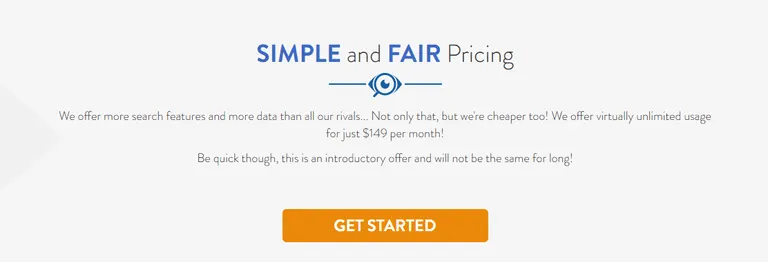
$149/month flat rate with no free trial or lower-tier plan. Access includes all regions and all filters. The pricing model is aimed at high-volume research users.
4. BigSpy
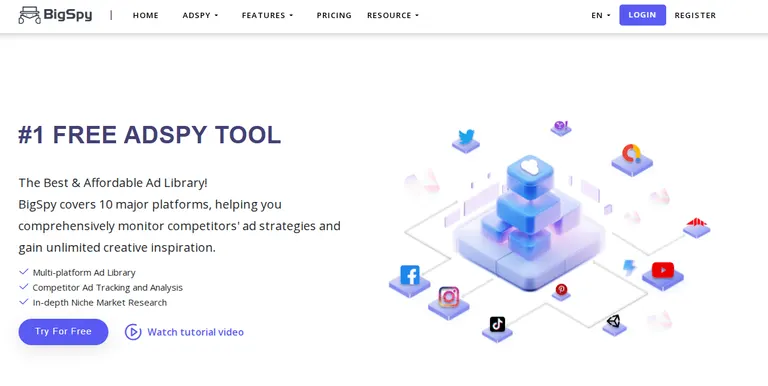
BigSpy is a multi-network ad spy platform covering Facebook, Instagram, TikTok, YouTube, X (formerly Twitter), Pinterest, Reddit, and several other networks, making it one of the least Meta-specific tools in this category.
Its primary purpose is cross-platform ad research for teams that need to monitor brands across multiple paid channels, not just Meta.
What makes BigSpy different is its scale: more than one billion indexed creatives across 10+ platforms, combined with a relatively accessible entry price.
Buyers evaluating BigSpy also consider Atria as the best alternative with deeper Meta-focused intelligence.
Best for
Teams running cross-network paid social campaigns that need a broad creative database at a low entry cost.
Key features
- 1B+ cross-network creatives: Search ads across Facebook, Instagram, TikTok, YouTube, X, Pinterest, Reddit, and additional platforms in a single interface.
- Creative trend reports: Identify trending ad formats, hooks, and visual patterns across industries using automated trend analysis.
- Advertiser watchlists: Track competitor brands and get notifications when they launch or update ad campaigns.
- Ad performance scoring: Automatically score ads based on engagement signals to surface higher-performing creatives.
- Chrome extension: Capture and save competitor ads while browsing supported social platforms.
Pricing
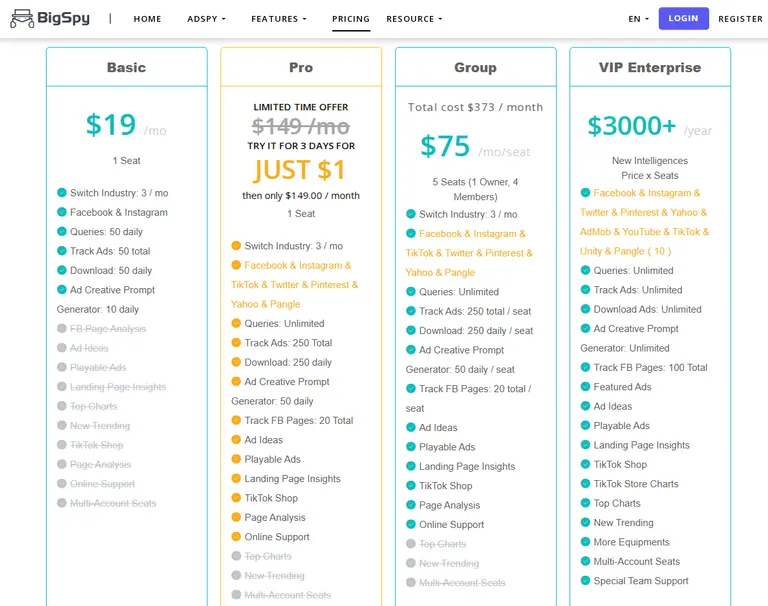
BigSpy uses a tiered subscription model with pricing based on plan level and, on higher tiers, the number of seats.
A free plan is available with limited searches.
The Basic starts at $19/month for 1 seat, Pro at $149/month for 1 seat, Group at $75 per seat/month with 5 seats total, and VIP Enterprise starting at $3000+/year with custom pricing by seats/features.
5. Brandwatch
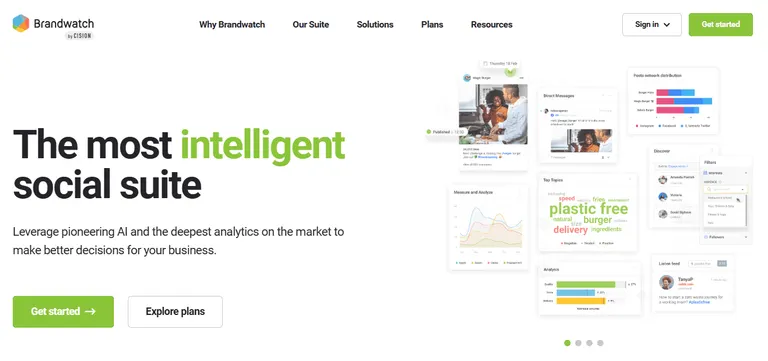
Brandwatch is a consumer intelligence and social listening platform owned by Cision, expanded into competitor content and ad monitoring.
Its primary purpose is enterprise-grade brand tracking, audience analysis, and social listening, with competitor ad intelligence as one module rather than the core product.
What makes Brandwatch different is scale: it processes insights from 100M+ sources and uses AI-powered analysis (Iris AI) to show key KPIs, such as posting frequency, top-performing content, and sentiment trends.
It is not Meta-specific and covers Facebook, Instagram, X, TikTok, news sites, forums, and blogs.
Best for
Enterprise marketing and PR teams that need social listening combined with competitor content tracking on a large scale.
Key features
- Social listening at scale: Monitor brand mentions, sentiment, and competitor activity across 100M+ online sources, including social platforms, news sites, forums, and blogs.
- Competitor content tracking: Track competitors' organic posts, paid ads, and content strategies across Facebook, Instagram, X, TikTok, and the open web.
- Audience segmentation: Break down competitor audiences by demographics, interests, and behaviors to support targeting and creative decisions.
- Iris AI insights: Detect patterns, anomalies, and trends across large datasets using Brandwatch's AI engine.
- BrandwatchGPT: Generate natural-language reports and insight summaries without manual dashboard setup.
Pricing
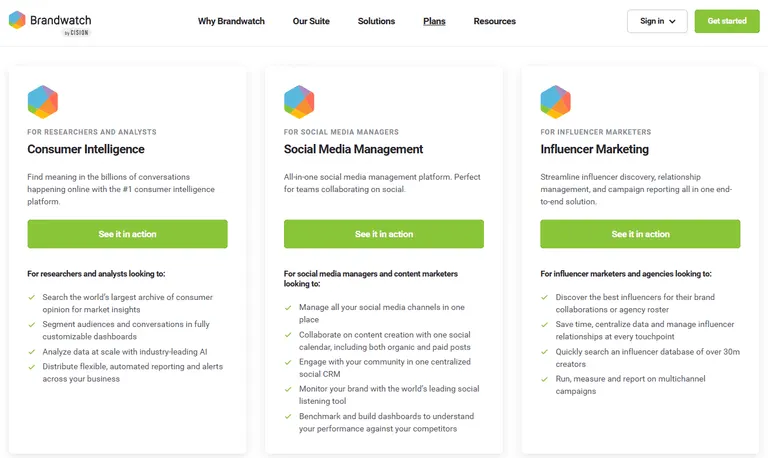
Custom pricing only, available on request. Third-party estimates place entry-level plans around $800/month, with full enterprise deployments significantly higher. Sold on annual contracts with onboarding included.
6. Minea
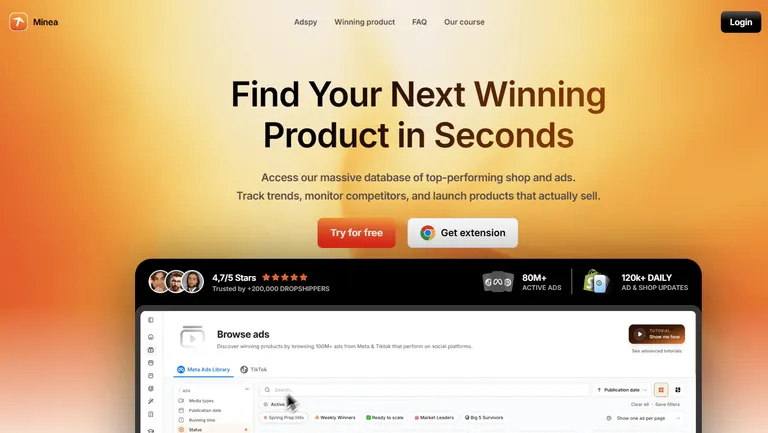
Minea is a product research and ad spy tool originally built for ecommerce dropshippers and now used more broadly by DTC teams.
Its primary purpose is combining product discovery with competitor ad research, providing visibility into both what competitors are advertising and which products are gaining traction.
What makes Minea different is its winning-product finder, which sits on top of more than 80 million indexed ads and surfaces trending items based on engagement signals.
It is not Meta-specific and covers Facebook, Instagram, TikTok, and Pinterest, with Facebook being the most heavily used network.
Best for
Dropshippers and early-stage DTC brands that want product discovery combined with cross-platform ad intelligence.
Key features
- 80M+ cross-platform ad library: Search ads across Facebook, Instagram, TikTok, and Pinterest with filters for country, language, and engagement.
- Winning product finder: Identify trending products based on engagement patterns and ad frequency signals across multiple platforms.
- Influencer tracking: Monitor influencer partnerships and analyze the performance of sponsored content tied to competitors.
- Shop analysis: Study competitor storefronts, pricing strategies, and product catalogs alongside their ad activity.
- Chrome extension: Capture competitor ads and product data while browsing supported platforms.
Pricing
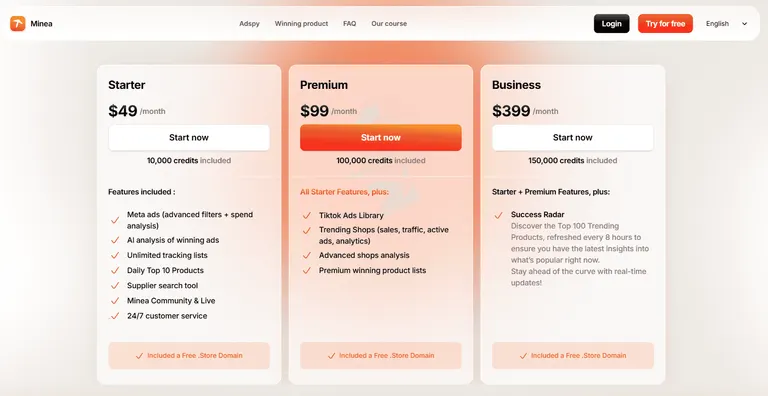
Three tiers: Starter at $49/month, Premium at $99/month, and Business at $399/month.
A limited free plan is also available.
7. Motion
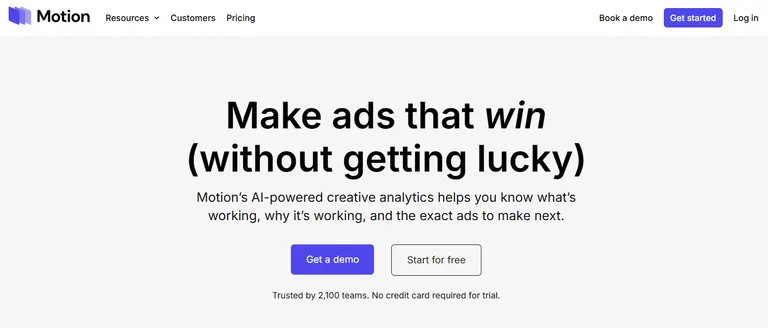
Motion is a creative analytics platform built for performance creative teams running paid social. Its primary purpose is automated tagging and performance reporting on a company's own ads rather than competitor research.
What makes Motion different is the depth of its first-party creative analytics: it connects directly to Meta and TikTok ad accounts and automatically tags every creative by visual elements, hooks, post types, and format.
It is primarily Meta-focused, with TikTok support as a secondary channel. Learn more about Motion alternatives.
Best for
In-house performance creative teams that need automated tagging and reporting on their own ads at scale.
Key features
- Automatic creative tagging: Connect ad accounts to automatically tag every creative by hook, format, visual element, and messaging theme.
- Video-level reporting: Break down video ad performance by scene, hook, and duration to identify which creative elements drive results.
- Hook and format analysis: Compare performance across different ad hooks and format types to inform future creative briefs.
- Competitor ad tracking: Monitor competitor Facebook and Instagram ad activity alongside the user's own creative performance data.
- Team dashboards: Share creative performance insights across teams with customizable, role-based reporting views.
Pricing
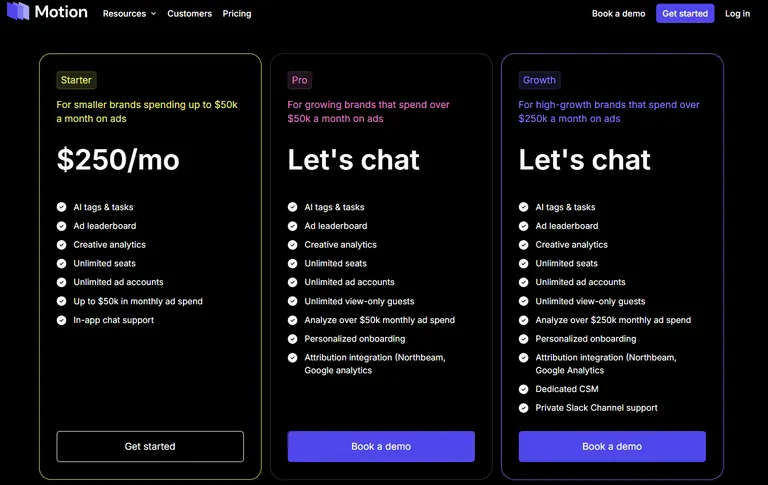
Starter plan at $250/month for single-brand teams. Pro, Enterprise, and Agency tiers are quoted on request based on ad spend and seat count. No public free trial; access is typically via demo request.
8. Panoramata
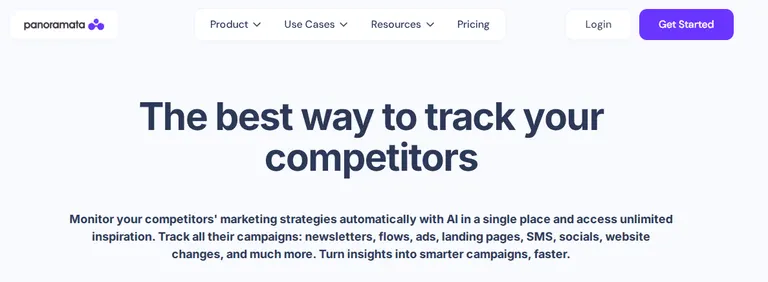
Panoramata is a competitive marketing intelligence platform that indexes ad creatives, email campaigns, landing pages, and SMS flows from more than 100,000 brands worldwide.
Its primary purpose is cross-channel competitor tracking, giving ecommerce teams a unified timeline of each tracked brand's content strategy across seven channels.
What sets Panoramata apart is the breadth of coverage per brand: it tracks posting frequency, ad volume, email cadence, and landing page changes in a single view, but the trade-off is lighter depth within any single channel.
It is not Meta-specific and covers Facebook, Instagram, TikTok, Google, email, SMS, and landing pages.
Best for
Ecommerce teams that want a cross-channel view of competitor marketing rather than Facebook-only ad intelligence.
Key features
- Cross-channel tracking: Index competitor activity across Facebook, Instagram, TikTok, Google, email, SMS, and landing pages in a single timeline.
- Brand benchmarking: Compare ad volume, posting frequency, and channel mix against tracked competitor brands.
- 100K+ brand database: Track more than 100,000 brands, primarily in DTC ecommerce, with historical campaign data.
- Trend reports: Surface category-wide creative and messaging trends across industries and competitor sets.
- Campaign alerts: Get notifications when competitors launch new creatives, email campaigns, or landing page changes.
Pricing
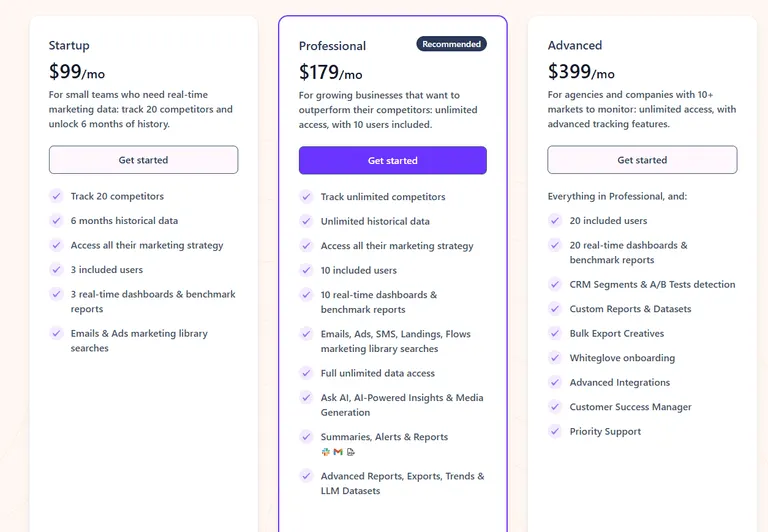
There is no free plan available. Paid plans start at $99/month, with higher tiers for agencies and larger brand portfolios.
9. Vaizle
Vaizle is a social media analytics and competitor analysis platform that bundles Facebook, Instagram, LinkedIn, YouTube, and X reporting into one dashboard.
Its primary purpose is combined organic and paid competitor analysis for small-to-midmarket social teams and agencies managing multiple brand accounts.
What makes Vaizle different is its price-to-breadth ratio: it tracks organic posts, competitor pages, and paid ads alongside white-labeled reporting, starting at a very low entry cost.
It is not Meta-specific and instead covers five major social platforms while focusing on core KPI reporting across them.
Best for
Small-to-midmarket social teams and agencies that need combined organic and paid competitor analysis on a budget.
Key features
- Facebook ad spy: Search and analyze competitor Facebook and Instagram ads with filters for format, date range, and engagement metrics.
- Organic competitor reports: Track competitor posts, top-performing content, engagement rates, and content strategy across multiple platforms.
- Cross-platform analytics: Monitor Facebook, Instagram, LinkedIn, YouTube, and X performance in a single dashboard.
- AI content generator: Generate content ideas and captions informed by competitor performance data and trending topics.
- White-label reporting: Create branded client reports with competitor benchmarks for agency use.
Pricing
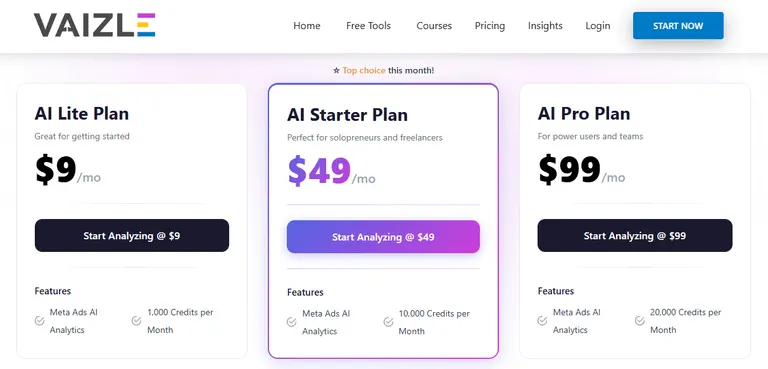
AI Lite at $9/month, Starter at $49/month, and Pro at $99/month.
Enterprise pricing is available on request.
Is Atria the Best Facebook Ads Competitor Analysis Tool?
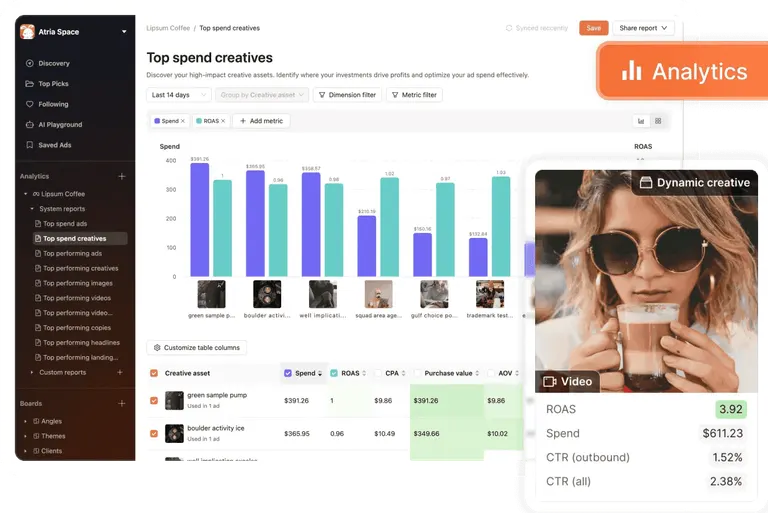
For performance marketing teams running Meta as a primary acquisition channel, Atria is the strongest pick in this category. The reason comes down to a structural advantage that no other tool replicates.
The core difference
Most tools fall into one of two camps:
- Competitor intelligence only: AdSpy, BigSpy, AdFlex, Minea, Panoramata
- Own performance analytics only: Motion
- Broad platforms with partial overlap: Brandwatch, Sprout Social
Atria is the only platform that combines all three:
- Competitor activity intelligence
- The user's own ad performance
- $9B+ in aggregate market spend benchmarks
This combination is what turns raw data into actual decisions.
Why this matters
Competitive research on its own is incomplete.
- Seeing that a competitor runs static-image carousels is useful
- Knowing your own carousels outperform UGC by 38% in the same vertical is actionable
- Seeing that market benchmarks support the same pattern is decisive
That full picture is what changes creative direction. Atria provides that context in one place.
Faster path from research to execution
Atria also removes a major bottleneck: turning insights into briefs.
- Raya (AI creative strategist): Converts competitor ad libraries into ready-to-use concepts
- Eliminates manual workflow: No more swipe-file-to-brief lag
- Faster cycles: Teams report going from days to hours
- Higher output: More creative iterations per quarter
This is where most tools fall short. They stop at insight, while Atria pushes into execution.
Pricing context and fit
Atria is not the cheapest option, and it is not trying to be.
- Lower spend teams (< $10K/month): BigSpy (free tier) or Vaizle ($9/month) are often sufficient
- Scaling teams ($50K+/month): DTC brands, ecommerce teams, and agencies benefit most from Atria's combined dataset
For teams where every creative brief needs to be grounded in both competitor intelligence and internal performance data, a demo is the fastest way to evaluate fit.
See the combined competitor + performance view in action.
Book a 20-minute demo with Atria.
How to Use Facebook Ads Competitor Analysis Tools
The most effective way to use Facebook ads competitor analysis tools is to treat them as an always-on input to creative briefs, not a quarterly audit exercise. Follow this step-by-step process to turn research into results:
- Build a watchlist of 10–15 direct competitors and 5 adjacent-category brands whose creative you respect.
- Set a weekly review cadence, not monthly and define the time period each review covers (minimum: the last 7 days of new ads).
- Tag winning patterns by ad hooks, format, offer, and landing page archetype. The goal is to identify repeating patterns and spot trends at the category level, not just the brand level.
- Feed those tagged patterns into the creative brief, not the copy deck or the final QA round.
- Compare the brief's output against your own performance data before launch.
Teams that follow this cadence ship 2–3x more creative variants per month than teams relying on ad-hoc competitor spot checks and catch category-wide shifts weeks earlier.
Conclusion About Facebook Ads Competitor Analysis Tools
Facebook ads competitor analysis tools are no longer a nice-to-have in 2026. With Meta ad prices up 9% year-over-year and creative cycles shorter than ever, competitor intelligence is a core input to every brief and every data-driven campaign decision.
The nine tools in this guide each solve a different slice of the problem:
- Raw ad spy (AdSpy, BigSpy, AdFlex, Minea)
- Cross-channel tracking (Panoramata, Brandwatch)
- Creative analytics (Motion)
Atria is the only solution that gives you full creative intelligence, helping you turn insights into faster decisions, stronger campaigns, and better-performing ads.
Start a free trial today. Enjoy a 7-day trial with no credit card required.
FAQs About Facebook Ads Competitor Analysis Tools
What are Facebook ads competitor analysis tools?
Facebook ads competitor analysis tools are software platforms that let advertisers search, monitor, and analyze competitors' active and historical ads on Facebook and Instagram. They pull from Meta's Facebook Ad Library and third-party databases to surface creative patterns, ad spend signals, landing page strategies, and engagement data that inform paid social campaign decisions.
Is it legal to analyze competitors' Facebook ads?
Yes. Meta's Facebook Ad Library is a public, free resource designed specifically for ad transparency. Third-party Facebook competitor analysis tools index only publicly available data. Competitor ad analysis is standard practice across the industry and does not violate Meta's terms of service or any advertising regulation.
What is the best free Facebook ad spy tool?
The best free tool is Meta's own Facebook Ad Library, which is free, searchable by advertiser or keyword, and covers all active ads globally. For richer filtering without paying, BigSpy, Minea, and Panoramata offer free tools with limited daily searches and database access. None of these free options provide the historical data or performance overlay that premium tools offer.
How much do Facebook ads competitor analysis tools cost?
Facebook ads competitor analysis tools range from $9 per month for entry-level plans (Vaizle AI Lite) to $800+ per month for enterprise platforms (Brandwatch). Mid-market tools like Atria, AdSpy, and BigSpy Pro sit between $129 and $269 per month. Pricing typically scales with database access, the time period of historical data available, and team seat count.
Can you see how much competitors spend on Facebook ads?
Not exactly. Meta does not publish competitor Facebook ad spend figures in the Ad Library. However, platforms like Atria and Panoramata estimate spend ranges based on ad frequency, run-time, format mix, and aggregate benchmark data, providing enough of a signal to guide budget planning, creative resourcing, and key metrics for competitive positioning.