
Every November, the same thing happens on Meta. CPMs spike, the auction fills with every DTC brand you’ve ever bought from, and the ad that printed money in October suddenly can’t buy a click.
In my experience, having run multiple BFCM launches, the brands that win Black Friday locked in their plan months earlier.
Black Friday Facebook ads come down to planning more than most people expect. Get the timeline, the campaign structure, and the creative right, and the peak gets a lot easier to handle. Below is the 2026 playbook, plus five brand ads worth studying.
The 2026 Black Friday Facebook ads timeline (week by week)
Treat Black Friday and Cyber Monday (BFCM) as one long campaign arc. Shoppers already think this way. Shopify’s 2025 Global Holiday Retail Report even found that 26% of them planned to start holiday shopping before the end of September.
The 2026 calendar breaks down like this:
| Phase | Dates | What to do |
|---|---|---|
| Build the foundation | Late Sept to early Oct | Lock offers, products, tracking, and creative production |
| Test before it’s expensive | Mid-to-late Oct | Test hooks, formats, and creators while competition is lower |
| Turn interest into intent | Early Nov | Scale proven creative, grow retargeting pools |
| Make it concrete | Week of Nov 16 | Announce the discount, launch time, and early access |
| Go live | Fri, Nov 27 | Open the offer, push in-stock priority products |
| Hold the peak | Nov 28 to Mon, Nov 30 | Refresh creative, retarget non-buyers, carry into Cyber Monday |
Late September to early October: build the foundation
Set your offer economics, priority SKUs, campaign objectives, landing pages, and tracking during this time. None of this is glamorous, but it’s exactly what I’ve seen the winners finish before November.
Mid-to-late October: test while traffic is cheap
Run your hooks, formats, and creator concepts before the auction heats up. The goal is to know which creative works before you’re paying peak prices to find out.
Build your email and SMS lists and tease early access while you’re at it.
Early November: turn interest into intent
Put spend behind the creative that proved itself, and start growing your warm audiences in earnest.
This is the window to build the retargeting pool you’ll lean on hard over the weekend, so cart abandoners and product viewers aren’t strangers by Black Friday.
Week before Black Friday (November 16 to 22): make it concrete
Vague teasers don’t give shoppers anything to act on, so introduce the discount, the launch time, and any exclusions now. A specific date and time lets people load their baskets in advance instead of waiting around. Black Friday 2026 is on Friday, November 27.
The BFCM weekend (November 27 to 30): hold the line
Lead with the offer, feature what’s actually in stock, and watch spend, conversion rate, and inventory closely. Refresh creative across the weekend and decide whether Cyber Monday (Monday, November 30) keeps the Black Friday deal or introduces a fresh online-only offer.
After Cyber Monday, you can extend into wider Q4 and holiday gifting. That’s a separate campaign with its own timeline, so keep this one focused on BFCM and build a dedicated holiday push for December.
Starting late? A three-week Black Friday Facebook ads plan
If you’re reading this in November, you’ve missed the cheap October testing window. You can still run a solid Black Friday on Meta, as long as you cut the plan down to the steps that change what shoppers see.
November 2 to 8: lock the offer and the tracking
Pick one offer and your priority SKUs, make sure purchase tracking fires, and get your landing pages live. Skip anything that doesn’t change the ad or the checkout, as there isn’t time for a brand refresh.
November 9 to 15: test fast on a small budget
Run a handful of hooks against each other for a few days. You won’t get October-level data, and every test costs more now, so pick the winner on cost per purchase and move on. Start your retargeting campaign this week too, so the pool is warm by the weekend.
November 16 to 22: announce and lock the structure
From here you’re back on the main timeline. Announce the discount, the launch time, and any exclusions, then build your two campaigns (one broad or Advantage+, one retargeting) and stop editing them before Friday.
How to structure your Black Friday Facebook ad campaigns
Many teams over-engineer this. They build fifteen ad sets, split every audience into its own silo, then wonder why so many get stuck in the learning phase before the sale ends.
A simpler setup works better here, and it breaks down into four pieces:
Run BFCM as one unified promotion
Pick one campaign concept and carry it from your pre-sale teasers through Cyber Monday. Shoppers who saw your early-access ad should recognize the same look when the deal goes live.
One continuous promotion also gives Meta’s delivery system a single stable target to optimize toward across the whole week.
Default to Advantage+ sales campaigns for scale
For prospecting, Advantage+ sales campaigns (Meta’s broad, automated prospecting engine) are the right tool for peak demand. Broad targeting plus strong creative tends to beat tight manual segmentation here.
There's enough in-market demand during BFCM that Meta's Andromeda system, which decides which ads get considered for each person, can find buyers on its own without narrow targeting getting in the way.
Choose:
- Advantage+ when: You have a healthy catalog, clear offer economics, and enough creative to feed broad delivery.
- Manual campaigns when: You need tight control over a specific audience (say, a high-value loyalty segment) that you don’t want blended into broad.
Layer audiences without overcomplicating it
A broad or Advantage+ campaign brings in new buyers, and a dedicated retargeting campaign recaptures the cart abandoners and product viewers you warmed up in early November.
Any extra audience split needs its own budget, and small budgets can struggle to exit the learning phase before the sale ends.
Protect the learning phase: don't edit mid-flight
Meta’s delivery system goes through a learning phase while it figures out how to deliver an ad set, and significant edits can knock it back into learning. Resetting that on Black Friday morning is a self-inflicted wound.
Do your testing in October and lock the structure before the weekend. If you need fresh creative on the big days, add it in a new ad set, or in a separate campaign, so your main ad sets keep their learning. Leave targeting and the optimization event alone once spend ramps.
Budget and bidding for the peak week
Black Friday is one of the most expensive auctions of the year, and higher costs are normal. US Facebook CPMs averaged about $23 per 1,000 impressions from mid-2025 to mid-2026, and they hit about $27 in November 2025.
CPMs jumped about $4.60 going into November 2025, the biggest monthly rise of the year, and on peak days like Black Friday and Cyber Monday they can double or more.
Budget for that spike up front so it doesn't catch you mid-sale:
Pace spend toward the peak
Early November budgets exist to learn what works, so keep them modest. Save the largest share for the Friday-to-Monday window, when intent is highest, and you want to be fully funded as buyers show up.
Raise budgets in small steps
Big overnight budget jumps can send an ad set back into learning, right when you can least afford it. Scale in smaller increments and let delivery stabilize. Choosing between ad set budget optimization (ABO) and campaign budget optimization (CBO) also affects how you pace.
For the peak, I’d run CBO on the broad campaign so Meta can move spend to whichever ad set is converting that hour, and give the retargeting campaign its own fixed budget so prospecting can’t eat it.
Know when to lock in reach
I’d run BFCM through the auction with a cost cap by default, because it keeps your cost per sale in check when CPMs double. The calculation changes when reservation buying beats the auction, usually when guaranteed reach for a specific launch moment matters more than efficiency.
Creative best practices for the Black Friday scroll
Creative does a lot of the heavy lifting on Black Friday. In my view, a handful of habits hold up from one year to the next:
- Put the offer in the first frame: During BFCM, the deal is the hook. Shoppers scan the feed at speed, so "40% off" belongs at the top of the ad, ahead of any brand storytelling.
- Design for mobile and sound-off: Shoot 9:16 vertical, add captions, and make the first second count. Reels often play with sound on, but your offer should land with the audio muted too.
- Use urgency honestly: Real deadlines and real stock levels create genuine pressure. Fake countdown timers teach shoppers to distrust you.
- Match the format to the job: Video carries the hook, carousels show multiple deals in one unit, and dynamic product ads do the heavy lifting on retargeting.
- Ship more creative than you think you need: At peak frequency, winners fatigue fast, sometimes within days. I'd keep a full rotation live with backups queued.
5 Black Friday Facebook ad examples (and why they work)
Enough theory. Here are five live examples from this year’s Black Friday creative, pulled from Meta’s Ad Library:
Airmoto

The ad opens with “up to 52% off” stacked over a hand inflating a tire with the device itself, the on-screen display climbing from 0.0 to 30.1 PSI mid-ad.
The whole ad is the product doing its job on camera. When a product can demonstrate its own result like that, I’d skip the staged photography. The readout sells harder than the discount headline does.
Muravai
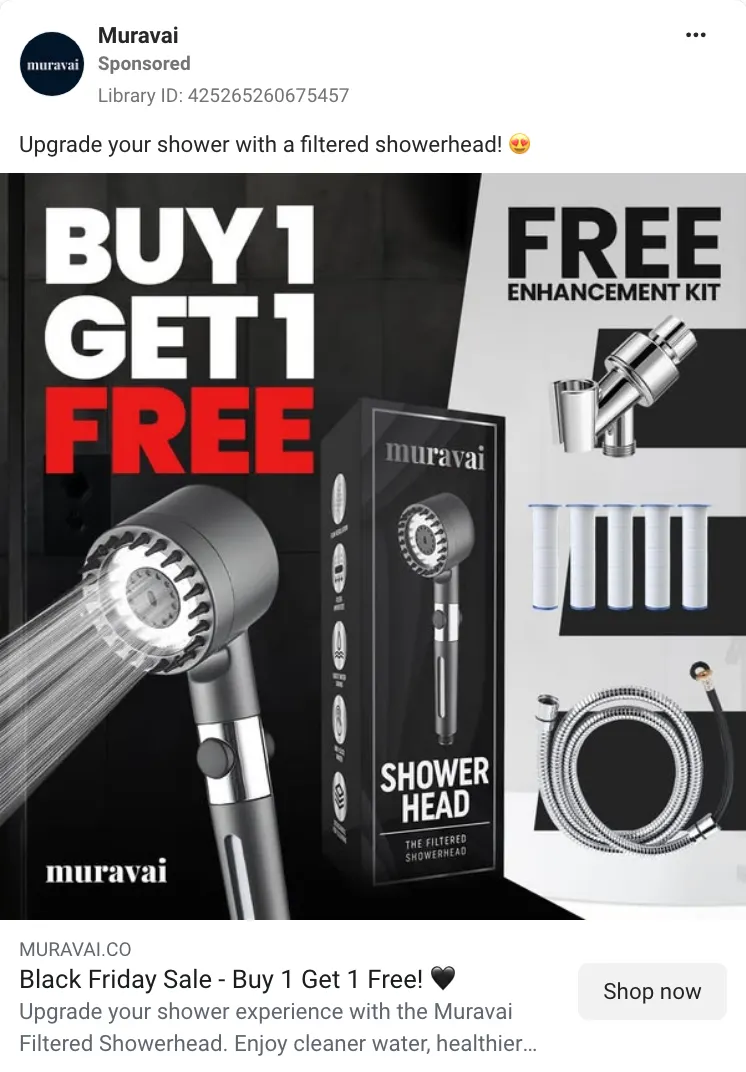
This one buries the lede in a good way. The headline offer is buy-one-get-one on a filtered showerhead, but the product photo also shows a free “enhancement kit,” extra filter cartridges, and a longer hose. The whole bundle is laid out before anyone reads a word of copy.
On a low-ticket item, a bonus that looks bigger than the product itself raises perceived value more than another 10% off might.
PLUFFI Slippers

PLUFFI whispers “early access” in the opening line, then points straight at gift-giving (“find the perfect cozy gift for friends, family, or just treat yourself”), wrapped in Christmas-adjacent reds and candy canes well before the holiday window opens.
For gift-heavy categories, I don’t think that’s too early. Black Friday creative can carry holiday framing from the start, as long as the discount and the code stay the first thing a shopper reads.
FREYARA Cosmetics
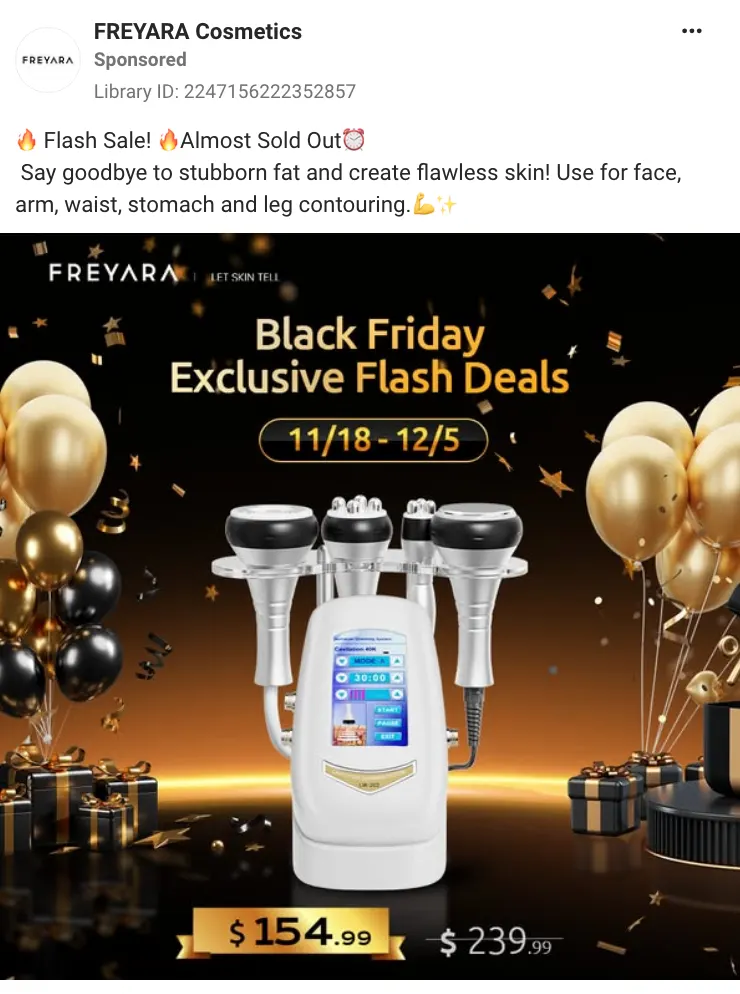
FREYARA Cosmetics prints the exact sale dates (11/18 to 12/5) directly on the creative, next to a strikethrough price ($239.99 down to $154.99) and an “almost sold out” flag. That’s the detail worth copying.
Doing the discount math for the shopper and dating the window removes a step, and it creates urgency that vague “limited time” language doesn’t quite manage.
MoxieLash

This ad has “Up to 70% off” with a 15% code stacked on top. There’s also “100,000+ 4/5 star reviews” dropped into the copy before the shopper even reaches the offer.
Proof ahead of the pitch reads differently than proof after it. Combining a flat discount with a code also gives price-sensitive shoppers a second reason to act.
Black Friday Facebook ad mistakes to avoid
Black Friday moves fast, and most of the costly errors are preventable. These are the six I'd check before launch, with a fix for each:
| Mistake | What it costs | Fix |
|---|---|---|
| Launching too late | Testing in the priciest auction of the year | Lock offers by early October, test in mid-to-late October |
| Advertising out-of-stock products | Paid traffic to a sold-out SKU | Check inventory before launch, pause static ads that sell out |
| Discount-only creative | No brand or product story, forgettable ad | Show the product and use case beside the discount |
| Editing campaigns mid-flight | Learning phase resets on peak weekend | Finalize structure before Friday, change little |
| Misleading "was" prices | Regulator action and lost trust | Use a genuine recent selling price |
| Running winners to death | A sudden mid-sale performance drop | Keep fresh variants queued, watch frequency |
How Atria supports your Black Friday Facebook ads
Black Friday Facebook ads get harder to manage once the sale starts, because the auction shifts by the hour and winning creative can fatigue within days. Atria is a creative engine for Meta ads, built for that kind of week.
Raya, Atria’s AI creative strategist, works inside Slack. She pulls the hooks and offers performing in your category, turns them into briefs, then generates variants you can batch-launch to Meta. That keeps your creative velocity high when you can’t build every ad by hand.
Radar also grades every live ad and tells you exactly what to fix, so you know which ad to swap before it drains budget.
See what Radar flags in your own account before the sale starts. Start for free with 1,000 free credits, no credit card required.
Frequently asked questions
When should you start advertising for Black Friday?
Start preparing in late September and start testing ads in mid-to-late October. Use that window to lock your offers, build audiences, and test creative while CPMs are cheap, then move spend behind proven ads in early November, before the auction peaks.
Should Black Friday ads run through Cyber Monday?
Yes, run Black Friday (November 27, 2026) through Cyber Monday (November 30) as one continuous promotion. A single campaign concept keeps delivery stable across the weekend and lets you decide whether Cyber Monday keeps the deal or adds a fresh online-only offer.
How much do Facebook ads cost per 1,000 impressions on Black Friday?
US Facebook ads averaged about $23 per 1,000 impressions over the past year and peaked at about $27 in November 2025. Black Friday can double that or more. Budget for the spike and put your largest share of spend on the Friday-to-Monday window, when buying intent peaks.
Which campaign type should you use for Black Friday on Facebook?
Use Advantage+ sales campaigns for broad prospecting, since peak demand gives the algorithm plenty of buyers to find. Pair them with a dedicated retargeting campaign for cart abandoners and warm audiences.
How do you stop Black Friday ads from fatiguing?
Rotate in fresh creative before frequency climbs, and refresh the hook first, since it often fatigues fastest. Keep backup variants ready in a new ad set, so you can launch fresh ads without resetting your main ad sets.