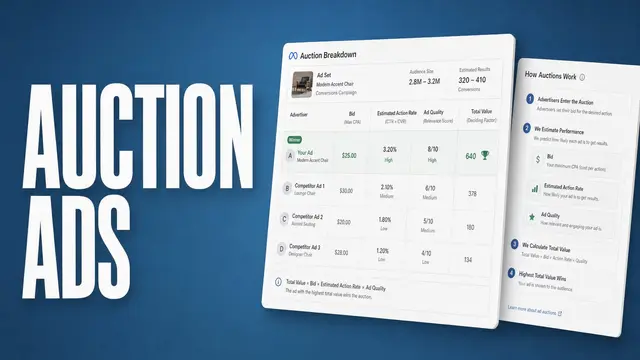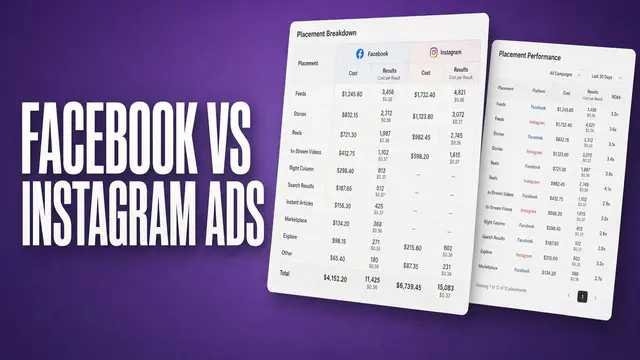

Auction vs reservation ads on Facebook is a decision you have to make whenever you advertise on the platform. If you want the mechanics first, auction ads covers the three factors that decide who wins.
Meta auction ads use real-time bidding to adjust prices dynamically based on market demand, while reservation ads let you lock in predictable CPMs and guaranteed reach ahead of time.
Getting the buying type wrong means either burning budget with zero guaranteed reach or overpaying for conversion traffic.
Here's how the two buying types differ, when each one wins, and how to choose. For where this choice sits in the wider setup, we walk through building a campaign end to end.
Auction vs Reservation: TL;DR
Auction buying fluctuates dynamically to win ad placements based on your bid amount, ad quality, and estimated action rates, which Meta combines into a total value score.
Reservation buying reserves fixed inventory at a set price, guaranteeing your placement and reach.
The key difference is that auction buying maximizes performance and conversions through algorithmic bidding, while reservation buying guarantees fixed inventory and predictable CPMs for brand campaigns.
Auction vs Reservation: At a Glance
Here's how auction and reservation buying compare across key operational factors. Use this reference table as a quick decision matrix for your client pitches and campaign planning.
| Aspect | Auction Buying | Reservation Buying |
|---|---|---|
| Definition | Real-time bidding system where ads compete for inventory based on bid and total value score. | Fixed-rate buying system where you reserve guaranteed inventory in advance at a locked CPM. |
| When to Use | Direct response, performance marketing, lead generation, and dynamic budget scaling. | Major product launches, brand awareness campaigns, and time-sensitive product drops. |
| Common Example | E-commerce retargeting campaign optimizing for online product sales. | Brand campaign securing guaranteed reach during a major sporting event or holiday. |
| Minimum Spend / Audience | $1/day technical minimum with zero audience size restrictions. | Large audience requirement (typically 200,000+ users) and higher spend minimums. |
| Key Difference | CPMs fluctuate dynamically based on auction competition and creative quality. | CPMs remain locked, guaranteeing exact impression delivery and controlled reach. |
What is Auction Buying?
- Auction buying is Meta's default purchasing model, where your ads compete in real-time against other advertisers for user attention.
- Meta's algorithm assigns a total value score based on your bid, predicted action rates, and ad quality, so the highest bid alone doesn't automatically win the placement.
- That scoring only happens after Meta's Andromeda retrieval engine has already narrowed the eligible pool down to a shortlist.
- This model gives performance marketers maximum flexibility. You can launch campaigns with small budgets, edit creative on the fly, and pause underperforming ad sets instantly. The algorithm constantly searches for the cheapest conversions within your target audience.
- For example, an e-commerce brand running a promo can use auction buying to drive sales. If a creative converts well, you scale budget into that winning ad. If competition spikes during Black Friday, your CPMs rise, but Meta's system keeps looking for users most likely to buy.
What is Reservation Buying?
Reservation buying lets you purchase Meta ad inventory at a fixed CPM before your campaign runs. Meta previously called this Reach and Frequency buying. It works like this:
- Instead of competing in real-time auctions, you secure predictable impression volume and guaranteed reach.
- This model is built for advertisers who need complete control over campaign delivery and pacing. You lock in your ad budget, target audience size, and impression schedule for campaigns running up to 90 days.
- Meta delivers those impressions at the agreed-upon rate with a high degree of predictability, though even reservation buying doesn't guarantee 100% of planned reach and impressions.
For example, an enterprise brand launching a global product can use reservation buying to secure impressions across launch week. You know exact reach numbers before spending a single dollar. You sacrifice creative agility, but you protect your media plan from unexpected CPM spikes.
Auction vs Reservation: Key Differences
Choosing between auction and reservation buying means matching your buying mechanism to your client's business goals, risk tolerance, and media strategy.
Here's how these two models differ across the key operational areas that shape campaign performance.
Cost Structure and Predictability
Auction buying operates on dynamic pricing. Your CPM changes constantly based on advertiser competition, audience overlap, ad relevance, and seasonality.
During high-demand periods like Q4 or Cyber Week, auction costs spike quickly as thousands of brands bid for the same impression inventory.
You get price efficiency during low-demand periods, but your budget won't deliver a guaranteed impression volume. If your CPA rises unexpectedly outside of a known high-demand period, run through Atria's Facebook ad performance decline diagnostics before assuming it's a buying-type problem.
Reservation buying locks in a fixed CPM when you book the campaign. You pay that exact rate regardless of market fluctuations or seasonal demand spikes.
If Q4 CPMs double in the auction, your reserved campaign runs at the contract price you secured months before. This gives financial teams complete budget predictability, though you miss out on potential cost dips during quiet market periods.
Campaign Objectives You Can Run
Auction buying gives you access to every objective Meta offers. You can optimize for Sales, Leads, App Promotion, Traffic, Engagement, or Awareness. The algorithm checks individual user behavior, placing your ad in front of users most likely to complete your specific goal.
Reservation buying limits your choices strictly to upper-funnel goals. Meta restricts reservation campaigns to Awareness and Engagement objectives.
You can't run conversion, lead generation, or catalog sales campaigns through reservation. Performance goals remain locked to Reach, Ad Recall Lift, and ThruPlay. If your client wants direct online purchases or form fills, auction buying is your only option.
Minimum Spend and Audience Size
Auction buying has low barriers to entry. Meta's minimum runs from $1/day for impression-based campaigns up to $5/day for conversion-optimized ones, letting small brands test concepts and scale spend gradually as performance warrants
Reservation buying works best with audiences of 200,000 or more. Meta's own guidance recommends this as the effective floor for reserved inventory.
If your client's target audience is well under 200,000 people, reservation buying likely won't deliver the guaranteed reach it's designed for.
Platforms and Placements
Auction buying grants access to Meta's full advertising network. Your ads can appear across Facebook, Instagram, Messenger, and Audience Network.
You can choose Advantage+ Placements to let Meta's algorithm allocate budget automatically across all surfaces based on real-time performance.
Reservation buying has narrower placement flexibility. While you can access major placements across Facebook and Instagram (Feed, Stories, and Reels), you lose access to Audience Network and certain dynamic placement options.
You must select placement structures that support guaranteed reach and frequency controls.
Creative Flexibility and Testing
Auction buying rewards rapid iteration. You can swap out ad copy, add new video creative, pause losing variations, and launch dynamic creative tests inside live campaigns.
If a visual angle fails, you stop it immediately and pivot your budget toward winning concepts.
Reservation buying locks your campaign structure. Once you confirm a reservation order, Meta reserves that inventory based on your booked campaign parameters. Editing creative angles, changing ad formats, or swapping assets mid-flight isn't the flexible process it is in auction.
Only a narrow set of changes, like adjusting budget, extending your end date, or pausing an ad set, are supported mid-schedule, and even those can throw off your ad sequencing and delivery pacing for the rest of the campaign.
You must test and validate your creative concept before locking it into a reservation window.
When to Use Auction vs Reservation
Choosing the right model depends on your core goals, timeline, and risk tolerance. Here's a clear breakdown of when to deploy each buying type.
Use Auction when:
- You're driving performance and sales: You need lower-funnel results like catalog purchases, lead submissions, or app installs where algorithm optimization matters.
- You need testing and creative flexibility: You want to swap out creative assets, test new copy variations, or scale winning ad sets mid-flight.
- You're working with modest budgets or niche audiences: Your target audience is under 200,000 users, or you want to launch campaigns with flexible daily budgets.
Use Reservation when:
- You need guaranteed reach for major launches: You're launching a product, hosting an event, or executing a time-sensitive campaign where impression volume cannot fall short.
- You want to protect against Q4 CPM spikes: You're planning major Q4 initiatives and want to lock in your media costs before Q4 market demand drives auction prices up.
- You require strict frequency control: You want to control exact impression pacing across your audience to avoid ad fatigue while maintaining steady brand presence.
Choosing as an Agency: How to Justify the Call to a Client
Clients buy business outcomes. Models matter very little to them. When you present an ad strategy, you need to justify why you chose auction or reservation buying in terms your client's finance team and CMO will respect.
Use this decision matrix on your next client slide deck:
| Client Scenario | Recommended Buying Type | Strategic Justification |
|---|---|---|
| High ROAS Target, Flexible Timeline | Auction | Allows Meta's algorithm to identify high-intent buyers dynamically, minimizing acquisition costs. |
| Strict Launch Date, Fixed Product Budget | Reservation | Eliminates CPM volatility risk, which secures predictable reach and impression pacing on launch day. |
| Mid-Funnel Retargeting or Small Audience | Auction | Bypasses reservation's 200,000-user minimum while letting you iterate ad creative fast. |
Remind your client that reporting and attribution work differently across these two models. Auction campaigns evaluate performance through direct response metrics like CPA, ROAS, and conversion volume.
Reservation campaigns evaluate success through brand lift, total reach, impression delivery, and frequency caps.
Aligning your client on these evaluation metrics upfront prevents mid-campaign friction over why a reservation brand push isn't generating immediate direct sales.
Auction vs Reservation Ads on Facebook: Validating Your Creative Before You Choose
Neither buying type forgives weak creative. Auction burns through budget chasing an angle that never had a real shot. Reservation locks that same weak creative into a fixed window you can barely touch once you commit.
Either way, the fix is the same: know which creative is strong before you spend against it.
Atria runs right inside Slack alongside the rest of your team, so you're not logging into a separate dashboard to check what's working
Radar shows which creative angles are performing across your campaigns and your competitors', and Atria's AI teammate, Raya, turns that into a ready-to-use creative brief instead of another report you have to interpret yourself.
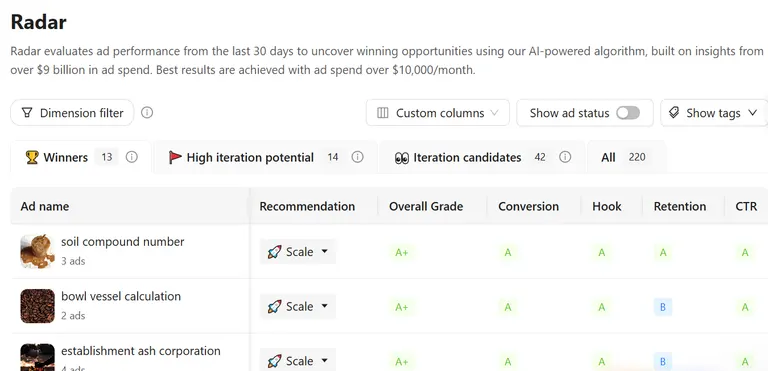
As Melissa Izbicki, Senior Manager, Growth Creative Strategy at Ipsy, put it, “A lot of Motion’s same functionality is there, except that you get all these research tools in addition to the visualization stuff.”
Key benefits:
- Creative intelligence over raw data: Radar shows you which visual hooks and messaging angles are already winning, so you're not guessing before you lock budget into either buying type.
- Faster from insight to brief: Raya turns performance data into a ready-to-use creative brief, cutting the time between spotting what's working and shipping the next ad.
- Built for your ROAS and CPA goals: Atria is built to help you ship more ads, lift ROAS, and lower CPA.
Ready to see what Radar surfaces for your own campaigns? Try Atria free. No credit card required, and you start with 1,000 free credits.
Still comparing options? This roundup of AI tools for scaling Meta ad performance breaks down how Atria stacks up against the alternatives.
Frequently Asked Questions
Can I switch buying types mid-campaign?
No, you can't convert an existing campaign from auction to reservation or vice versa. Meta sets the buying type at the campaign creation level. If you want to change your purchasing model, you must pause your active campaign and build a new one under the alternative buying type.
Can I run auction and reservation campaigns at the same time?
Yes, running both buying types simultaneously is a common strategy for large brands. You can deploy reservation campaigns to guarantee baseline awareness and reach, while running auction campaigns alongside them to capture demand and drive lower-funnel conversions.
What is the minimum budget required for reservation buying?
Meta doesn't set a universal fixed dollar minimum for reservation buying, but it enforces a minimum audience size of 200,000 users.
Depending on your target geography, placement selection, and campaign duration, booking reserved inventory typically requires a committed budget starting in the thousands of dollars.
Is reservation buying available on Instagram?
Yes, reservation buying covers key placements across both Facebook and Instagram. You can reserve guaranteed inventory on Instagram Feed, Stories, and Reels, provided your campaign meets Meta's minimum audience size requirements.
Does reservation buying guarantee campaign results?
Reservation buying guarantees impression delivery, CPM rates, and reach parameters, but it doesn't guarantee conversions, click-through rates, or business outcomes. The actual performance of your campaign still depends on your audience targeting relevance, offer strength, and creative quality.