
Billions of Facebook ad impressions are bought and sold every day, in a fraction of a second each, and the surprising thing is the biggest budget doesn't always win.
Once you understand how that auction picks a winner, you'll see why a competitor with half your budget can beat you for the same impression. That's also the fastest way to bring your own costs down.
This article breaks down the 3 factors that decide who wins auction ads, how to check your own standing in Ads Manager, and what changed in how Meta picks candidate ads before the auction even starts.
TL;DR: Auction ads
- Meta picks a winner using three inputs: your bid, estimated action rate, and ad quality. Whichever ad scores highest on all three wins.
- Before that math even runs, an AI system called Andromeda decides which ads get considered at all, based mostly on your creative.
- Check your standing anytime in Ads Manager: quality ranking, engagement rate ranking, and conversion rate ranking show where you're losing.
- Your fastest lever to lower costs is better creative.
What decides which Facebook ad wins
Meta runs an auction every time a slot opens on someone's feed. It happens in milliseconds, and millions of advertisers are competing for that same slot. The highest bidder doesn't automatically win it.
Meta scores every eligible ad on three things:
- Your bid: What you're willing to pay for the result you want.
- Estimated action rate: Meta's guess at how likely this person is to engage with or buy from your ad.
- Ad quality and relevance: How good or bad the experience will be, based on how people have reacted to your ads before.
When you add those three together, you get a score called Total Value. Whichever ad has the highest Total Value wins the slot.
Your bid is the slowest lever to move. If you want to win more auctions and pay less to do it, fix your creative and relevance first.
How the Facebook ad auction works
Meta runs a new auction every single time a slot opens up. Open Instagram right now, and an auction resolves in milliseconds to decide which ad lands in your feed.
The Total Value formula, broken down
Here's how media buyers describe the math:
Meta itself only publishes the three inputs, not the exact formula:
Total Value ≈ (Your Bid) × (Estimated Action Rate) + (Ad Quality Score).
The numbers below are illustrative, since the point is the mechanic.
Say two brands want the same impression.
Brand A bids $20. Their creative is tired, so Meta estimates a 1% action rate (0.01) and assigns them an ad quality score of 2.
Total Value: ($20 × 0.01) + 2 = 2.20
Brand B bids $10, half of what Brand A bids. But Brand B has been testing creative hooks, so Meta predicts a 4% estimated action rate (0.04) and gives them a quality score of 3.
Total Value: ($10 × 0.04) + 3 = 3.40
Brand B wins while bidding half as much because its score is higher.
These numbers are made up to keep the math simple (not pulled from a real campaign), but the mechanic is true. Meta rewards a lower bid over a higher one when the ad performs better.
Why the textbook explanation is now incomplete
While that formula explains the final calculation, it skips a step that happens before Meta ever runs it.
Meta built an AI system called Andromeda to handle candidate selection. Older versions of the auction pulled candidates mostly from your targeting settings: age, interests, location.
Andromeda works one step earlier. Before Meta calculates a Total Value score, it scans tens of millions of eligible ads and narrows them down to a shortlist of a few thousand real candidates for that one impression.
The shortlist Meta hands to the auction is still roughly a few thousand ads. What changed is how many ads Andromeda can evaluate to build that shortlist.
Meta's engineering team put the model-capacity jump at 10,000x, which is what lets it read tens of millions of ads in real time instead of relying on rule-based shortcuts.
Andromeda reads your creative itself (the visuals, the hook, the message) to build that shortlist, more than it reads your targeting settings.
Nothing else matters if Andromeda doesn't shortlist your ad. Your bid and your quality score never get calculated, because your ad never makes it that far.
When you fix your creative, you improve both your action rate and your odds of making the shortlist at all.
How to see the auction's verdict on your own account
Ads Manager shows you where you stand against the competition.
Quality ranking, engagement rate ranking, conversion rate ranking
Check these three rankings in Ads Manager:
- Quality ranking: How your ad's perceived quality stacks up against ads chasing the same audience. Below average usually means your copy or visuals feel spammy or off-putting.
- Engagement rate ranking: How your expected clicks, shares, and comments compare to competitors targeting that same audience. Below average means people see your ad and scroll past it. Fix your hook first.
- Conversion rate ranking: How your expected conversion rate compares to ads with the same goal as yours. A low score often means your ad promises one thing and your landing page delivers another.
What rising CPM or frequency is telling you
Your CPM goes up when your rankings drop, which is Meta's way of charging you more for a worse ad.
A sudden CPM spike almost always means your estimated action rate is falling. People stopped engaging, so Meta charges more to keep showing your ad.
Rising frequency plus falling conversions is linked to creative fatigue, which means your audience has seen the ad too many times. Your action rate drops, and the auction charges you a premium to keep running the same creative.
This combination is one of the clearest signals across your ad performance metrics that it's time for new creative.
What you can control (and what you can't)
Scaling profitably means knowing which levers you control, and which ones you just have to react to.
| Controllable levers | Uncontrollable levers |
|---|---|
| Ad creative and formats | Competitor bids and budgets |
| Offer and positioning | Seasonal demand spikes (e.g., Q4) |
| Post-click experience | Meta platform algorithm updates |
Why creative is the fastest lever on estimated action rate
You can't control how much a competitor spends during Q4, but you can control the hook and the message you put into the auction.
A stronger creative hook lifts engagement, which raises your Total Value score without you touching your bid at all. Test creative fast and often, and you win auctions cleanly while your costs stay flat.
The levers that move slowly, or that you don't control
Bid changes and budget increases move slowly compared to a creative swap. A bigger budget doesn't make your ad more appealing by itself. You'll burn through your budget faster and drive your CPMs up if you push it behind weak creative.
Holiday spikes and sudden competitor spending push costs up for everyone. Trying to outbid a well-funded competitor during a seasonal spike is expensive if your ad relevance can't keep up.
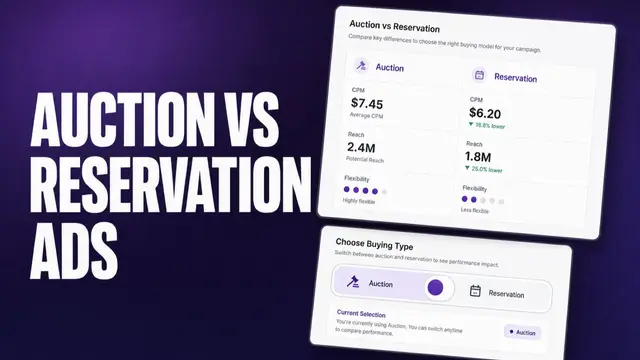
Auction vs. reservation buying
Most advertisers buy through the auction, where prices move with real-time demand and ad quality.
Meta also has reservation buying (it used to be called Reach and Frequency). This locks in a fixed CPM and predictable reach ahead of time.
Reservation is good for cost certainty on big brand campaigns. It's not built for performance efficiency the way the auction is, so most direct-response advertisers stick with auction.
Common misconceptions about the Facebook auction
“The highest bid always wins.”
That's not true. A $5 bid beats a $25 bid if its action rate and quality score are high enough.
“A bigger budget fixes weak performance.”
That's not true either. Budget doesn't touch ad relevance. If you pour more money into a low-scoring ad, Meta will enter it into worse sub-auctions, and your cost per result will go up.
“Narrow targeting means higher relevance.”
Also not true. Boxing in your audience limits what Andromeda can do. Broad targeting lets Meta find the people most likely to respond to your creative, and your action rate rises on its own.
What this means for scaling auction ads
Once you understand auction ads, you scale differently. Bumping your budget by 20% every few days is more of a guess.
The real skill is scaling Facebook ads profitably, which means raising your score before you raise your budget.
Want to spend more without your costs spiking? Raise your estimated action rate and quality score first. Keep a steady stream of fresh creative in testing, and you'll win more high-value auctions without needing to outbid anyone.
A high Total Value score is what lets you scale reach and protect your Facebook ads ROI at the same time.
Atria has two tools built for this problem. Radar reads every ad in your account and grades it in plain English, using signals like hook rate, CTR, and ROAS, then sends a proactive alert when a creative starts declining and tells you specifically what to fix.
Raya is an AI creative strategist trained on more than $9 billion in real ad spend data. It watches your competitors, tags what's already working in your own account, and generates new ad concepts and image variations every week, so you always have fresh creative ready to test.
Together, they're built to help you catch a declining ad before it drags down your results, and keep new creative in testing so you're never guessing what to make next.
Start making winning creative today with Atria.
Frequently asked questions
Does your daily budget affect auction outcomes?
Your daily budget doesn't directly affect auction outcomes, since it isn't part of the Total Value formula. But a bigger budget helps you exit the learning phase faster, since Meta gathers conversion data quicker and can estimate your action rate more accurately.
Why did my CPM suddenly increase overnight?
Your CPM usually increases overnight for one of two reasons: more competition in the auction, which spikes during holidays, or your creative going stale. Stale creative drops your estimated action rate, and Meta charges more to keep showing it.
Does ad quality decay over time?
Yes, ad quality decays over time. The more times people see the same ad, the less they engage with it. That drop pulls down your estimated action rate and quality ranking, and your costs climb until you swap in fresh creative.
What happens if you lose the Facebook ad auction?
If you lose the Facebook ad auction, your ad doesn't show for that one impression. There's no penalty and no waiting period. A new auction runs for the very next impression, and your ad competes again with a fresh shot at winning it.