
Your ads stopped working, and pulling the budget won't fix that.
Every media buyer hits this wall eventually. CPA spikes, CTR drops, and ROAS slide. The teams that recover fast are those that find the exact point of failure before touching a single setting.
This guide shows you how to improve ad performance by fixing 4 root causes: creative fatigue, audience saturation, tracking breaks, and offer mismatches.
The mistake most people make: fixing before diagnosing
Most experts hand you a fix the second performance dips. They tell you to swap the creative, widen the audience, or tweak the bid.
That's like taking medicine without knowing what's wrong with you. It works sometimes if you're lucky, but most days it resets your learning phase and makes performance worse.
Performance drops happen for specific, traceable reasons. Maybe your creative burned out, your audience saturated, your tracking broke, or your offer stopped landing. Copy-pasting a tactic without knowing which one happened wastes more budget.
Start by reading the signals your account is already sending you. Once you find the exact point of failure, the solution becomes obvious.
Diagnose what's wrong
You can't fix a broken campaign until you know what broke. Most media buyers panic and change five variables at once when ROAS drops, which only creates noise.
Your account dashboard already has the data you need. Look at the right combination of metrics, and the failure point shows itself.
Creative fatigue vs. audience saturation vs. tracking failure vs. offer mismatch
Use this matrix to spot your issue:
| Metric Pattern | Primary Signal | Root Cause | Immediate Action |
|---|---|---|---|
| High Frequency + Declining CTR | Creative Fatigue | Your visual asset or messaging is wearing out | Refresh visual hooks, angles, and ad formats |
| High Frequency + Softening ROAS | Audience Saturation | You hit the ceiling of your audience segment | Expand targeting or diversify campaign structures |
| Sudden Performance Cliff | Tracking Failure | Event pixels, CAPI, or tag managers failed | Check server connections and match rates |
| Healthy CTR + Poor Conversion Rate | Offer Mismatch | Traffic likes the ad, page isn't converting | Fix landing page load speed, messaging, or offer |
Here's what each one looks like:
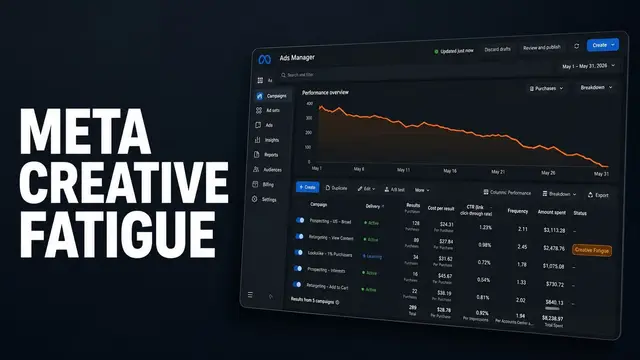
- Creative fatigue: Frequency climbs while CTR drops. People have seen the same image, video, or copy too many times, so they stop paying attention. For more on this, see our Meta creative fatigue guide.
- Audience saturation: Frequency climbs past 3 while ROAS weakens, even if CTR holds steady. The platform keeps showing your best creative to the same high-intent buyers because it's run out of fresh targets in that pool.
- Tracking failure: Performance drops off a cliff overnight, with no changes to creative or targeting. If CPA doubles between Tuesday and Wednesday without a change in spend, your pixel or conversion API likely dropped events. For more, see our guide to ad measurement.
- Offer mismatch: Strong CTR, but weak conversion rates on your site. Your ad hooks people, but your landing page doesn't deliver on that promise, or the price doesn't land.
Read the trend, not today's number
Never make big changes based on one day of data. Ad platform attribution keeps changing, so a midday CPA spike often smooths back to baseline once delayed conversions sync overnight.
Look at 7-to-10-day trend lines instead. Two campaigns can share the same $45 CPA today while heading in opposite directions. Take these two examples:
Campaign A (Breakout): $85 CPA → $65 CPA → $50 CPA → $45 CPA (Scaling signal)
Campaign B (Decay): $20 CPA → $28 CPA → $35 CPA → $45 CPA (Fatigue signal)
Campaign A is recovering from its learning phase and gaining efficiency. Campaign B, meanwhile, is decaying into audience fatigue. If you were to judge both by today's numbers, you'd treat them the same way, killing Campaign A's momentum.
A 10-minute audit checklist
Run this check before you touch a single setting:
- Compare 7-day CTR vs. previous 7-day CTR: Did CTR drop by more than 15%? (Signal: Creative Fatigue)
- Check ad set frequency at the account level: Is frequency above 3 on cold audience ad sets? (Signal: Saturation)
- Review purchase events in Event Manager: Did conversion volume drop sharply without a traffic drop? (Signal: Tracking Failure)
- Inspect cost-per-click (CPC) alongside cost-per-landing-page-view: Is there a massive drop between clicks and page loads? (Signal: Slow site load speed or broken redirect)
- Check top spenders: Is 80% of your daily budget spent on 1 or 2 ads? (Signal: Creative bottleneck)
Fix it: creative fatigue
Once your check confirms creative fatigue, stop tweaking your audience settings. Get new creative into the pipeline.
Fixing creative fatigue doesn't mean redesigning your brand from scratch or making a new video shoot every time CTR dips. You just need a repeatable way to produce fresh variations that grab attention again.
How much new creative you need per week, by spend level
Media buyers always ask how many ads to launch. The answer comes down to creative velocity, how fast you need to produce new variations relative to your spend. Higher spend burns through creative faster because your ads hit high frequency sooner.
Here's the baseline volume you need to stay ahead of fatigue:
| Daily Spend Level | New Creative Variations / Week | Recommended Mix |
|---|---|---|
| Under $500 / day | 2 to 4 variations | 2 new hooks, 2 static image variations |
| $500 to $2,000 / day | 5 to 10 variations | 3 new hooks, 3 UGC iterations, 2 statics |
| $2,000 to $10,000 / day | 10 to 20 variations | Multi-angle video edits, new hooks, motion graphics |
| $10,000+ / day | 20+ variations | Continuous batch testing across formats, hooks, and offers |
What to test first (hook, format, or offer)
Test one variable at a time, starting with the one that has the biggest visual impact:
- The Hook (First 3 Seconds): Change the opening line, the visual pattern interrupt, or the text overlay on your top-performing videos. A new hook can rescue winning body content with almost no extra effort.
- Visual Format: Convert your best video script into a static carousel, a single high-contrast image, or a simple graphic. Different people respond to different formats, even within the same audience.
- The Offer Framing: Keep the core product the same, but change how you present the value. Test a "Buy One, Get One" visual framing against a "20% Off" messaging angle.
Fix it: targeting and audience saturation
When frequency climbs past 3, and ROAS softens, your platform algorithm has squeezed every easy conversion out of your target pool.
Since Meta's Andromeda update, the algorithm leans on creative signals over precise targeting, so force-feeding more budget into that same group won't improve ad performance. It only inflates your CPMs.
Standard advice says to consolidate everything into one broad campaign. That works until your broad ad set stalls, and you're left with no backup.
Build a multi-campaign structure instead. This gives your daily spend somewhere else to go once one targeting method hits saturation.
Run these four campaign types side by side to keep your budget efficient:
- Advantage+ Shopping/Broad Targeting: Let the algorithm find buyers at scale using creative-led targeting. This is your primary volume driver.
- Interest Stack Campaigns: Group 3 to 5 tightly related niche interests into an ad set. When broad targeting hits a wall, interest stacks give the algorithm a focused pocket of high-intent users.
- Dynamic Catalog Ads (DPA): Retarget past visitors and engagers with real-time product feeds. DPA captures warm intent without burning out cold prospecting pools.
- Dedicated Retargeting: Build custom audiences for 30-day site visitors, social engagers, or video viewers. Keep budgets modest here so you don't over-saturate warm leads.
If your account momentum stalls despite audience tweaks, review our Facebook ads audit checklist to rule out bigger account health issues.
Spreading spend across these four channels protects your account from sudden platform swings. When Advantage+ campaigns hit a learning spike, your interest stacks and catalog ads absorb the budget without losing efficiency.
Fix it: tracking and measurement
When tracking breaks, your ad manager is flying blind. The algorithm loses its feedback loop, stops optimizing for high-value buyers, and misspends your daily budget.
Browser-side tracking alone doesn't cut it anymore. Ad blockers, Safari's Intelligent Tracking Prevention (ITP), and network opt-outs block 20% to 40% of standard client-side pixel events.
Relying only on a browser pixel guarantees underreported conversions and bloated CPAs.
Fix your data foundation with three layers:
- Server-Side API Redundancy: Add server-to-server tracking alongside your browser tags. Set up Meta Conversions API (CAPI) and TikTok Events API, so purchase events are sent straight from your server. That way, conversions still reach the ad platform even when browser scripts get blocked.
- Event Deduplication: Sending both browser and server events risks double-counting conversions. Assign the same event_id parameter to the browser pixel and the server payload. Platforms match those IDs and collapse duplicates into one recorded conversion.
- Customer Information Parameters (Match Rates): Server-side setups only work if you pass enough user data to match events back to account profiles. Pass hashed first-party variables with every checkout event:
- First and last name
- Email address
- Phone number
- City, state, and zip code
- Client IP address and User-Agent string
Check your Event Match Quality (EMQ) score in Meta Events Manager. Aim for 7.0 or higher on Purchase and Lead events. Higher scores mean more attributed conversions and cleaner data for your bidding models.
Fix it: landing page and offer
If your ad gets strong CTRs but conversions flatline, stop touching the ad account. Your ad did its only job, which was to get qualified traffic to click. The breakdown is on your landing page.
A high-performing campaign needs your feed promise and your landing page to match exactly.
Fix these conversion leaks first:
- Message Match: Your landing page headline should mirror the hook or promise from the ad. If your ad highlights a "30-Day Anti-Aging Challenge," don't send traffic to a generic homepage listing twenty unrelated products.
- Page Load Speed: Every second of delay drops conversion rates. Compress heavy images, cut unnecessary third-party scripts, and get your mobile page loading under two seconds.
- Offer Clarity: Friction kills conversions faster than price does. Put the call-to-action (CTA) above the fold. Show shipping costs, return policies, and money-back guarantees right at checkout, so doubts don't kill the sale.
- Mobile Experience: Mobile is projected to account for 82.9% of paid social ad spend by 2030. Test your layout on real phones. Make checkout buttons sticky, inputs easy to tap, and forms short.
Meta vs. TikTok: what's different
Meta and TikTok need different playbooks. Apply Meta's media buying rules to TikTok, and you'll burn budget fast. If you treat Meta like TikTok, you'll create production friction you don't need.
Here's where their diagnostic signals diverge, so you don't misread your account data:
Creative fatigue cycles operate on different timelines
In my experience, TikTok burns through creative far faster than Meta does. On Meta, a winning static ad or polished video can hold performance for 2 to 4 weeks before frequency hits fatigue limits.
On TikTok, creative fatigue hits in 7 to 10 days. The algorithm leans hard on native, fast-paced content trends. Once users scroll past your ad twice, view-through rates plummet, and TikTok's auction engine raises your CPMs.
Saturation signals tell different stories
On Meta, audience saturation looks like high frequency paired with a slow ROAS decline. Meta keeps serving impressions to a warm audience as long as conversion efficiency holds up.
TikTok shows a sharp creative drop-off instead of gradual saturation. TikTok relies on broad, content-graph targeting rather than demographic lookalikes, so you almost never run out of people. The algorithm stopped distributing your video because watch time dropped.
Production styles demand different approaches
Meta lets you scale high-production assets, polished product shots, and graphic carousels right alongside raw User-Generated Content (UGC).
TikTok rejects traditional advertising polish. Ads that look like native TikToks (shot on phones, with native text fonts, trending audio, and fast cuts in the first 1.5 seconds) consistently beat studio-grade videos.
Running this across a client roster (for agencies)
Managing ad performance across a portfolio of 15 client accounts requires a standardized system.
Agency performance turns chaotic when media buyers run accounts on gut feel. One account manager audits creative weekly, while another swaps targeting every three days. Without shared structure, client results turn unpredictable and labor costs balloon.
Agencies scale profitably by turning diagnosis into a repeatable routine.
Standardize the audit cadence
Set one audit cadence across your whole media buying team:
- Daily Pass (10 minutes per account): Check spend distribution, identify sudden tracking cliffs, and confirm campaign budgets deploy smoothly.
- Weekly Creative Pass (30 minutes per account): Review 7-day CTR trends, flag ad fatigue across core assets, and queue up weekly iteration briefs.
- Bi-Weekly Growth Pass (45 minutes per account): Evaluate audience frequency levels, test new interest or Advantage+ angles, and adjust bid strategies.
The agencies scaling profitably through this cadence lean on creative intelligence platforms to compress the weekly and bi-weekly passes from hours per account into minutes.
Build unified client reporting frameworks
Clients want to know why performance moved and what your team is doing about it. Platform vanity metrics like impressions or raw clicks don't mean much to them.
Replace generic reporting spreadsheets with a three-part account status update:
- The Diagnostic Summary: State clearly what broke or succeeded over the last 14 days using trend data (e.g., "Meta CPA increased 12% due to hook fatigue on our primary video asset").
- The Primary Fix: Detail the immediate operational change deployed to address the signal (e.g., "Launched 4 new video hook variations to refresh CTR").
- The Scaling Runway: Highlight which campaign structures have room to absorb additional spend over the coming week.
This gives account executives a clear, data-driven story for client calls, and keeps media buyers focused on high-leverage fixes.
How Atria speeds this up
Diagnosing ad accounts by hand takes time, and it's not the only way to improve ad performance. Pulling CSV exports, calculating hook retention across 50 video ads, and cross-referencing CTR drops against frequency metrics eats hours every week.
Atria’s AI tools speed up this diagnostic pass by spotting patterns in your performance data automatically.
Focus AI automation on three manual bottlenecks:
- Automated Pattern Detection: Atria's Radar surfaces creative fatigue, tracking gaps, and audience saturation from account-level metrics in real time so you skip the CSV export.
- Hook and Asset Analysis: Atria's Raya analyzes the first three seconds of your top ads and tags what's driving retention, whether that’s visual cues, text overlays, or spoken hooks.
- Iteration Brief Generation: Atria turns those signals into creative briefs your design team can build against.
Rubix, a performance marketing agency, cut creative analysis time by 40% and lifted ROAS by 15% using Atria's creative intelligence platform to grade ads and surface what's working across accounts.
Founder and CEO Alex Realmuto says, "Atria is phenomenal, especially from a reporting standpoint. It's going to make your life easier, and it's an easy decision when you look at ROI."
Want to get similar results? Try Atria today for free.
Frequently asked questions
How do I know if it's creative fatigue or a targeting problem?
To find out if the issue is creative fatigue or a targeting problem, check frequency alongside CTR. If frequency climbs above 3 while CTR drops sharply, your creative is fatigued. If frequency climbs while CTR stays stable but ROAS softens, your target audience pool is saturated.
How often should I refresh ad creative on Meta vs. TikTok?
Refresh Meta creative every 2 to 4 weeks, depending on daily spend. On TikTok, refresh every 7 to 10 days, since fatigue sets in faster on fast-paced video feeds.
Why did my ad performance drop overnight?
Overnight drops almost always point to a tracking break as opposed to creative burnout. Check your Meta pixel, Conversions API, and tag manager for server-side event drops, then check the checkout flow for broken redirects or slow load times before touching campaign settings