
Do you still create an ad, hit publish, and pray it hits? Meta’s delivery system doesn't work like that anymore.
Today’s algorithm runs on dynamic creative and Advantage+ placements. It tests variations automatically, finding different angles for different users on the fly.
To find what actually gives Meta's algorithm enough raw material to work with, the team at Atria pulled apart 5 frameworks that separate a scroll-stopper from a scroll-past.
By the end, you'll have Facebook ad copywriting frameworks you can name and reuse, plus a way to tell which part of your copy is converting.
The 4 parts of a Facebook ad (and current character limits)
Every Facebook ad relies on four distinct text fields to pull users down the page. Knowing where each element lives and how Meta renders it prevents your best copy from getting cut off mid-sentence.
Here is the breakdown of each component and its current specs:
- Primary Text: This sits above your image or video and carries your hook, benefits, and problem framing. Meta allows thousands of characters, but usually only the first 125 show on mobile before "See More" triggers. Front-load your hook there, or most of your audience won't see it.
- Headline: Located right below your creative, this is bold, prominent text. Mobile feed placements truncate headlines after roughly 27 to 40 characters. Treat this as a short, benefit-driven caption anchoring the visual.
- Description: Gray text beneath the headline. Meta recommends 25 characters and truncates past roughly 30. Only renders on Audience Network, Marketplace, Search, and In-Stream Video. Skip essential details here and use it for reassurance like "Free Shipping" or "5-Star Reviews."
- CTA Button: The clickable button sitting on the bottom right. Meta limits you to a set list of choices, like "Shop Now," "Learn More," or "Get Offer." Pick the button that matches the exact effort level required on your landing page.
A frequent mistake brands make is repeating the headline inside the description field, or restating the visual's text overlay in the primary text. Each of these four parts occupies different visual real estate. Repeating yourself wastes valuable room.
When your primary text introduces the problem, your headline names the solution, and your description adds risk removal, all three elements build on each other to drive the click.
5 Facebook ad copywriting frameworks
Naming the frameworks behind successful ads gives you a repeatable system of winning formulas, so you can pick the exact copy structure your target audience needs.
1. AIDA (Attention, Interest, Desire, Action)
AIDA builds a logical ladder from initial curiosity to conversion. It works exceptionally well for cold, completely unaware audiences who need context before buying.
- Attention: Stop the scroll with a surprising statement or strong visual contrast.
- Interest: Present a fresh stat or relational insight about their situation.
- Desire: Paint a clear picture of life after using your product.
- Action: Direct them to take one specific next step.
Here's how I'd write copy using the AIDA framework for a DTC ergonomic chair:
Sitting for 8 hours shouldn't leave your lower back throbbing by 3 PM.
Standard office chairs trap tension in your lumbar spine. The ErgoGrid dynamic lumbar matrix shifts as you move, actively supporting your posture every minute you sit.
Imagine finishing your workday without stiffness or shoulder fatigue.
Claim your 30-day risk-free trial today.
This ad by Furlife uses the AIDA framework.
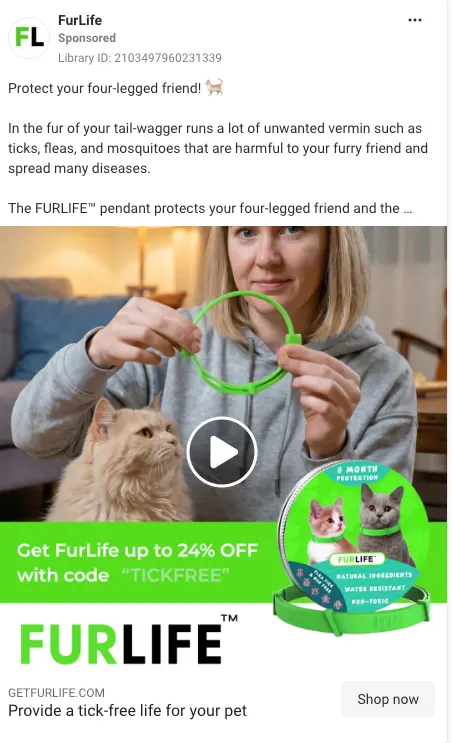
Source: Meta Ad Library, Ad ID: 1386162350119695
2. PAS (Problem, Agitate, Solution)
PAS hits a specific pain point, amplifies the frustration, and introduces your product as the natural solution. The secret weapon is the "ladder to the core desire": go past the surface annoyance and agitate how the problem impacts your everyday life.
- Problem: Identify a specific daily annoyance.
- Agitate: Show how that minor problem creates deeper frustration or wasted effort.
- Solution: Present your product as the fast relief.
Here's how I'd write Facebook ad copy for time-tracking software using this framework:
Still logging client hours on manual spreadsheets?
Every unbilled minute eats into your profit margins. Worse, you spend your Sunday nights auditing column entries instead of resting for the week ahead.
AutoTrack captures every client activity automatically. Start your free trial and reclaim your weekends.
Artkive applies this framework here.
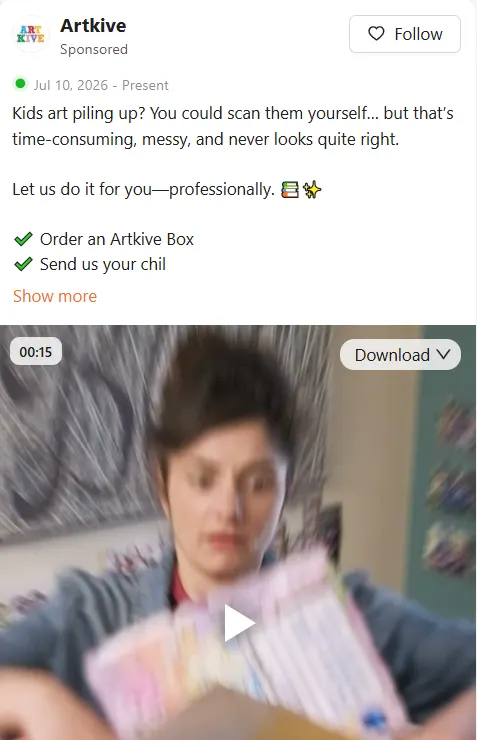
Source: Meta Ad Library, Ad ID: 1343785317253669
3. Before-After-Bridge (BAB)
BAB is the ideal structure for lifestyle, wellness, and aspirational consumer products. It relies on stark contrast by showing where you sit right now, painting your ideal outcome, and positioning the product as the bridge between both states.
- Before: Describe your current, sub-optimal reality.
- After: Paint a vivid picture of the desired end state.
- Bridge: Introduce your product as the single vehicle that takes you there.
Here's copy I wrote (for cold brew coffee concentrate) using the BAB framework:
You wait in a 15-minute drive-thru line every morning just to pay $7 for watered-down iced coffee.
Picture pouring rich, smooth, cafe-quality cold brew right in your kitchen, in less than 10 seconds, for under a dollar a glass.
BrewDrop concentrate turns your tap water into premium cold brew instantly. Grab your starter pack now.
Number Artist runs this same structure here:
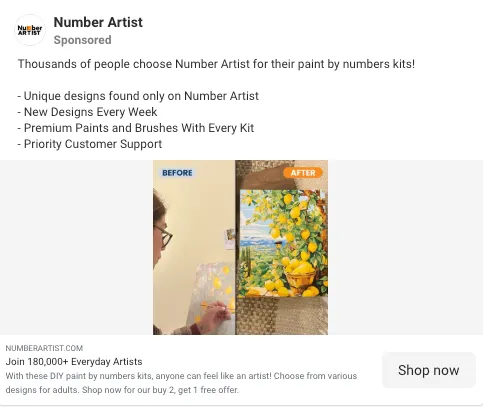
Source: Meta Ad Library, Ad ID: 781758964826365
4. Hook-Body-Stinger
Hook-Body-Stinger is built for mobile feed behavior. It accounts for truncated primary text by packing the main hook upfront, delivering fast-paced value in the body, and closing with a punchy call to action.
- Hook: A punchy, 1-sentence opening under 125 characters that halts scrolling.
- Body: 2-3 quick sentences explaining the core offer or top benefits.
- Stinger: A direct, low-friction close that pushes the click.
A typical Hook-Body-Stinger copy goes like this:
Ditch the 7-step skincare routine.
Our multi-active night serum combines retinol, niacinamide, and hyaluronic acid into a single pump. You get hydrated, even-toned skin without stacking multiple bottles.
Get 20% off your first bottle today.
5. Social proof plus CTA stack
This framework bypasses long educational copy and leads entirely with third-party credibility. It works best when your brand has massive review counts, press mentions, or high-profile endorsements.
- Proof: Lead with hard numbers, star ratings, or direct customer quotes.
- Validation: Briefly state what makes those customers love you.
- CTA Stack: Close immediately with a direct buying prompt.
This is how I'd write a travel backpack copy with this framework:
“The last carry-on bag you will ever buy." (press quote)
Over 45,000 travelers rate the FlightPack 5 stars for its quick-access laptop pocket, waterproof shell, and expandable packing capacity.
Order today and get free express shipping on all orders.
This ad by Flo Mattress uses this framework.
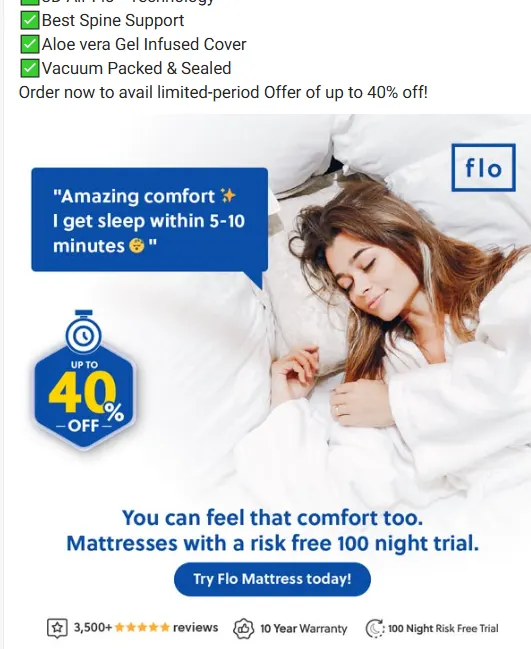
Source: Meta Ad Library, Ad ID: 944806490627932
Match your framework to the funnel stage
A common mistake in Facebook advertising is running the right ad copy at the wrong time. Match your copy framework to your audience's level of awareness to avoid pitching features to someone who doesn't even recognize their problem yet.
Eugene Schwartz's classic 5 Stages of Awareness framework maps directly onto standard top-of-funnel (TOF), middle-of-funnel (MOF), and bottom-of-funnel (BOF) ad campaign structures.
| Funnel Stage | Frameworks |
|---|---|
| TOF: Unaware & Problem-Aware | PAS/AIDA |
| MOF: Solution-Aware & Product-Aware | Before-After-Bridge/Social Proof |
| BOF: Most Aware | Social Proof and CTA Stack/Direct Offer |
Top of Funnel (TOF): Unaware and Problem-Aware
At this stage, users don't know your brand exists, and many don't even realize there's a solution for their problem. Pitching product specs or limited-time discounts here usually fails because the user lacks context.
- Goal: Capture attention and build initial awareness around an active pain point.
- Best Frameworks: PAS or AIDA.
- Copy Approach: Lead with the daily frustration or an undeniable stat. Use PAS to agitate the hassle before introducing your brand as the fix, or use AIDA to draw them from general curiosity into learning more.
Middle of Funnel (MOF): Solution-Aware and Product-Aware
These users know they have a problem and are actively comparing potential solutions. They recognize your product category or may have visited your site once, but they haven't decided if your specific offer outperforms competitors.
- Goal: Build trust, overcome objections, and differentiate your product.
- Best Frameworks: Before-After-Bridge (BAB) or Social Proof.
- Copy Approach: Highlight the transformation using BAB to paint a clear picture of their life after using your product. Introduce customer testimonials, press quotes, or expert reviews to validate your performance claims over rivals.
Bottom of Funnel (BOF): Most Aware
Prospects at the bottom of your funnel know your brand, understand your offer, and sit on the edge of buying. Friction here comes from hesitation around price, timing, or trust.
- Goal: Trigger immediate action and close the conversion.
- Best Frameworks: Social Proof plus CTA Stack or Direct Offer / Hook-Body-Stinger.
- Copy Approach: Remove purchasing risk. Lead with massive star ratings, money-back guarantees, free shipping thresholds, or specific discount codes. Keep the copy short, punchy, and centered around a single clear call to action.
Writing copy to test, not to "win"
Writing Facebook ad copy used to mean crafting one master version, polishing every word, and pushing the campaign live.
Modern Meta performance works differently. With Advantage+ creative and dynamic testing features driving media buying, pushing a single copy variation forces the algorithm to guess who will respond.
Write structured sets of distinct copy angles and let the account tell you which one wins. Atria's Raya can generate several of these angles for you in one pass, so you're testing variations.
This is where creative velocity matters more than any single polished ad, since the faster you can produce performance creative worth testing, the faster Meta's system finds a winner.
| Test Type | Example |
|---|---|
| Bad Test (Wording Tweaks) | Variant A: "Get 20% off our comfortable ergonomic chairs." Variant B: "Save 20% on our comfortable ergonomic chairs." |
| Good Test (Angle Changes) | Angle 1 (Pain-focused): Lower back pain after sitting Angle 2 (Aspirational): Designing a dream home office Angle 3 (Social Proof): Rated #1 chair by 10,000 work-from-home pros |
Hook angles over wording tweaks
Testing "Get 20% off" against "Save 20%" yields little insight. Minor synonym changes don't alter the core motivation behind a user's click.
True copy testing relies on changing the underlying angle:
- Pain vs. gain: Compare a hook highlighting lower back pain with one highlighting peak daily focus.
- Us vs. them: Compare a hook challenging traditional office chairs against a hook comparing your price point to custom ergonomic builds.
- Social proof vs. direct offer: Compare a customer review headline against a flat percentage discount.
Isolate one primary variable per test (usually the opening 125-character hook) while keeping the body copy and CTA consistent across variants.
How many variations do you need?
Start with 2 to 3 variants under $100/day and scale to 5 to 10 above $500/day. Meta doesn't publish an official budget-to-variant mapping, so treat the split below as a practical starting point and don't swamp Meta's Andromeda-powered delivery system with more creative volume than your budget can feed.
There's no official Meta-published or industry-standard mapping between budget and variant count, but as a practical starting framework, here's a reasonable split based on campaign budget:
| Daily Ad Set Budget | Number of Copy Angles | Primary Focus |
|---|---|---|
| Under $100/day | 2 to 3 variants | Test 1 distinct hook angle against a control |
| $100 to $500/day | 3 to 5 variants | Test 3 distinct hook angles across 2 body frameworks |
| $500+/day | 5 to 10 variants | Run dedicated dynamic creative tests (DCT) continuously |
Traceable naming conventions
If you don't name your ad copy variations systematically, analyzing performance data later becomes a nightmare. Keep your ad account's naming setup clean so your analytics stay readable.
Structure your primary text ad name field using this format:
[Angle]_[Framework]_[Hook Summary]_[Date]
- Example 1: PAIN_PAS_BackPainAt3PM_2026Q3
- Example 2: PROOF_SocialProofStack_10kFiveStarReviews_2026Q3
- Example 3: TRANSFORM_BAB_SayGoodbyeToDriveThru_2026Q3
This structure lets you filter campaign reports by angle or framework, and shows you whether your account scales best on pain-agitation, third-party proof, or aspirational transformations.
Why Facebook rejects ad copy (and how to avoid it)
Most copy-level rejections come down to three things: implying a personal attribute, promising a specific result, or overstating what the product does.
Each one stalls campaign momentum and risks flagging your account with Meta's automated moderation. Here's how to write around them.
1. Personal attribute language
Meta strictly prohibits copy that asserts or implies a user's personal attributes like health conditions, financial status, age, race, or sexual orientation.
Using "you" or "your" to call out a personal trait often triggers an instant rejection. Reframe your copy to focus on the product, brand experience, or general benefits instead of pointing fingers at the reader.
- Non-compliant: "Are you struggling with hair loss?"
- Non-compliant: "Tired of drowning in credit card debt?"
- Compliant: "Discover a daily routine designed to support thicker, fuller-looking hair."
- Compliant: "Our debt consolidation tool helps simplify your monthly payments into one fixed rate."
2. Unrealistic claims and timeframes
Meta cracks down hard on absolute health, financial, or performance claims, especially those promising specific results within a set timeframe.
Avoid writing copy that guarantees outcomes. Focus on real user experiences, process improvements, or verified product features instead.
- Non-compliant: "Lose 15 pounds in 10 days with this keto smoothie!"
- Non-compliant: "Make $10,000 a month working from home!"
- Compliant: "Formulated to support your daily wellness and weight management goals."
- Compliant: "Learn the core marketing strategies top freelancers use to grow their client base."
3. False-positive triggers: before/after and urgency phrasing
Certain words and phrases act as automatic red flags for Meta's automated compliance bots, even when your core message is harmless:
- Sensory / body focus: Words like "fat," "weight loss," "cure," or "wrinkles" frequently trigger health policy rejections. Focus on how users feel or describe the product texture instead.
- Fake urgency: Aggressive clickbait phrasing like "ACT NOW BEFORE THIS IS DELETED" or "SECRET HACK THEY DON'T WANT YOU TO KNOW" often flags your ad for low-quality or deceptive content. Stick to standard, honest incentives like "Limited inventory available" or "Sale ends Sunday."
Common Facebook ad copywriting mistakes
Even experienced media buyers and copywriters stumble into habits that hurt ad performance. Spotting these common traps early keeps your ad spend focused on testing genuine creative angles. Atria's Radar flags most of these automatically, but it helps to know what it's looking for.
- Writing for desktop preview instead of the mobile crop: The ad editor's desktop preview shows your full image, but most traffic sees a cropped, vertical version in-feed. Always check the mobile preview before publishing, or your headline or product shot may get cut off entirely.
- Killing a variant before it clears the learning phase: Pausing an underperforming ad within the first 3 to 7 days interrupts Meta's delivery algorithm before it has enough data to judge fairly. Let each variant exit the learning phase before deciding whether to cut it.
- Splitting intent with multiple CTAs: Asking users to "Read our blog post, follow us on Instagram, and buy now" creates decision paralysis. Give users a single clear action step per ad unit.
- Promising one thing in the ad and delivering another on the landing page: If your copy leads with a specific discount, product, or offer that isn't immediately visible on the landing page, you lose the trust you just built and tank your conversion rate, even if the ad itself performs well.
How to tell which part of your ad copy is working
When an ad converts, writing another winner requires knowing why it worked. When an ad fails, fix the exact element underperforming. There’s no need to scrap the entire asset. Creative analytics helps you connect the metric back to the specific line of copy that moved it.
Isolating performance at the copy level depends on three primary performance metrics:
| Metric | Evaluates | Goal |
|---|---|---|
| Hook Rate (3-Sec Video Views/Impressions) | The opening 125 characters / first 3 seconds | Target 30%+ |
| Hold Rate (ThruPlays/3-Sec Video Views) | Body copy structure, pacing, and core message | ~20-50%+ (varies by audience temperature) |
| Outbound CTR (Outbound Clicks/Impressions) | Offer strength and Call to Action (CTA) | ~1-2%+ (unofficial industry estimate) |
Hook Rate isn't a Meta-native metric (it's a ratio marketers calculate), and Meta doesn't publish official benchmarks for Hold Rate or Outbound CTR either. Treat all three ranges as directional and weigh your own account's history more heavily.
- Hook Rate (3-second video views ÷ impressions): This measures how effectively your initial opening line captures attention in the feed. If your Hook Rate is below 30%, your opening 125 characters or initial visual hook failed to stop the scroll. Rework your opening before touching the body copy.
- Hold Rate (thruplays ÷ 3-second video views): This measures how many users stay engaged after the hook. If your Hook Rate is strong but your Hold Rate plummets, your body copy failed to hold their interest or deliver on the opening hook's promise.
- Outbound Click-Through Rate (outbound CTR): This is the percentage of viewers who click through to your landing page. If users read your entire ad but don't click, your Call to Action is weak, hidden below a truncation line, or the core offer lacks tension.
Why isolate variables?
If you change your hook, rewrite your body copy, and swap the CTA button all in one edit, analyzing performance data becomes impossible.
Once a clear winning hook emerges, test three body variations beneath that winning hook to optimize the asset systematically.
Atria's Radar feature brings creative intelligence to ad grading, automating part of the Facebook ad copywriting process. It grades your live ads, tells you specifically what to fix, and sends a proactive alert the moment a creative starts declining, so you catch drop-off before it eats into your ROAS.
Raya writes the angle variations, and Radar grades them as they run and flags what to fix before drop-off eats your ROAS. Start for free, 1,000 free credits, no credit card required.
Frequently Asked Questions
What is the Best Framework for Facebook Ad Copy?
The best Facebook ad copywriting framework depends on your audience's awareness level. Use PAS (Problem-Agitate-Solution) or AIDA for cold audiences who don't know your brand yet.
For retargeting or warm traffic, shift to Before-After-Bridge or a Social Proof stack to overcome friction and close the sale.
How Long Should Facebook Ad Copy Be?
Facebook ad copy can run from one short line to several paragraphs, there's no fixed length. Short copy (under 280 characters) works well for direct offers and retargeting, while long-form copy works for complex B2B products or cold DTC audiences.
Why Did Facebook Reject My Ad Copy?
Meta most commonly rejects copy for using personal attribute language. Ads also get flagged for unrealistic claims, guaranteed timeframes, or false-positive trigger words tied to sensitive health and wellness categories.
How Many Copy Variations Should I Test at Once?
Test 2 to 3 variations under $100/day and up to 5 to 10 above $500/day. Past that, you risk diluting spend before Meta finds a clear signal.
Should My Headline Repeat My Primary Text?
No. Repeating your headline inside your primary text or description wastes limited real estate. Treat each component separately.
Use primary text to deliver the hook and story, the headline to state the primary benefit or offer, and the description to add reassurance like ratings or shipping terms.