
You build clean visuals, write punchy copy, and target the right audiences, but your Cost Per Acquisition stays stubborn.
When prospects scroll past a brand they don't know, their main focus is avoiding a bad purchase. Using social proof in Facebook ads bridges that trust gap.
This guide covers 6 social proof Facebook ad formats working on Meta now, how to build proof from zero, and how to scale winning ads without losing accumulated engagement.
What social proof means in a Facebook ad
Most media buyers treat social proof like a popularity contest where they chase likes, comments, or a busy-looking thread, but that’s the wrong way to look at it.
Social proof is a risk-reduction signal. A stranger scrolling past your ad is wondering whether you'll rip them off.
Likes and comments only prove your ad got attention. Social proof shows people paid money, used your product, and liked the result enough to say so in public.
On Meta, that proof shows up as:
- A verified buyer’s quote placed over an unboxing video.
- A support screenshot showing a problem getting solved.
- A 4.8-star rating shown next to a concrete headline claim ("Cuts our client's CPA 30% in 14 days").
- A comment section full of buyers talking to each other.
When you change your target from “get more likes” to “kill more doubt,” your creative strategy changes with it. You start building ads that turn someone else's trust into your sale.
Why it works
Social proof works because buying from an unfamiliar Facebook ad feels risky.
Your prospects don't know your supply chain, your quality, or your return policy. Every impression forces a fast gut check: worth the risk, or a scam?
Social proof answers that gut check with three mental shortcuts:
- Bandwagon effect: hundreds of happy buyers make new prospects assume it works too.
- Uncertainty reduction: seeing real customers use the product kills doubt about performance.
- Implicit trust transfer: a stranger's raw review outweighs your best sales copy, every time.
You don't need a famous brand to pull this off. Real proof, placed in front of the hesitation, does the job.
6 social proof ad formats working on Meta right now
Winning on Meta today takes specific, visual proof that earns trust in under two seconds. Here are six formats doing exactly that, right now:
Testimonial statics and carousels
Static images with text overlays are still one of the cheapest, highest-converting formats on Meta.
Pair a sharp product shot with a specific customer outcome.
- Single-image statics: a five-star graphic, a quote that kills a real objection, one strong product visual.
- Carousels: one story or benefit per card. Card one shows the main transformation, and later cards handle specific features through individual quotes.
Keep text legible on mobile. High-contrast cards with dark text on light backgrounds work well.
UGC video ads
UGC videos beat studio commercials because they look like the feed.
A high-performing UGC ad follows one structure:
- The Hook (0-3s): a real customer holding the product, showing a before-and-after, or naming the pain point.
- The Body (3-15s): quick cuts of the customer using it in everyday settings.
- The Proof (15-20s): a visual result, plus native text captions.
- The Call to Action (20-30s): where to buy, what the offer is.
Don't over-edit these clips. Raw smartphone footage builds more trust than a scripted talent reel ever will.
Review-mined hook ads
Your review inbox is already full of your best ad copy, waiting to be used.
Review-mined hook ads pull a direct quote from a real review and turn it into the visual hook. A prospect stops scrolling when they see their exact frustration mirrored back at them.
Scan your 4- and 5-star reviews for recurring phrases, especially ones that mention:
- Surprising results: “I thought this was a gimmick until...”
- Direct comparisons: “Threw away my old brand after day one...”
- Specific problem solving: “Finally fixed my morning back pain...”
Drop the exact quote in large, bold text across the top of your image or video.
Comment-overlay and reply ads
Skeptical comments on your ads are free ad copy.
Comment-overlay ads take a real comment, or a common objection from your post threads, and put it directly on top of the video.
- The format: screenshot a real comment (say, “Does this work on sensitive skin?”) at the top of the frame.
- The execution: the video answers it immediately, with a demo or a founder on camera.
This mimics a real conversation, pulls the eye straight to the text, and kills the objection before a prospect scrolls past.
An example is this ad by Primary Goods:

Source: Meta Ad Library. Ad ID: 304612529380311
DM-story hook ads
DMs feel personal. Borrow the format, and you borrow the trust.
A DM-story ad recreates a real customer conversation from Instagram DMs or iMessage.
- Visual layout: frame the whole ad as a phone screen showing a chat between a customer and your brand.
- The narrative: the customer sends an unprompted compliment or result, and your brand replies with thanks or a quick tip.
- Why it converts: people read a text thread instantly, and it feels like a private exchange.
Keep the text legible on small screens, and stick to standard message bubbles so it still reads like a real chat.
Creator and influencer endorsement ads
Creator ads sit between influencer marketing and performance advertising, and they take the best of both.
Instead of waiting for a creator to post on their own page, run their content through your own ad account with Meta Partnership Ads.
- Whitelisting / Partnership Ads: the ad shows as coming from the creator's handle, but you control the targeting.
- Authority angle: pick creators with real domain authority, a dermatologist for skincare, a certified trainer for fitness gear.
- Unboxing and review: let the creator explain why they'd recommend it, in their own words, focused on utility over hype.
When you combine a creator's built-in trust with your own targeting, you get an ad asset that converts better than either one alone.
A good example is this Instagram Reels ad by IM8 Health, featuring running coach Jess McDowell:
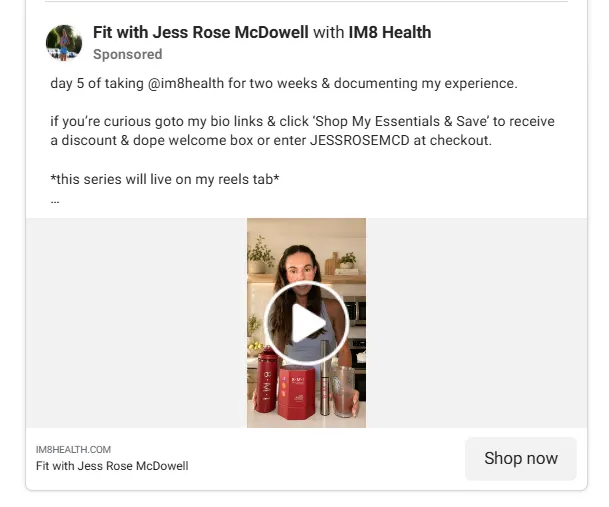 Source: Meta Ad Library. Ad ID: 288782561794336
How to get social proof when you don't have any yet
A new ad account or a fresh product launch means zero reviews, an empty comment section, and no customer videos.
To fix that, you need a system for pulling proof out of your earliest customers.
Mine reviews and support conversations for language
No public reviews yet? Check your private customer conversations instead.
Your support inbox, live chat logs, and post-purchase surveys are full of the exact language buyers use to describe a problem, and the relief of solving it.
- Support tickets: messages where a customer thanks your team for fixing something.
- Email replies: responses to your welcome sequence or order confirmation.
- Survey answers: open-ended answers on why someone picked you over a competitor.
Lift those exact sentences. Drop them straight into a static template or use them as a video hook.
Wayfair mined 5-star reviews and displays the number in this ad:

Source: Meta Ad Library. Ad ID: 1028844173091643
Run a structured UGC or testimonial ask
Waiting for customers to send video reviews on their own rarely works. Give them a reason and a five-minute process instead.
Set up an automated email or SMS sequence, 7 to 14 days after delivery:
- Offer a direct incentive: a $20 credit or a free product for a short, honest video.
- Give clear direction: tell them what to film. Show the product, name their biggest hesitation before buying, and share the result.
- Remove friction: give them a direct upload link, with no account required, that works straight from their phone.
A pipeline like this builds a steady library of usable assets every month, instead of chasing down content one customer at a time. Iterate faster on what comes in with the best AI ad generator
Nutrition Geeks uses UGC in this ad:
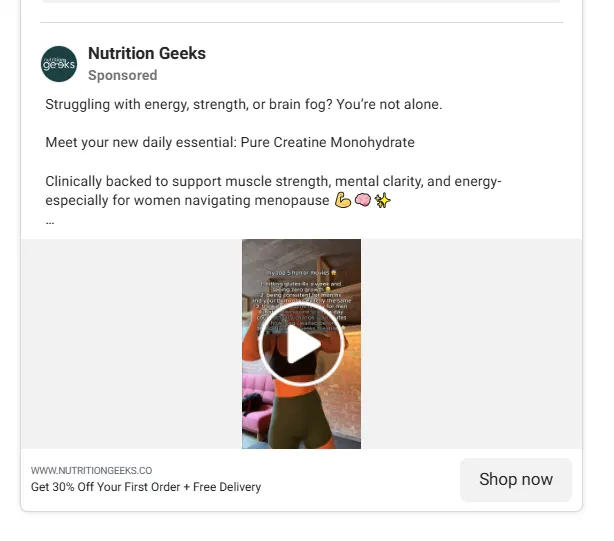
Source: Meta Ad Library. Ad ID: 1057927263317354
Turn comments and DMs into new ad angles
Your social channels are already full of ad creative sitting in your comments and DMs.
When a follower compliments you in a comment or a DM, ask permission to screenshot it:
- Screenshot the message cleanly.
- Blur any personal details.
- Drop it over a simple product video or lifestyle photo.
These small moments build real social proof fast, before you've even launched a formal campaign.
This ad by Flo Mattress is a good example:
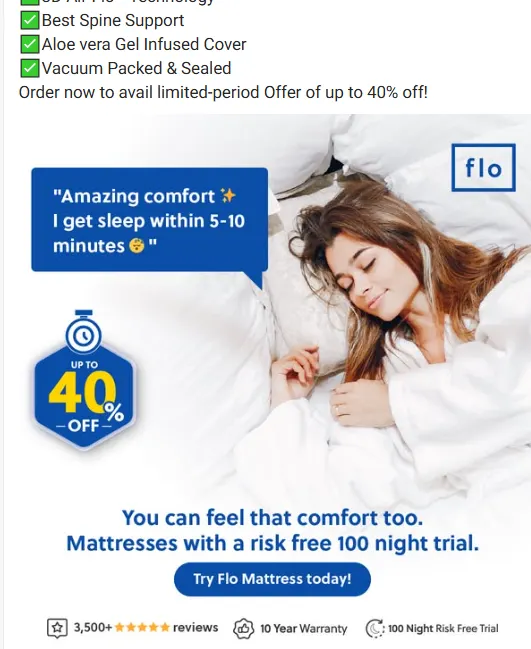
Source: Meta Ad Library. Ad ID: 944806490627932
How to scale a winning ad without losing its social proof
You build an ad, rack up hundreds of likes, collect dozens of glowing comments. Then you scale it, and watch all that engagement vanish.
That's because Meta's standard workflow resets your social proof to zero.
What happens when you duplicate an ad the normal way
When you duplicate an ad inside Meta Ads Manager using standard methods, Meta creates a brand-new post behind the scenes.
Your new ad gets a fresh internal tracking ID, and all accumulated likes, shares, and customer comments stay tied to the original post. Your scaled ad launches with zero engagement, which forces you to rebuild audience trust from scratch.
Finding and reusing a Post ID
Reusing your Post ID keeps all accumulated social proof attached to your ad asset, no matter how many campaigns or ad sets you run it in.
Here's how to preserve it:
- Go to Ads Manager and select the winning ad.
- Open the ad's Preview, choose Facebook Post with Comments, then grab the Post ID from your Page's Published Posts view (the ID column) rather than the preview URL. Meta warns URL-copied IDs often fail.
- Copy the numerical string at the end of the URL. That's your Post ID.
- Create your new ad set or campaign.
- At the ad level, switch the dropdown from Ad setup to Use Existing Post.
- Click Enter Post ID, paste your code, and submit.
Your new ad now shows every like, comment, and share from the original.
When to leave it alone
Reusing a Post ID isn't always the right call. Skip it when:
- The comments turn negative: customer service issues or shipping delays in the thread mean you'd be scaling toxic engagement.
- You're testing a new audience: heavy engagement from one demographic can confuse Meta's delivery algorithm when you switch personas.
- You're changing the message: a new headline or offer needs a new post. Don't mix conflicting messages on an old one.
Turning social proof into a repeatable creative pipeline
Performance always drops eventually. Scaling spend month after month takes a system, one that turns customer trust into a steady supply of fresh creative.
Why one-off social proof ads plateau
Even your strongest testimonial ad will decline. Audiences saturate, delivery costs climb, and the same customer quote stops landing.
Stacking more engagement onto an old ad with a Post ID won't fix that. Social proof doesn't stop people from tuning out a visual they've seen ten times.
Once the hook wears out, performance drops no matter how many likes sit under the post. Learn how to catch that earlier with our guide to Meta creative fatigue diagnosis and fixes.
Building a testing loop around proof-driven creative
Build a continuous testing loop around proof instead of a one-off asset:
- Extract new proof weekly: fresh reviews, support praise, survey answers, every week.
- Isolate one variable: pair a single validated quote with three visuals: a static shot, an unboxing clip, a founder video.
- Run micro-tests: small-budget ad sets to find the highest-CTR combination fast.
- Scale the winner: move it into your main campaigns with the Post ID method to keep the proof intact.
This keeps your account stocked with validated concepts. There’s more on structuring your account for this in the future of creative strategy.
Watching for fatigue and refreshing before it drops
Watch three numbers to catch decay before your CPA spikes:
- Frequency: most performance teams treat a weekly frequency past 2.5 to 3.0 on cold audiences as the point where fatigue sets in.
- Outbound CTR: a steady drop means the audience is tuning out your hook.
- CPM: a steady climb usually means falling relevance and engagement.
When these move, don't ditch the social proof angle. Swap the visual or the hook, keep the core customer message. The best AI ad tools for creative analysis spot the pattern faster than a manual scroll through your account.
This is how top brands hit real creative velocity, with a steady flow of validated winning formulas.
What to track
Skip the vanity metrics and track the numbers that move revenue:
- Outbound CTR lift: compare social proof ads against your plain product-only baseline. Industry ranges for expected lift vary too widely to trust, so use your own baseline as the benchmark, and watch for a lift that holds.
- CPA and ROAS: less hesitation means lower acquisition cost and higher return, if the proof is working.
- Engagement-to-conversion ratio: are the people engaging with your comments buying? High engagement with no sales means your proof and your landing page are telling two different stories.
Staying compliant
Real proof comes with real legal responsibility. Here are four rules to keep in mind:
- Get explicit consent: always get written permission before using a customer's name, image, video, or social media post in a paid ad campaign.
- Avoid exaggerated claims: health, financial, or performance claims need to represent typical customer results. If a result isn't typical, disclose what the typical result is, with real numbers. A vague line like “results may vary” no longer satisfies FTC requirements on its own.
- Keep reviews unaltered: don't edit a customer's words in a way that changes their meaning. Fixing a typo might be fine, changing their sentiment isn't.
- Disclose paid partnerships: clear disclosures are mandatory when running creator content or incentivized reviews. Use Meta's Paid Partnership labels as a starting point, and pair them with clear on-screen and verbal disclosures to meet full FTC guidance.
Common mistakes that kill social proof in Facebook ads
Here are four ways to waste good proof:
- Relying on outdated statistics: old research and stale numbers cost you credibility. Keep your proof current.
- Scaling toxic comment sections: reusing a Post ID with unresolved complaints in the thread scales the complaints, not the trust.
- Sticking to one format: static testimonial cards alone leave reach on the table. Mix in UGC, comment overlays, and creator content.
- Editing an ad linked to a Post ID: any change to the text or creative resets the ID, and every like and comment resets with it.
Every mistake above can be traced back to managing social proof by gut feel in place of real reporting. The teams that treat it as a discipline see it show up in their numbers.
SelfMade, a performance creative agency, improved ROAS by 33%, cut CAC by 29%, and reduced their iteration cycle from 2-3 weeks down to 2-4 days using Atria's creative reporting.
CEO, Will Sartorius, says, “Atria has gotten rid of the guesswork and forces data-driven decisions across the whole team. Our creative reporting has gotten so good at this point that our customers couldn't live without it.”
Want results like that in your own account? Try Atria today for free.
Frequently asked questions
Does reusing a Post ID help bypass the Meta Learning Phase?
No, reusing a Post ID doesn't bypass Meta's Learning Phase. But the accumulated engagement often drives higher initial CTR, helping the ad exit the phase faster
How much social proof do I need before running ads?
You don't need thousands of reviews to launch. A single compelling quote, a detailed customer email, or one authentic unboxing video is enough to build a high-converting ad concept. Focus on the quality and specificity of the claim rather than total volume.
Can I use organic social media comments in my Facebook ads?
Yes, you can use organic social media comments in your Facebook ads, but you must secure permission from the user first. Send a quick direct message asking for consent to feature their comment in your ad campaign before publishing the creative.
Does social proof work for cold audiences, or only retargeting?
Social proof works best on cold audiences, since that's where buyer hesitation is highest. Someone who already knows your brand needs less convincing. A stranger scrolling past you for the first time needs the reassurance most.