
The best dynamic creative optimization platform depends on your ad volume, your data sources, and how much control you want over what gets swapped in each ad.
I put dozens of DCO tools through pricing, feature, and Meta integration checks to land on the 9 platforms worth your time in 2026.
This guide breaks down what each platform does well, where it falls short, and how to pick the right fit for your ad account.
9 best dynamic creative optimization platforms: TL;DR
- Atria: Best for performance marketers who want ad creative decisions backed by real spend data and a closed research-to-launch loop on Meta
- Smartly: Best for enterprise teams managing large-scale, multi-market creative versioning across Meta's full ad surface
- Celtra: Best for brands running high-volume dynamic product ad campaigns that need frequent template and catalog updates
- Madgicx: Best for lean e-commerce teams that want AI-driven budget and creative automation layered directly on their Meta account
- Hunch: Best for agencies and multi-market brands localizing and scaling creative variants across Meta, Snapchat, and TikTok
- The Brief (formerly Creatopy): Best for non-designers who need a template-driven editor for building and resizing ad variations quickly
- Storyteq: Best for global brand teams that need centralized governance over video and display creative across many markets
- AdCreative.ai: Best for solo marketers and small teams generating high volumes of ad creative and copy from a single brand profile
- ROI Hunter: Best for e-commerce retailers connecting product-level performance data to their Meta and Google ad creative
What is dynamic creative optimization (DCO)?
Dynamic creative optimization (DCO) is advertising technology that builds personalized ad variations automatically from one set of creative assets.
The platform pulls signals like audience behavior, location, and past ad performance. Then, it swaps in the image, headline, or call to action that fits each viewer.
I've tested enough of these platforms to say the value is in how fast a platform gets from "this creative is fatiguing" to "here's the replacement" without a designer rebuilding the ad from scratch.
A DCO platform can generate hundreds of ad versions from a single campaign brief. An e-commerce brand can show one shopper the exact product they browsed last week, while a different shopper sees another item from the same catalog.
How does DCO work?
DCO works by combining a data feed, a creative template, and a decision engine that assembles each ad in real time.
3 pieces make this possible:
- Data feed: Holds the dynamic information, like product names, prices, images, or copy variations
- Creative template: The visual shell with placeholders for those dynamic elements
- Decision engine: Checks each viewer's data against the campaign's rules and picks the best combination for them
When a user loads a page or scrolls past an ad slot, the decision engine picks the best combination of image, headline, and call to action for that specific viewer. The final ad gets assembled and served in the same moment, often in milliseconds.
Once the ad runs, the platform tracks how it performed and feeds that back into future decisions. Over time, the system measures which combinations work for which audiences, and it adjusts accordingly.
I've watched this process happen behind the scenes on a few of these platforms, and the part that surprised me most was how much the output depends on the quality of the data feed going in. A platform with weak product data will still assemble an ad fast, but may not convert.
Why does DCO matter?
DCO matters because it turns one campaign into hundreds of tailored versions, each built for a different viewer. It's also become more important since Meta's Andromeda update started rewarding accounts that feed it diverse creative instead of the same handful of ads on repeat.
Dynamic creative optimization has moved from an optional add-on to a core part of the toolkit. A 2024 Digiday and Clinch survey found 99% of agencies consider DCO significant to their strategy, with 45% calling it 'very significant.'
Beyond relevance, DCO solves a production problem. Building 50 versions of an ad by hand eats up a creative team's week. A DCO platform automates that work, so a team can focus on the core concept without having to manually resize and rewrite each variant.
Here are a few concrete benefits worth naming:
- Higher relevance: Ads that reflect a viewer's location, browsing history, or interests can outperform static, one-size-fits-all creative.
- Faster production: Teams stop manually building every size and variation, since the platform assembles them automatically, which is what moves creative velocity when a team's output is the bottleneck.
- Ongoing testing: Every impression becomes a data point on top of the intended ad spend, without a separate A/B test to run.
- Better budget efficiency: Ad spend can shift toward the combinations that convert, which cuts waste on underperforming creative.
The real win, in my experience, is what a team learns from watching ad versions perform against each other.
Every impression becomes a small test on which headline lands, which image gets a click, which offer converts. That data can inform decisions well beyond the DCO campaign itself.
How I tested these DCO platforms
I tested each tool against 4 criteria: automated creative production, campaign launch and management, AI-assisted decisioning, and reporting depth. I also checked how well each one connected to Meta specifically, since that's where most performance marketers run the bulk of their ad spend.
I logged into demo accounts where I could, built sample dynamic ad sets, and compared how much manual work each platform still required against what it automated.
9 best dynamic creative optimization platforms: quick comparison
| Tool | Best for | Starting price (billed annually) | Strengths |
|---|---|---|---|
| Atria | Data-backed Meta creative strategy | $129/month | AI trained on $9B+ in real ad spend, a research-to-launch workflow, and native Slack integration |
| Smartly | Enterprise creative versioning at scale | Custom pricing | Native Meta feature support, spreadsheet automation, and blended reporting |
| Celtra | Frequent multi-platform catalog refreshes | Custom pricing | Hourly catalog refreshes, multi-platform DPA, and template automation |
| Madgicx | AI budget and creative optimization | $32/month | AI budget optimization, automated creative generation, and a unified dashboard |
| Hunch | Localized creative across multiple platforms | Custom pricing | Meta, Snapchat, and TikTok support, built-in localization, and feed-driven variation |
| The Brief (formerly Creatopy) | Template-based ads without a designer | $29/month | Non-designer editor, brand governance, and AI agents end to end |
| Storyteq | Centralized creative governance | Custom pricing | Centralized asset management, creative automation, and localization controls |
| AdCreative.ai | Fast, low-cost AI ad creative | $20/month | AI-generated creative, performance scoring, and automated photoshoots |
| ROI Hunter | Product data driving ad creative | Custom pricing | Product-level data, catalog management, and cross-channel creative links |
*Pricing correct as of September 2026. Confirm with vendor.
1. Atria: Best for data-backed Meta creative strategy
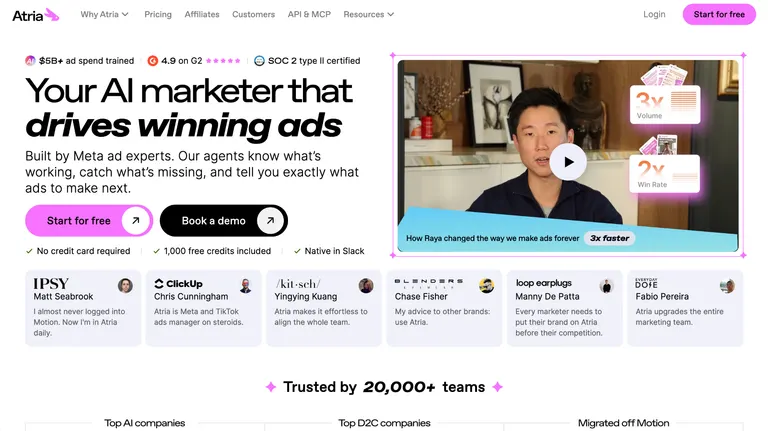
Atria is a creative intelligence platform built around Raya, an AI creative strategist trained on $9B+ of Meta ad spend data, as well as a research-to-launch workflow and native Slack integration.
We designed Atria to close the gap between "your numbers moved" and "here's the specific creative to build next," tying every suggestion back to what's actually converting in your account and sharpening your winning formulas as more campaigns run.
Inside Atria, a dip in performance comes with a graded reason attached.
Atria stays focused on Meta and TikTok first. Atria can still inform insights across other channels, but the ad library and direct integrations are focused on the first two platforms.
Atria starts at $129 per month, billed annually.
2. Smartly: Best for enterprise creative versioning at scale
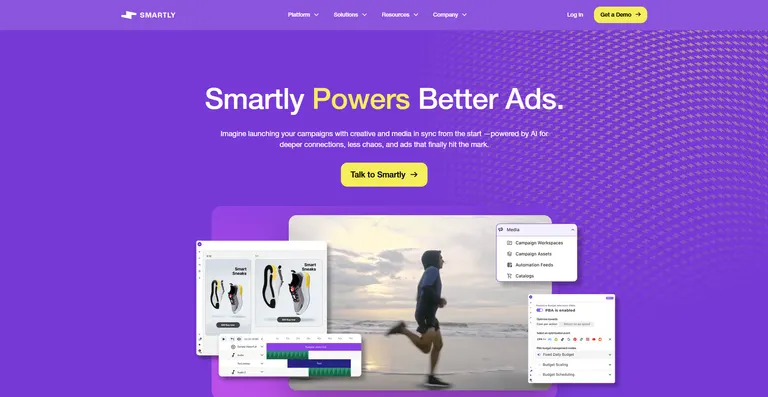
Smartly is an enterprise creative automation platform built to turn one campaign concept into hundreds of versioned ad variants across markets.
During a guided demo, I watched a modest catalog get managed through a linked Google Sheet with budget, targeting, and creative all updating from one source. The native Meta feature support looked deep, covering formats I've had to configure manually elsewhere.
In the time I spent with it, finding where a specific automation setting lived inside all the menu options looked like it would take a while to learn, even with someone walking through it.
Smartly offers custom pricing.
3. Celtra: Best for frequent multi-platform catalog refreshes
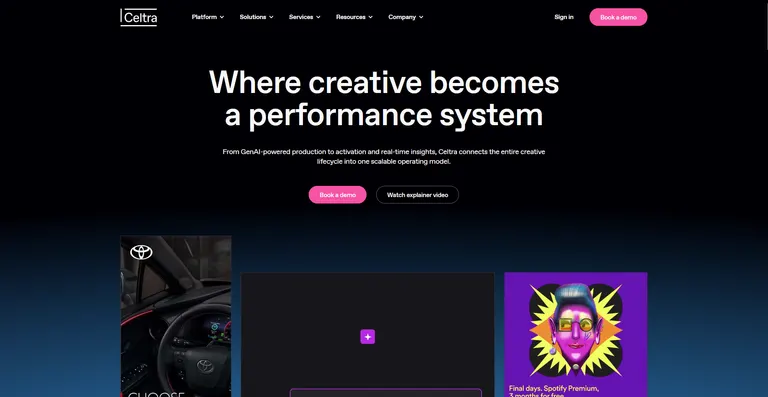
Celtra is a creative automation platform that keeps dynamic product ads current across Meta, TikTok, Snapchat, Pinterest, and X with hourly catalog syncs.
While I was watching the demo, I saw a template refresh a catalog across 5 platforms automatically, cutting down the hours normally spent updating each one by hand. Celtra’s mobile rich-media roots showed in how well the walkthrough demonstrated video and interactive formats.
Based on the explainer materials alone, it's hard to say how template editing holds up with several open at once, though a few reviews mention lag under that condition.
Celtra offers custom pricing.
4. Madgicx: Best for AI budget and creative optimization
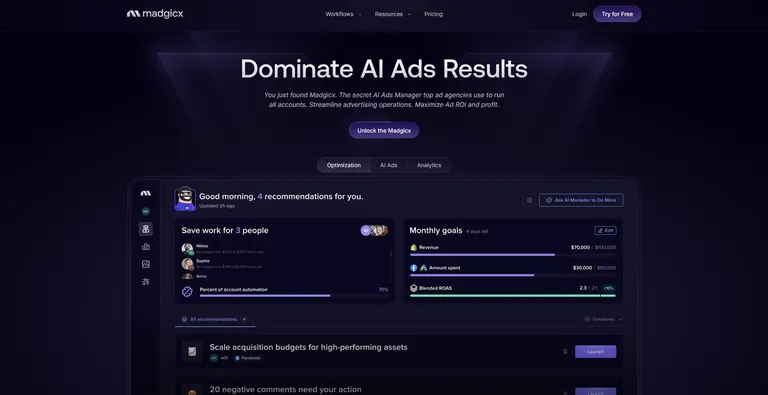
Madgicx is an AI-driven ad optimization platform for Meta and Google that pairs automated budget shifts with creative generation inside one dashboard.
I ran a week of spend through Madgicx and watched the budget recommendations land close to what I'd have adjusted manually, but faster. Since the unified dashboard held creative and spend data together, I stopped toggling between both.
Its depth is built around Meta and Google specifically, so testing dynamic creative on other ad platforms wasn't part of what it offered.
Madgicx starts at $32 per month, billed annually.
5. Hunch: Best for localized creative across multiple platforms
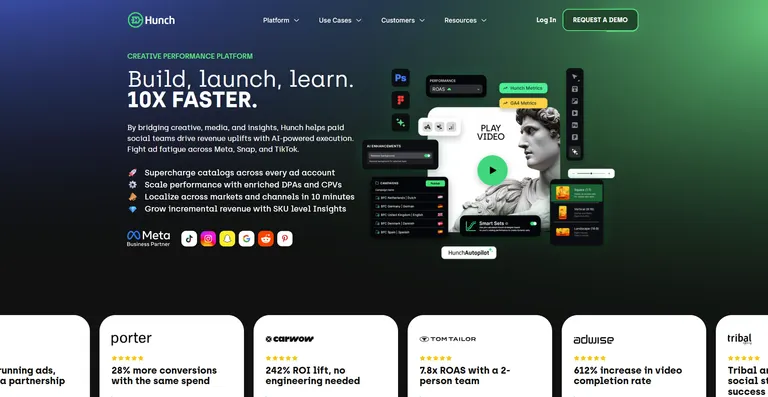
Hunch is a localization-focused creative platform built for agencies scaling variant production across Meta, Snapchat, and TikTok.
On a demo, I watched a single template turn into a dozen localized variants without rebuilding anything by hand. The languages and currencies stayed consistent across every version shown, and the segmentation tools also looked simple enough to tell which market a variant was built for.
Pinterest support wasn't part of the platform when I looked, so a fully unified cross-platform view stopped short of that one channel.
Hunch offers custom pricing.
6. The Brief (formerly Creatopy): Best for template-based ads without a designer
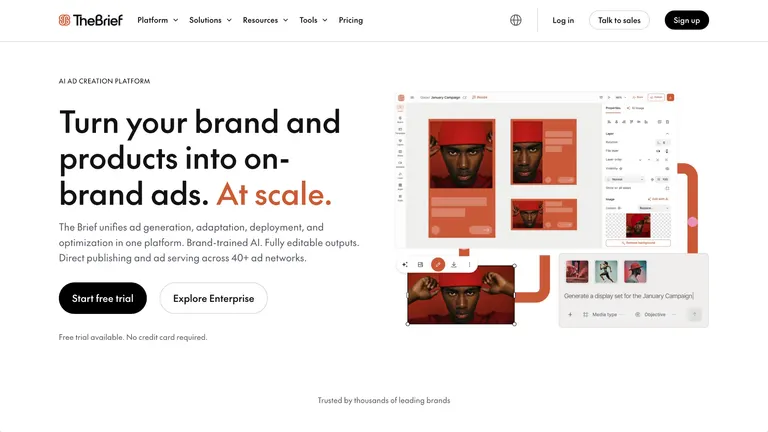
The Brief is a template-driven ad platform that recently rebuilt from Creatopy into an AI agent-based workflow covering research through optimization.
Building a static ad set from a template took minutes without me touching a design tool, and the brand kit kept fonts and colors consistent across every version. The AI agents handled the resizing work I'd normally do by hand.
The Creatopy-to-Brief transition has been rocky for existing users, with several recent reviews citing glitches and a steeper credit-based pricing structure since the switch.
The Brief starts at $29 per month, billed annually.
7. Storyteq: Best for centralized creative governance
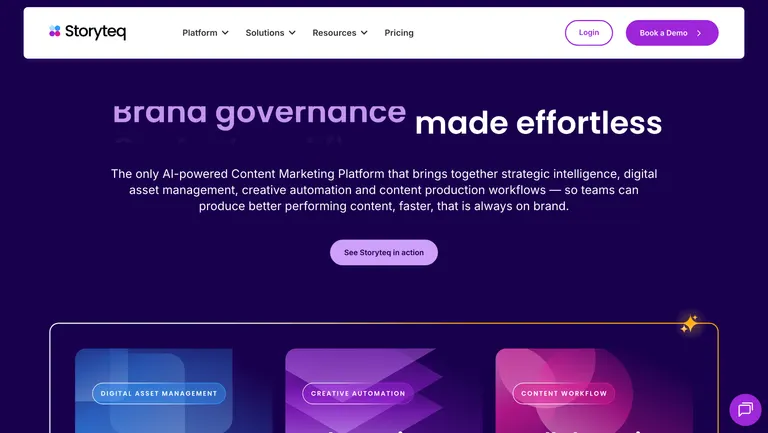
Storyteq is a content marketing platform combining digital asset management with creative automation for global brand teams.
I watched assets from a few different markets get centralized into one library. Brand consistency checks looked simple since every version pulled from the same approved kit, and localizing a video template across languages worked cleanly without rebuilding the base asset.
Template variety looked thinner than some competitors here, and a few reviews mention performance slowing once several templates are open in one session.
Storyteq offers custom pricing.
8. AdCreative.ai: Best for fast, low-cost AI ad creative
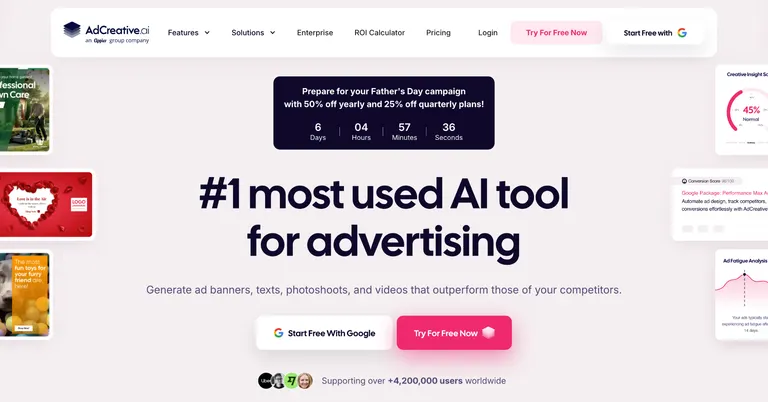
AdCreative.ai is an AI creative generation tool built around a Creative Scoring model that predicts how a new asset is likely to perform before it launches.
Generating a batch of ad variants from a single brand profile took me a few minutes, and the built-in scoring gave a quick read on which ones looked strongest before spending a dollar on them. Product photoshoot generation held up well for a handful of test items.
The predicted scores didn't always line up with how a creative actually performed once it launched, so I still treated the number as a starting point.
AdCreative.ai starts at $20 per month, billed annually.
9. ROI Hunter: Best for product data driving ad creative
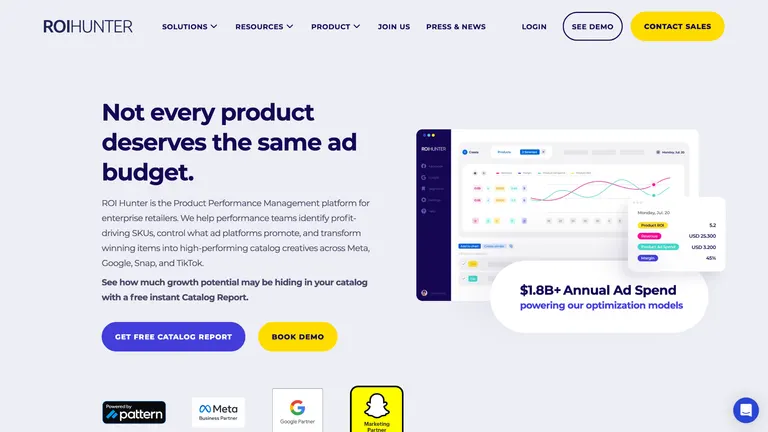
ROI Hunter is a product performance management platform connecting SKU-level profitability data to Meta and Google ad creative.
I watched someone link a product catalog to the platform and saw which items were actually driving margin versus which were just driving volume.
That data looked like it would feed directly into which products get prioritized in new ad creative. The catalog manager stayed organized even with a decent-sized product range shown.
Pattern acquired ROI Hunter in December 2025, so its roadmap and standalone future are worth watching before committing long term.
ROI Hunter offers custom pricing.
What to look for in a DCO platform
Before you commit to a platform, check it against these 5 criteria:
- Automated creative production: Look for a platform that pulls directly from your product feed and builds variations on its own. Manual per-version uploads are a red flag
- Native Meta integration: Confirm the platform supports Meta's specific ad formats, since a tool built primarily for display or DOOH won't translate cleanly to Feed and Reels placements
- Data feed flexibility: Check what data sources the platform connects to, like CRM, product catalog, weather, or location. Richer inputs generally lead to more relevant ad variations
- Reporting depth: Confirm the platform tracks performance at the creative-element level, down to which headline or image drove the result
- Support and onboarding: A few of these platforms have a real learning curve, so check whether onboarding support is included or billed separately
Every platform on this list handles the basics. Where they differ is how much of the process runs on its own versus how much still needs a person to manage it.
DCO vs. dynamic creative vs. static ads
DCO, dynamic creative, and static ads get used interchangeably, but they're not the same thing.
Here's how they stack up side by side:
| Static ads | Dynamic creative | DCO | |
|---|---|---|---|
| Personalization | None, one version for everyone | Basic, a few variable fields | Full, every element can adapt |
| How it's built | One finished ad | A template with limited variables | A library of modular, swappable pieces |
| Optimization | Manual A/B testing | Simple rule-based swaps | Ongoing, automated, based on real performance |
| Best for | Cold, top-of-funnel awareness campaigns | Basic localization, like swapping a location or price | Retargeting warm audiences with fast creative fatigue |
I've seen teams assume dynamic creative and DCO are the same thing, then get frustrated when a basic template tool can't adjust on its own the way a real DCO platform can.
The distinction matters most when you're evaluating a platform: dynamic creative fills in blanks, DCO decides which blanks to fill and how.
I'd also add that static ads still hold their own for cold, top-of-funnel awareness, where you're introducing a brand instead of reacting to someone's specific behavior.
DCO earns its keep further down the funnel, retargeting warm audiences who've already shown intent.
Give your next ad variation a head start
A dynamic creative optimization platform can swap in a new headline or image once a variation starts to underperform. Fewer of them tell you which fresh angle is worth building next, based on what's already proven to convert somewhere else.
We designed Atria to close that gap. As a creative intelligence platform, Atria ties every new variation to real account performance and market research, giving you a starting point already proven to work elsewhere.
Here's what that looks like in practice:
- Creative generation: Build a new ad variation from a hook that's already converting in your account, pulled straight from your performance data
- Creative performance tracking: Radar, Atria's always-on grading engine, flags a variation losing steam early, often before your reporting dashboard shows the dip
- Competitor research: Raya, Atria's AI creative strategist, tracks competitor accounts and surfaces their top-performing hooks and angles from a library of 100 million-plus ads, giving your next brief a proven starting point
Curious what Atria would flag in your next campaign? Try Atria for free today.
Frequently asked questions
What's the difference between dynamic creative optimization and dynamic creative?
Dynamic creative fills in a few preset variables, like a city name or price, using fixed rules.
Dynamic creative optimization tests and selects entire combinations of elements using machine learning, then keeps adjusting based on real performance.
Some tools marketed as AI creative generators only handle the simpler, rule-based version.
What's the difference between DCO and creative intelligence?
DCO decides which assembled ad variation to serve at the moment of delivery.
Creative intelligence analyzes why creative wins in the first place, breaking each ad down by hook, format, and message to find what to make next.
One feeds the other, since sharper creative analysis means better inputs for DCO to test.
Is DCO the same as programmatic advertising?
No, DCO is a creative delivery technique, while programmatic advertising is the automated buying and placement of ad inventory across exchanges.
You can run DCO within a programmatic campaign, and most ad creative automation platforms plug directly into your existing programmatic stack.
Does Meta have built-in dynamic creative optimization?
Yes, Meta offers Dynamic Creative within Ads Manager, which tests combinations of images, headlines, and calls to action automatically.
However, it's no longer available for Sales or App Promotion objectives. Meta replaced it with Flexible Ad Format in 2024, which now lives inside Advantage+ creative instead of as its own standalone format.
What data does DCO use to personalize ads?
DCO pulls signals like location, device, browsing behavior, and past purchases, then matches them against a data feed of product names, prices, and images. Some platforms also layer in weather or time-of-day signals to decide which combination to serve next.