
Ad creative testing platforms tell you why your ads aren't converting and which new creative will win before you spend.
Are you burning cash on ads, with your CAC rising, but you can't tell if the problem is the offer, the audience, or the creative? Or you want to validate an idea, so you don't find out an ad flops after you've paid Meta to show it.
These 7 platforms will help you figure out why your live ads aren't converting and aid you in choosing the ones that will work before you spend.
You'll get the exact tool for your stage: research, generation, analysis, or automation, so you're not stuck toggling between reports.
TL;DR: Best Ad Creative Testing Platforms
- Atria: Best for AI-powered creative intelligence and workflow
- Foreplay: Best for building swipe files and creative briefs
- Marpipe: Best for scaling catalog and SKU ads automatically
- AdCreative.ai: Best for fast static ad generation on a budget
- Motion: Best for element-level performance breakdowns
- Bïrch (formerly Revealbot): Best for rule-based budget automation
- Meta Ads Manager: Best free native option for low-spend testing
How this comparison was researched
This comparison pulls from each platform's documentation, pricing page, and verified reviews.
Each platform was scored on five points:
- Features: What the vendor's own docs say about research, generation, or analysis
- Usability: What verified reviewers report about friction for non-technical teams
- Integrations: Documented connections to Meta and TikTok ad accounts
- Pricing: Current published rates, checked against the official page
- Use Cases: How vendors and reviewers describe fit for agencies versus in-house teams
7 Best ad creative testing platforms: quick comparison
Here's the side-by-side breakdown:
| Tool | Core Strength | Best For | Starting Price |
|---|---|---|---|
| Atria | Research, creative intelligence, analytics | One-platform creative workflow | $159/month ($129/month annual) |
| Foreplay | Swipe files, briefs | Ideation before spend | $59/month ($49/month annual) |
| Marpipe | Catalog/DPA templating | Large SKU/product feeds | $199/month |
| AdCreative.ai | Fast static generation | Budget static batches | $39/month ($20/month annual) |
| Motion | Element-level video breakdowns | Why creatives win/lose | $750/mo |
| Bïrch | Rule-based budget automation | Scaling winners fast | $49/month($45/month annual) |
| Meta Ads Manager | Native A/B testing | Low-spend starters | Free |
Find winning concepts: competitor research tools
Before you generate or test anything, you need to know what's already working, for your competitors and for you.
1. Atria: Best for AI-powered creative intelligence and workflow
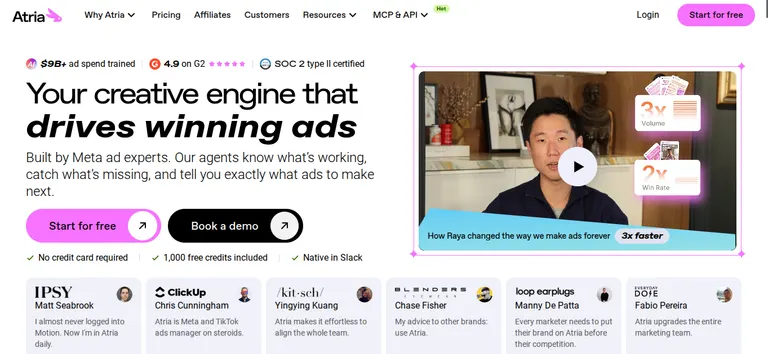
What it does: Atria is a creative intelligence and workflow platform that combines competitor ad research, briefing, script/layout cloning, and performance analytics in one place.
Best for: E-commerce brands and media buyers who want research, generation, and reporting without stitching different tools together.
In a connected workflow, Atria’s AI creative strategist, Raya (trained on $9B+ in ad spend), pulls competitor ads, clones winning scripts and layouts with AI, then tracks the new variant's performance metrics on your live accounts.
Radar (Atria's grading tool) flags creative fatigue before it drains ROAS, catching the drop before you'd notice it in a spreadsheet.
That loop of research, briefing, generation, and analysis is the platform's real differentiator.
Key features
- Competitor ad spying: Save and tag competitor ads from Meta and TikTok by hook, angle, and persona
- AI script and layout cloning: Reverse-engineer scripts, clone layouts, and adapt on-brand variants from a URL or review.
- Performance analytics: Track performance metrics by creative, with Radar's AI scoring
Pros and cons
Pros:
- Combines research, scriptwriting, and analytics. Eliminates the cost and difficulty of juggling three separate subscriptions
- AI cloning and review-mining produce usable starting points, so you don't start from scratch
- One login for the whole review cycle so you can check competitor wins, brief a variant, and confirm it lifted CTR without opening a second tab
Cons:
- The platform only covers Meta and TikTok accounts
- AI credits are capped by plan tier
What users say
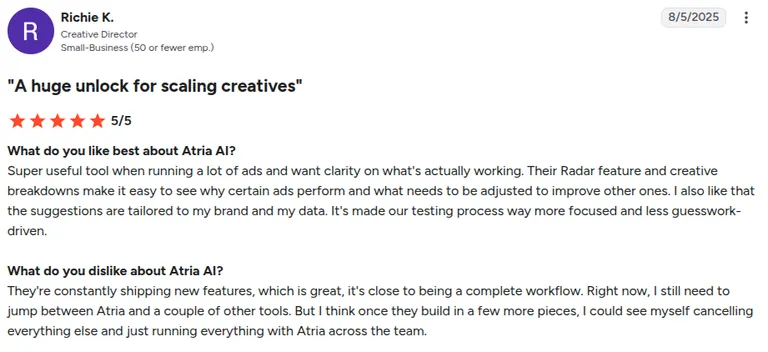
“Super useful tool when running a lot of ads and want clarity on what's actually working.” (Richie K., G2)
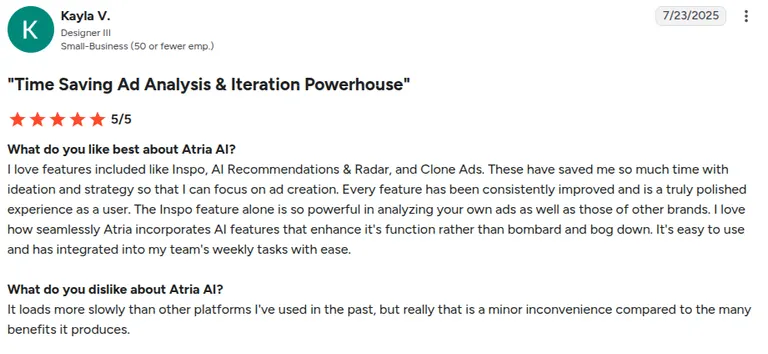
“It loads more slowly than other platforms I've used in the past.” (Kayla V., G2)
Pricing
Core starts at $159 a month, or $129 a month billed annually. Plus is $599/month ($479/month annual) while Business is $1199/month ($959/month annual). Plus and Business tiers add seats, AI credits, and brand tracking. A custom Enterprise plan is also available.
Bottom line
Choose Atria if you need creative and competitor intelligence. You get competitor research, creative intelligence, and analytics all in one place.
2. Foreplay: Best for building swipe files and creative briefs
What it does: Foreplay is a competitive intelligence and swipe-file tool for marketers and e-commerce brands that lets users discover, save, organize, and analyze high-performing competitor ads.
Best for: Brands building creative inspiration and briefs before committing spend, especially smaller ad-spend operations.
Foreplay drags competitor ads into boards, tags them by hook, angle, and format, then turns the strongest ones into a brief your writers can use. It's built for teams stuck at the “find good ideas” stage.
Key features
- Ad discovery and saving: Mood-board style organization for live competitor ads
- Swipe file organization: Tag by hook, angle, and format so editors find what they need
- Scripting and briefing: Turn saved concepts into briefs and storyboards
Pros and cons
Pros:
- You move from concept to execution with less friction
- Chrome extension covers Meta, TikTok, LinkedIn, and YouTube Shorts, with Google Transparency Center listed as coming soon
- Boards share easily with clients or internal teams, speeding up feedback loops and keeping everyone aligned
Cons:
- No creative generation or ad publishing
- Price feels steep if you only need occasional inspiration
What users say
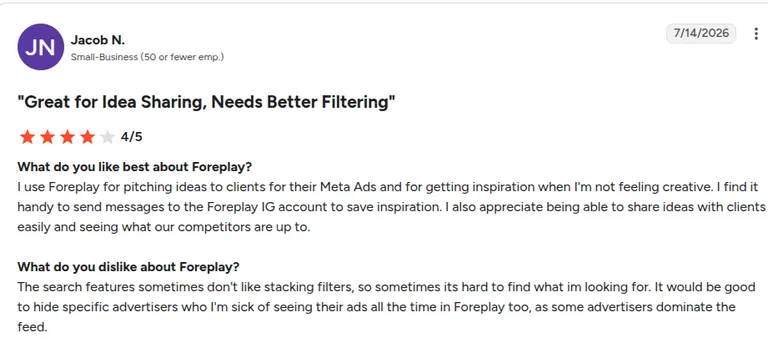
“I use Foreplay for pitching ideas to clients for their Meta Ads and for getting inspiration when I'm not feeling creative.” (Jacob N., G2)
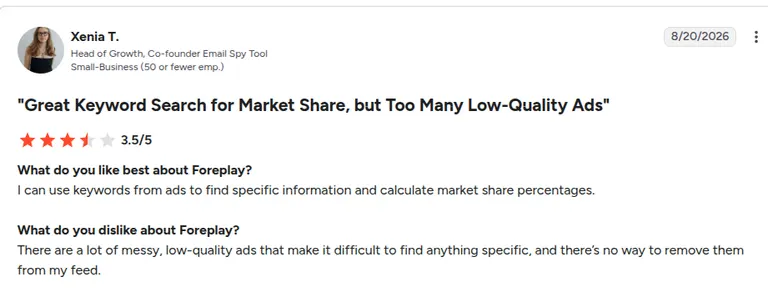
“There are a lot of messy, low-quality ads that make it difficult to find anything specific.” (Xenia T., G2)
Pricing
Basic costs $59 a month, or $49 billed annually, for one user. Workflow jumps to $175 a month ($149 annually) for five users. Agency costs $459 a month ($389 annually) for ten users. Enterprise is custom.
Bottom line
Pick Foreplay if your bottleneck is gathering inspiration into usable briefs.
Generate ad variants with AI
Once you know what concepts to test, these tools produce non-catalog variations at volume.
3. AdCreative.ai: Best for fast static ad generation on a budget
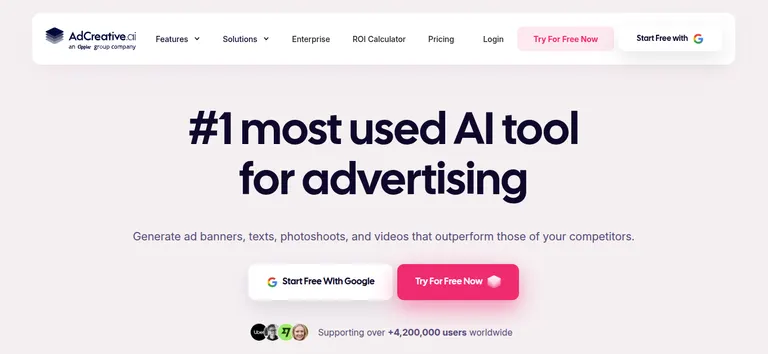
What it does: AdCreative.ai generates static ad creative fast, with predictive scoring before you spend a dollar.
Best for: Marketers who need batch-generated static ads without a design team on payroll.
The platform scans a product URL and applies your brand profile to generate a batch of static ads within minutes. It's fast and easy to use, although customization is limited after an ad is generated.
Key features
- Predictive performance scoring. Rank variants before you spend
- Batch static generation with built-in brand kit support
- Rapid turnaround plus a stock image library
Pros and cons
Pros:
- Fast batch generation for static variations, scale creative volume without slowing down production
- Scoring helps you prioritize what to test first, focusing budget on the highest-potential ads
- Cheaper entry point than most full-suite tools
Cons:
- Limited customization control once an ad generates
- Video generation is locked behind the $249/month Professional tier; Starter is image-only
What Users Say
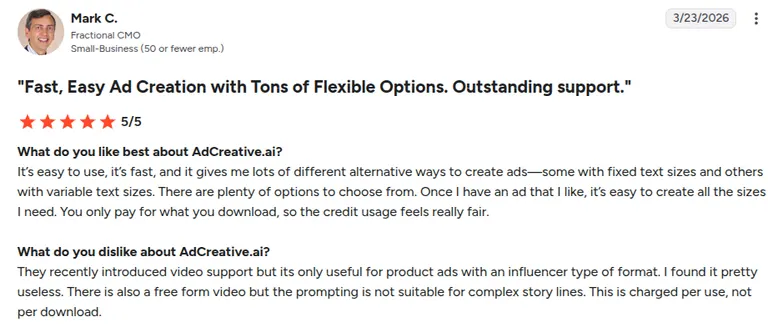
“It’s easy to use, it’s fast, and it gives me lots of different alternative ways to create ads.” (Mark C., G2)
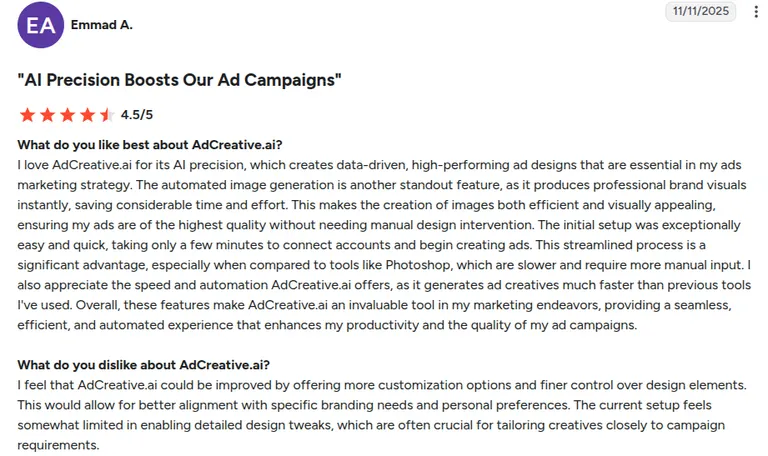
“AdCreative.ai could be improved by offering more customization options and finer control over design elements.” (Emmad A., G2)
Pricing
Starter lists at $39 a month for 10 credits, with discounts if you pay annually ($20) or quarterly ($29).
Professional costs $249 a month (also with discounted rates) and Ultimate costs $999 a month. Because promos shift constantly, pull current numbers straight from AdCreative.ai's page.
Bottom Line
AdCreative.ai works fine when you need volume static creative on a tight budget. If you need deeper customization, pair it with something else.
Scale catalog ads automatically
This is a different job from the tools above: templating and managing Dynamic Product Ads at scale, and not generating one-off creative concepts.
4. Marpipe: Best for scaling catalog and SKU ads automatically
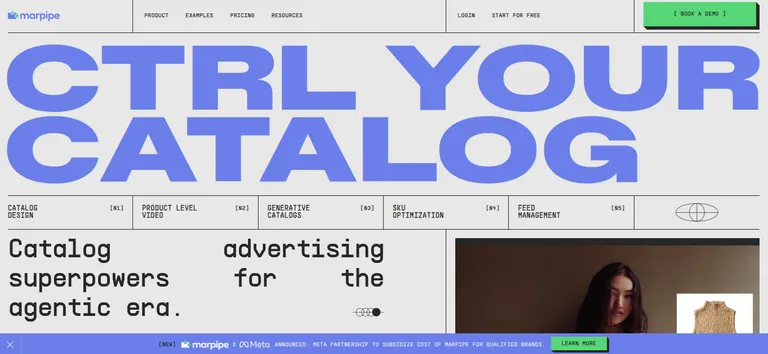
What it does: Marpipe turns raw product feeds into branded, designed catalog ads at scale.
Best for: Media buyers running Dynamic Product Ads who are tired of their catalog looking like a spreadsheet.
Connect a feed, apply templates that add layouts and text overlays, and Marpipe launches the enriched catalog automatically.
Marpipe's own performance data (on its pricing page) shows enriched catalog ads averaging a 19% ROAS lift over plain catalog ads.
That number depends on your base product photography doing its own part. Templates can't fix a bad product shot.
Key features
- Catalog creative: Raw SKU feeds become branded, designed ads
- Feed management: Sync and organize your product feed across ad platforms
- Product-level video and SKU optimization: Turn SKUs into video and cut weak performers automatically
Pros and Cons
Pros:
- Flat monthly pricing regardless of ad spend; competitors often charge a percentage
- Reported 19% average ROAS lift on enriched catalogs, per Marpipe's own performance data
- Fully self-serve
Cons:
- Built for catalog and DPA ads only. It doesn't handle general creative testing
- Big catalogs need custom Enterprise pricing
What users say
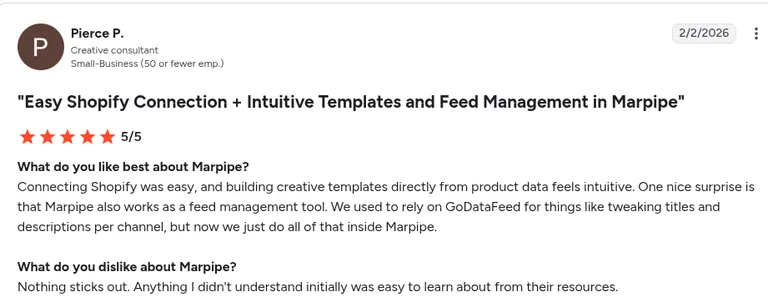
“Connecting Shopify was easy, and building creative templates directly from product data feels intuitive.” (Pierce P., G2)
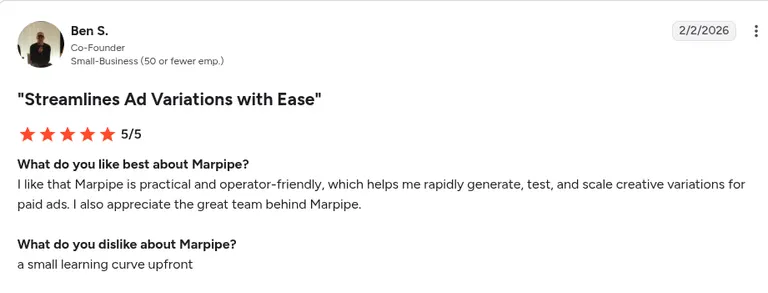
“A small learning curve upfront.” (Ben S., G2)
Pricing
Feed Management is free. Startup costs $199 a month. Enterprise starts at $999 a month and scales with your catalog size.
Bottom line
Marpipe is worth it if catalog ads are a huge part of your spend. Skip it if you're not running DPA at scale.
Analyze what's working
5. Motion: Best for element-level performance breakdowns
What it does: Motion compares ad creative side by side and tracks which ones win, surfacing why a hook works.
Best for: In-house creative strategists at DTC brands spending $50k+/month who need to know why creative wins, beyond which one did.
Motion uses comparative reports and weekly leaderboards built to surface which hooks, formats, and moments drive results across your account. That granularity is Motion's selling point.
Key features
- Comparative reports: Top ads compared side by side
- Leaderboard: Weekly tracking of your top-performing creative
- AI tags and tasks: Automatic tagging of creative elements across your account
Pros and cons
Pros:
- Detailed visual-driver analysis lets you understand why creatives perform, so you iterate smarter
- Visual interface ties creative assets directly to metrics, so it’s easy to spot patterns and act on insights
- Leaderboards make weekly strategy meetings faster, speeding up decision-making
Cons:
- Priced for brands spending $50k+ a month, so it’s not a fit for smaller accounts
- Cross-platform reports pull from one data source at a time, which means results don't consolidate across Meta, TikTok, YouTube, and LinkedIn in a single view
What users say
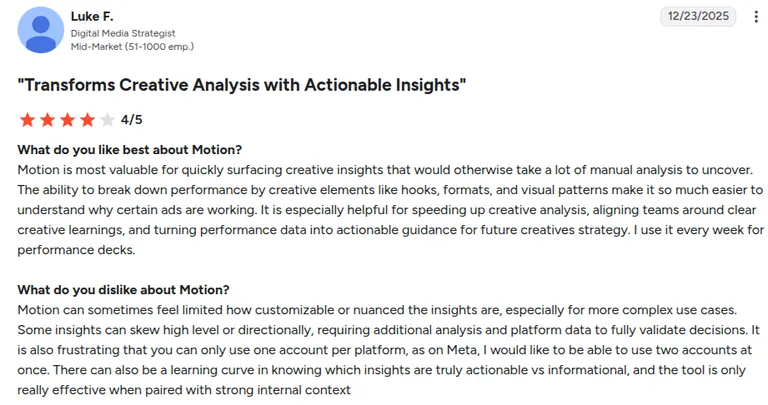
“Motion is most valuable for quickly surfacing creative insights that would otherwise take a lot of manual analysis to uncover.” (Luke F., G2)
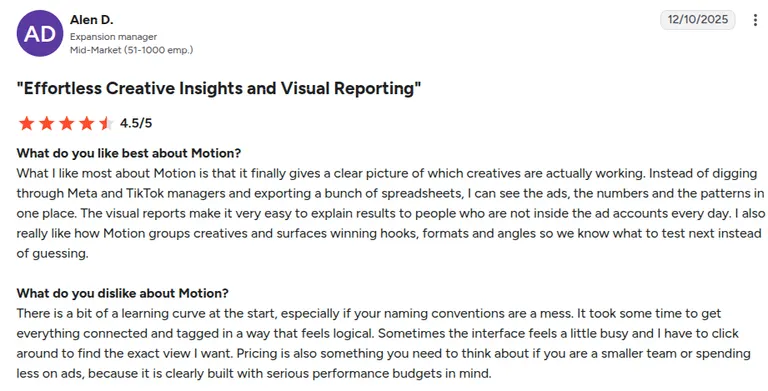
“There is a bit of a learning curve at the start.” (Alen D., G2)
Pricing
Motion doesn't have a free plan; Starter costs $750 a month for brands spending up to $50k on ads. Pro runs $1,200 a month.
Growth is custom-priced for $125k+ spenders and requires a demo. Motion has repositioned pricing significantly in recent months, so confirm current tiers on Motion's official pricing page before you budget.
Bottom line
Motion fits brands already spending enough to afford a $750-a-month tool. If you're early stage, start with generation and research, then add this later.
Automate based on test results
6. Bïrch (formerly Revealbot): Best for rule-based budget automation
What it does: Bïrch automates ad budgets and pauses with rule-based logic across Meta, Google, TikTok, and Snapchat.
Best for: Media buyers with confirmed winners who need fast reaction more than insight-gathering.
Set an if/then rule, say, increase budget on anything hitting a 3x ROAS, pause anything under, and Bïrch executes it around the clock.
It's built to act as an assistant, so it’s not a replacement for a media buyer's judgment. Bïrch reacts to data you already trust and doesn't generate the insight itself.
Key features
- Rule-based automation: Custom if/then logic for scaling and pausing
- Cross-platform support: Meta, Google, TikTok, and Snapchat from one dashboard
- Team alerts: Slack notifications when a rule triggers
Pros and cons
Pros:
- Cleaner, centralized interface
- Reacts to performance changes faster than a human checking manually
- Covers four major ad platforms from one login, streamlining your daily workflow
Cons:
- Spend-tier pricing climbs quickly as your ad budget scales
- Overages apply when you cross your plan's spend limit
What users say
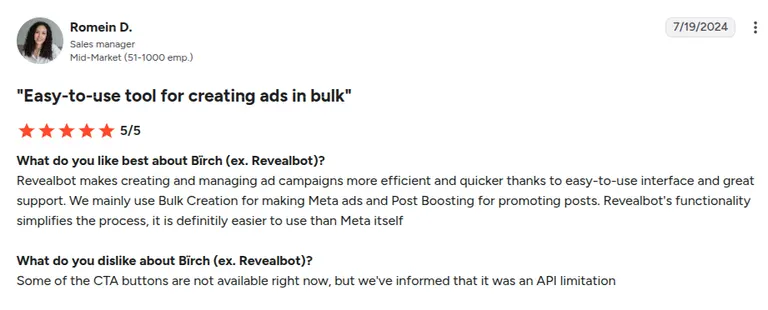
“Revealbot makes creating and managing ad campaigns more efficient and quicker thanks to easy-to-use interface and great support.” (Romein D., G2)
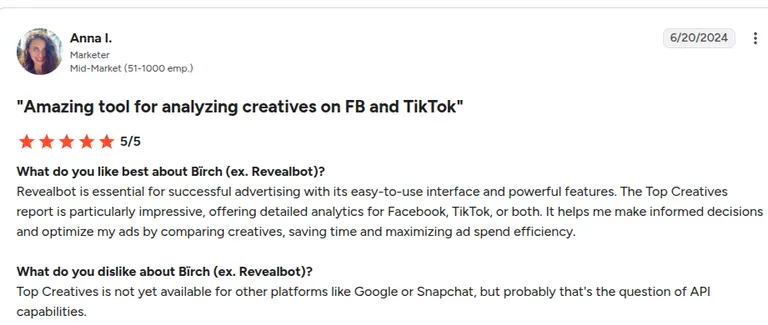
“Top Creatives is not yet available for other platforms like Google or Snapchat.” (Anna I., G2)
Pricing
Pricing scales with your monthly ad spend. Essential costs $49 a month ($45/month annual) which covers up to $50k per month in ad spend and scales from there.
Pro $99/month ($91/month annual) also increases with your ad spend, starting at $50k, while Enterprise is custom. A 14-day free trial gives you unlimited access to all features.
Bottom line
Bïrch is useful when you have confirmed winners and want an automated reaction. Skip it for now if you're still in discovery mode.
The free native option
7. Meta Ads Manager: Best for low-spend, basic A/B testing
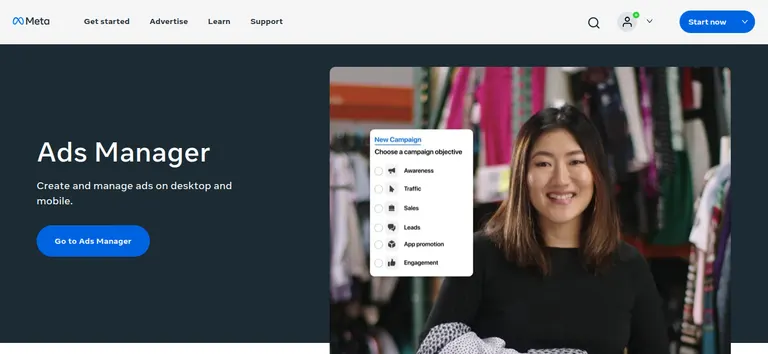
What it does: Meta Ads Manager runs native A/B tests inside the platform you're already using.
Best for: Brands new to paid ads, or running low monthly ad volume, who aren't ready to pay for a dedicated tool.
It handles basic split tests fine, but it lacks competitor research and element-level breakdown capability. If you can afford it, add a third-party research or tracking tool.
Key features
- Built-in split testing: No new tool to learn
- Zero added cost: It's already inside your ad account
- Direct platform integration: No connection setup required
Pros and cons
Pros:
- Free, and already part of your workflow
- No learning curve for basic split tests
Cons:
- No competitor research or element-level creative breakdowns
- Limited depth once your testing needs get specific
What users say
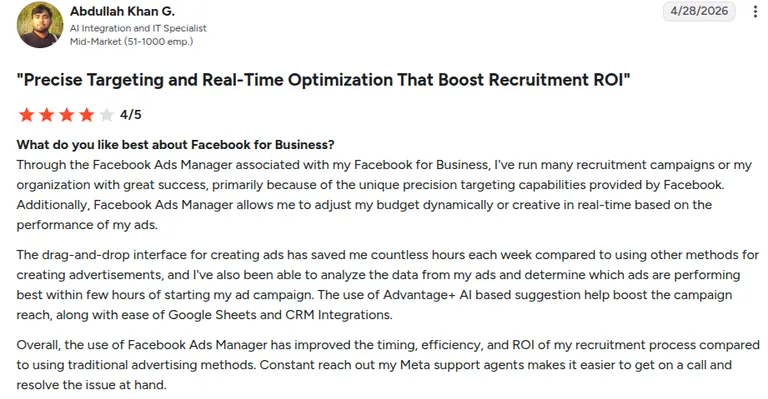
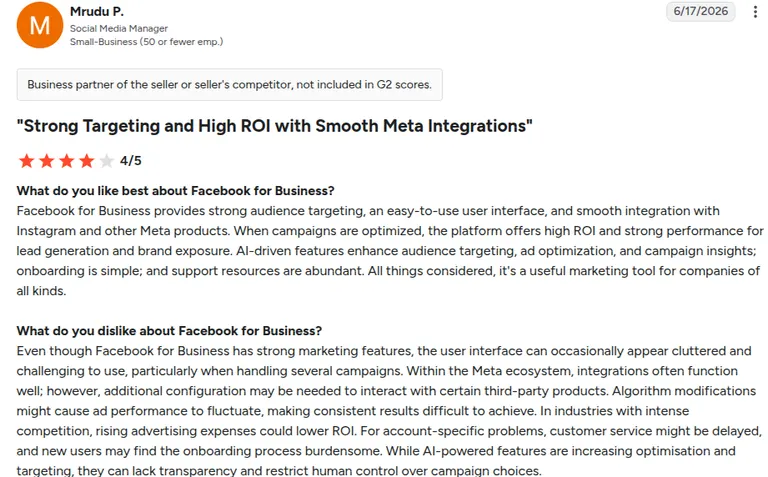
These reviews are under the Facebook for Business reviews on G2:
“Through the Facebook Ads Manager associated with my Facebook for Business, I've run many recruitment campaigns for my organization with great success.” (Abdullah Khan G., G2)
“The user interface can occasionally appear cluttered and challenging to use, particularly when handling several campaigns.” (Mrudu P., G2)
Pricing
Free to use. You only pay your ad spend.
Bottom line
Start here if your spend is low or you're pre-revenue, and graduate to a dedicated tool when you need faster research, more volume, or clearer element-level reads.
These tools didn't make the list but deserve a mention
Superside pairs human designers with AI-assisted workflows as a subscription service, so it's not self-serve software. Its official pricing page lists a $15,000-a-month minimum on an annual term, which puts it well outside every other tool's range here.
It fits media buyers who want managed production with human oversight. It doesn't make the ranked list because it's a service you don't operate yourself.
Which ad creative testing platform should you choose?
No single tool covers every stage of the workflow. Atria comes closest by combining creative intelligence, briefing, script/layout cloning, and analytics, which is four of five stages. Most teams end up running two or three tools depending on stage.
Choose Atria if you:
- Want research, generation, and performance tracking in one platform
- Run e-commerce or media buying and need to scale creative output
Choose Foreplay if you:
- Are still building creative inspiration and briefs
- Run lower ad spend and need ideation before execution
Choose Marpipe if you:
- Run Dynamic Product Ads at scale and need catalog templating
Choose AdCreative.ai if you:
- Need high-volume static variants fast, on a tight budget
Choose Motion if you:
- Already spend $50k+/month and want to know why creative wins, beyond which one did
Choose Bïrch if you:
- Have confirmed winners and need automated budget reaction
Still weighing which ad creative testing platform fits your workflow? Atria combines competitor research, creative intelligence, and performance data in one platform, so you're not paying for three separate tools to cover one job.
Try Atria today to see it running on your own ad accounts.
Frequently asked questions
What is the best ad creative testing platform for media buyers?
The best ad creative testing platform for media buyers depends on your stage. Atria is great for teams that need research, generation, and performance data together. Foreplay delivers swipe files and competitive tracking. Motion offers element-level video analysis once you're spending $50k+ a month.
What's the difference between ad creative testing and pre-launch concept testing?
Ad creative testing measures live performance: ad spend, clicks, and conversions inside ad platforms. Pre-launch concept testing uses surveys or panels, like Attest or Zappi, to gather feedback before you spend a dollar. This guide covers the live-performance side.
Do I need a dedicated tool, or is Meta Ads Manager enough?
You don't need a dedicated tool right away. Meta Ads Manager is enough to start with basic A/B tests if your spend is low. Once you need faster competitor research, higher-volume generation, or reliable automation, a dedicated tool pays for itself in time saved.
How much do ad creative testing platforms cost?
Ad creative testing platforms cost anywhere from free (Meta Ads Manager) to $40 to $200 a month for entry tiers, low hundreds for mid-tier tools, and $750 a month and up for Motion. Managed services like Superside start at $15,000 a month plus a $1,000 platform fee.
What should I look for in a creative testing platform?
Look for a creative testing platform that matches your needs: research and briefs, AI generation, element-level analysis, catalog templating, or budget automation. Check Meta and TikTok integrations, usability for non-designers, and whether the tool changes your workflow.