
I tested these 8 Madgicx alternatives to see how well they solved two problems advertisers run into: platforms whose optimization tools stop at Meta, and gaps in creative strategy that bid automation alone can't fix.
This guide covers what each tool does so you can find the one that fits your workflow.
8 best Madgicx alternatives: TL;DR
- Atria: For marketers whose bottleneck is creative. Atria finds out what's winning in your market, breaks down why, and turns that into new ad concepts to test.
- Bïrch: For businesses that want transparent, if-this-then-that rule automation they build and control themselves.
- Adzooma: For advertisers who want a simple, budget-friendly management layer without a steep learning curve.
- AdEspresso: For solo marketers and small businesses spending $5K–$15K/month who just need straightforward A/B testing. We compare it against the rest of the field in AdEspresso alternatives.
- Smartly: For enterprise brands and large agencies scaling creative templates across multiple channels.
- Triple Whale: For DTC and e-commerce brands that want Shopify-integrated metrics and multi-touch attribution beyond Meta's own numbers.
- Optmyzr: For marketers managing complex Google Ads search and display campaigns who want AI-driven optimization suggestions.
- AdRoll: For advertisers who want web-wide display retargeting and audience building across a DSP network.
Why look for a Madgicx alternative?
Madgicx earned its reputation for a reason. Its Audience Studio ranks interests by profitability and lets you intersect them with custom and lookalike audiences.
Its creative element analysis (breaking ad performance down by color, copy, and CTA placement) is useful for spotting what's driving results.
Madgicx starts from $45/month, scaling with ad spend, with exact pricing shown in-app above $20K/month. There's also a 7-day free trial and a $49/mo Tracking Pro add-on.
If you're spending $20K-$100K a month on Meta alone and have a team who can act on the insights, Madgicx does what it says it does.Here's why you might want to look for a Madgicx alternative:
- It's Meta-only for optimization: If you need active bidding, budget automation, or creative testing outside Meta, you'll need a separate tool for that.
- AI bidding can override your own strategy: Madgicx's automated bidding rules can step in and change budgets or bids even when you've already built and tested a custom media-buying approach, and you don't always get granular control at the ad-set level to stop it.
- The learning curve is real: Between the audience tools, creative breakdowns, and automation rules, it could take weeks to be really comfortable in the platform. If you need a tool you can pick up in a day, Madgicx isn't built for that. What long-term users make of it is collected in Madgicx reviews.
That said, it doesn't make Madgicx a bad tool. It just means one of these alternatives might be better suited to your needs.
The rest of this article breaks this down.
8 best Madgicx alternatives: at a glance
| 🏆 Platform | 🎯 Best for | 💰 Price |
|---|---|---|
| Atria | Creative intelligence and competitor research | Starts from $159/month ($129/month billed annually) |
| Bïrch | Rule-based automation you control | Starts from $49/month |
| Adzooma | Simple, budget-friendly ad management | Free (paid plans from $69/month) |
| AdEspresso | Solo marketers, small A/B testing budgets | Starts from $49/month |
| Smartly | Enterprise creative automation at scale | Custom pricing (no public starting price) |
| Triple Whale | E-commerce, Shopify-integrated attribution | Free (paid plans from $219/month) |
| Optmyzr | Complex Google Ads search/display campaigns | Depends on ad spend, starts from $209/month billed annually |
| AdRoll | Multi-channel display retargeting (DSP) | No platform fee. Pay-as-you-go |
The 8 best Madgicx alternatives
1. Atria
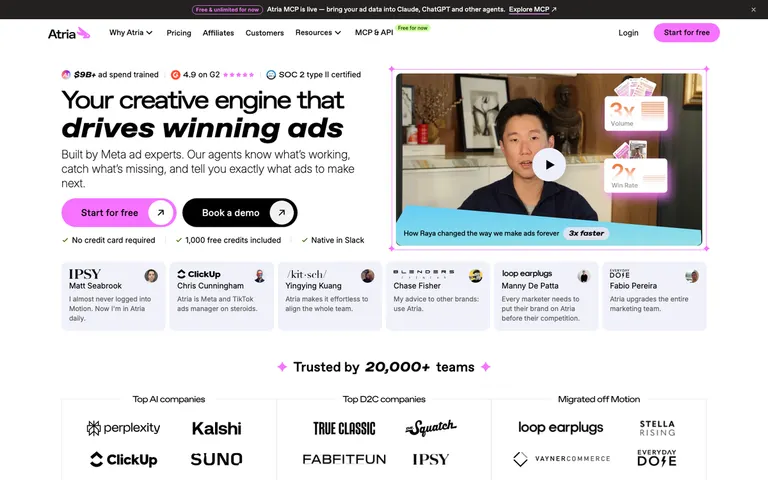 Atria focuses on the creative side and tells you what's working in the market right now, and why.
You can pull competitor ads directly from ad libraries, break winning creative down frame-by-frame to see which elements are doing the work, and use that analysis to generate new ad variations.Key features
- Competitor ad spying: See what other brands in your category are running.
- Frame-by-frame creative analysis: Understand which specific visual or copy elements correlate with performance.
- AI-assisted creative generation: Turn insights from top-performing ads into new variations to test.
Pros
- ✅ Builds market-level competitor research into the creative workflow, which is deeper than Madgicx's standalone ad library
- ✅ Turns creative analysis into action (new ad ideas)
- ✅ Useful for teams whose bottleneck is deciding what to make
Cons
- ❌ Not built for bid automation or budget management. You'll need a separate tool for that
- ❌ Less useful if your team already has a strong internal creative process and doesn't need competitive benchmarking
Best for
- Brands and agencies whose ad performance stalls on creative fatigue, not targeting or bidding
- Teams that want to know what's working for competitors before they build their next campaign
- Marketers who want AI help ideating and iterating on creative, not just measuring it
What users say
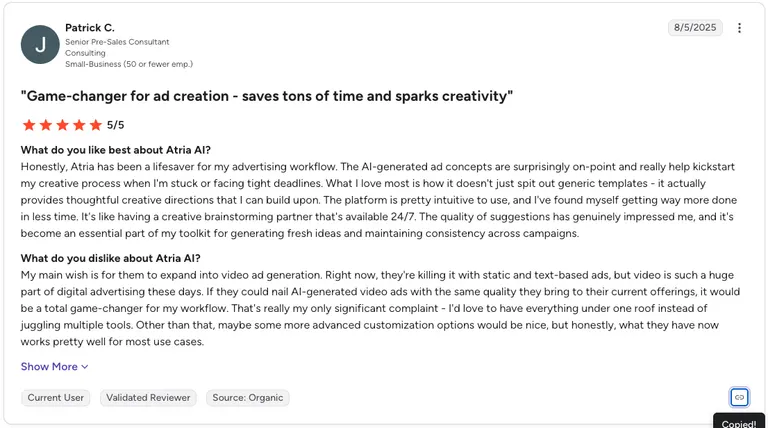
Pro: AI-generated ad concepts are thoughtful and specific, effectively jumpstarting the creative process under tight deadlines and helping maintain consistency across campaigns. All through an intuitive platform that speeds up workflow significantly.
“Honestly, Atria has been a lifesaver for my advertising workflow. The AI-generated ad concepts are surprisingly on-point and really help kickstart my creative process when I'm stuck or facing tight deadlines.” (Patrick C., G2 Review, August 5, 2025)
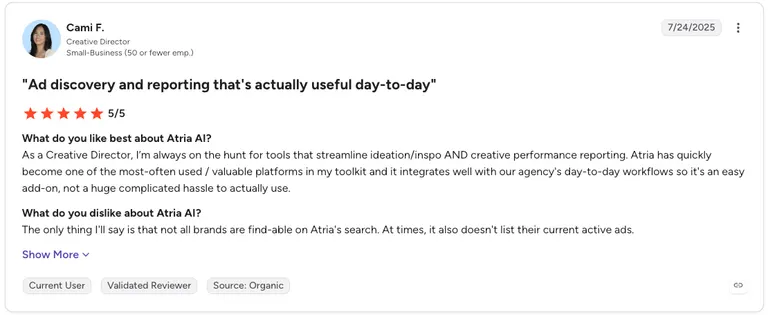
Con: Not all brands can be found through Atria's search, and even when a brand is found, its currently active ads aren't always listed.
“The only thing I'll say is that not all brands are find-able on Atria's search. At times, it also doesn't list their current active ads.” (Cami F., G2 Review, July 24, 2025)
Pricing
Core starts at $159/month billed monthly ($129/month billed annually), including 5 seats and 4,000 AI credits. Plus is $599/month ($479/month billed annually). Business is $1,199/month ($959/month billed annually). Enterprise is custom-priced.
2. Bïrch (formerly Revealbot)
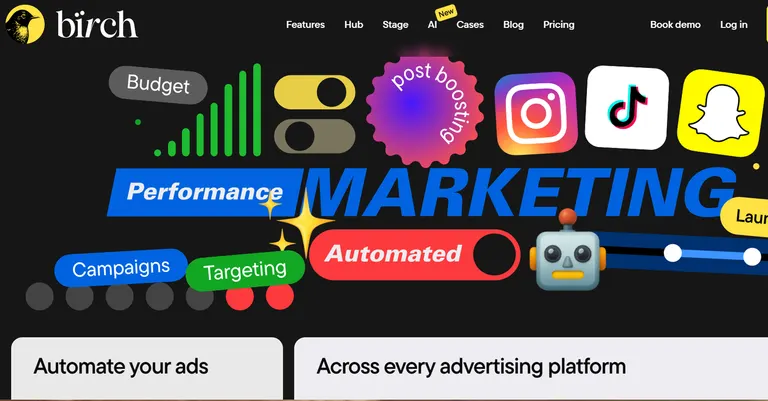 Bïrch is the tool if you want automation you can see and control.You build the logic yourself, stacking conditions like “pause any ad set with frequency above 3.5 AND CTR down 25% over 3 days”. And Bïrch executes exactly that, every time.
Key features
- Rule builder with AND/OR logic: Create precise automation without writing scripts.
- Custom metrics and Google Sheets integration: Pull external data (like margin or LTV) into your triggers.
- Multi-platform rules: Runs automations across Meta, Google, TikTok, and Snapchat from one dashboard.
Pros
- ✅ Full transparency. You always know why an automation fired
- ✅ No algorithmic guesswork. You set the exact conditions
- ✅ Automation history and debugging logs make troubleshooting easyCons
- ❌ You have to build and maintain every rule yourself, which takes real setup time
- ❌ No AI-driven audience discovery or creative analysis like Madgicx
Best for
- Agencies managing multiple client accounts with different rule sets
- Technical marketers who trust their own logic over a black box
- Teams that already know what triggers they want automated
What users say
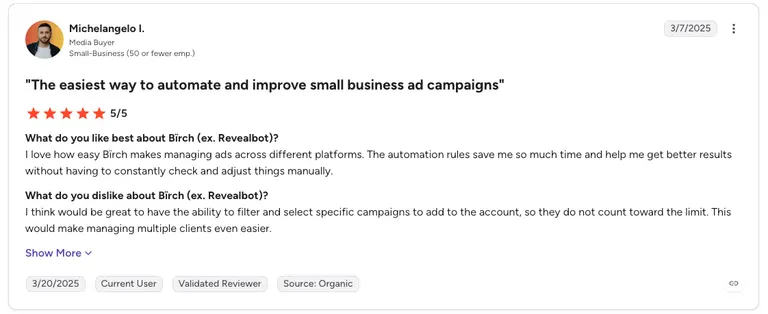
Pro: Cross-platform ad automation via rules saves significant time and improves results by removing the need for constant manual monitoring and adjustment.
“I love how easy Bïrch makes managing ads across different platforms.” (Michelangelo I., G2 Review, March 7, 2025)
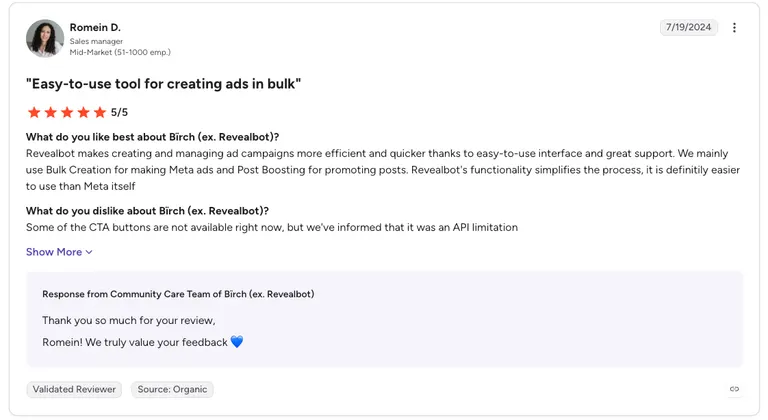
Con: Some CTA button options are currently unavailable, though this is understood to be due to an API limitation rather than a platform flaw.
“Some of the CTA buttons are not available right now, but we've informed that it was an API limitation”
(Romein D., G2 Review, July 19, 2024)
Pricing
Plans start at $49/month ($45 when billed annually) for up to $10K in monthly ad spend, with the more advanced Pro plan at $99/month (or $91 when billed annually), both scaling with spend. .
3. Adzooma
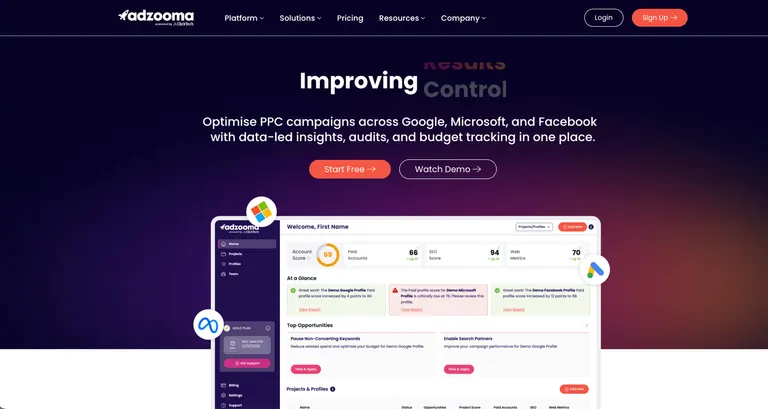 Adzooma strips away Madgicx's complexity and learning curve.
You get straightforward management. Connect your accounts, see performance across campaigns, and act on plain-language recommendations without wading through advanced AI settings.
Key features
- Cross-platform dashboard: View Google, Microsoft, and Meta campaigns in one place.
- Plain-language optimization suggestions: Recommendations written for non-specialists, not media buyer jargon.
- Free entry tier: Get started without committing budget to a new tool.
Pros
- ✅ Easy to learn. No weeks-long onboarding
- ✅ Free tier makes it low-risk to try
- ✅ Good starting point for teams without a dedicated PPC specialist
Cons
- ❌ Lacks the advanced AI audience and creative analysis Madgicx offers
- ❌ Not built for teams managing complex, high-spend accounts
Best for
- Small businesses managing their own ads without a specialist on staff
- Teams that want simplicity over advanced automation
- Anyone wanting to test the waters before paying for a premium tool
What users say
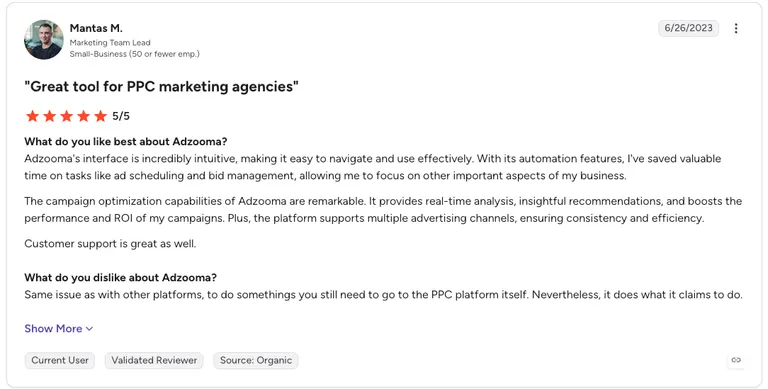
Pro: Intuitive interface with automation for tasks like ad scheduling and bid management, paired with real-time optimization recommendations across multiple advertising channels that boost campaign performance and ROI. Plus strong customer support.
“Adzooma's interface is incredibly intuitive, making it easy to navigate and use effectively.” (Mantas M., G2 Review, June 26, 2023)
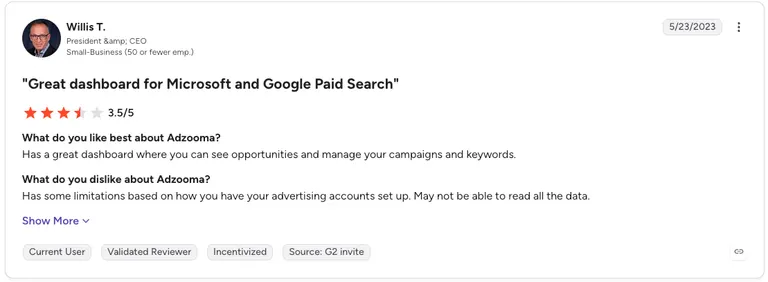
Con: Depending on how advertising accounts are structured, the tool may have limitations reading all the data.
“Has some limitations based on how you have your advertising accounts set up. May not be able to read all the data.” (Willis T., G2 Review, May 23, 2023)
Pricing
Adzooma has three tiers: Free ($0/month) for basic monthly reports and one SEO/web metrics profile, Silver ($69/month) for weekly reports and unlimited user seats, and Gold ($179/month) for daily reports and unlimited profiles. Enterprise is custom-priced.
4. AdEspresso by Hootsuite
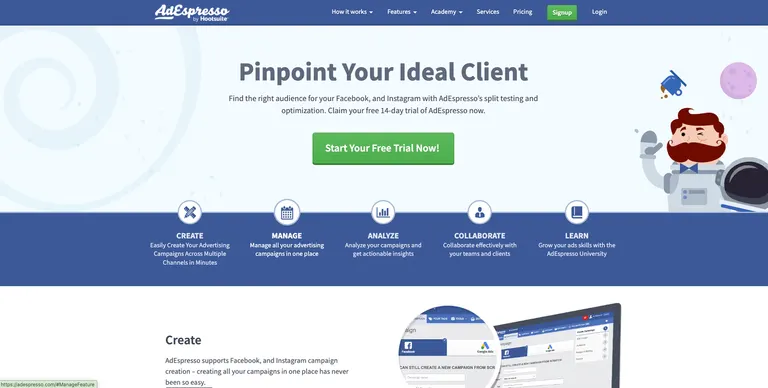 AdEspresso keeps things focused. You connect your account, set up a split test, and let the platform handle the heavy lifting of calling a winner.
It's a good fit for teams who don't need Madgicx's full suite and just want reliable A/B testing without a steep setup.
Key features
- Automated A/B testing: Test audiences, placements, and creative variations with statistical significance built in.
- Simple campaign creation: Launch tests without needing deep Ads Manager expertise.
- Clean reporting: Straightforward results without a cluttered dashboard.
Pros
- ✅ Fast, easy split testing for smaller budgets
- ✅ Low learning curve compared to Madgicx
- ✅ Good for teams still learning Meta advertising fundamentals
Cons
- ❌ Limited automation beyond testing. No audience intelligence or budget automation
- ❌ Slowed development.
Best for
- Solo marketers or small businesses spending $5K-$15K/month
- Teams that need split testing more than deep automation
- Anyone prioritizing simplicity over advanced AI features
What users say
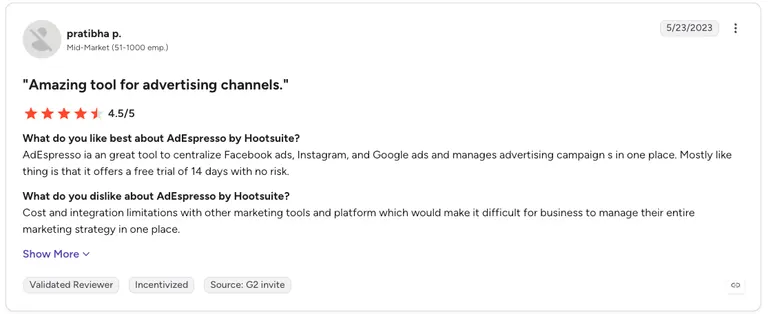
Pro: Centralizes Facebook, Instagram, and Google ad campaign management in one place, with a risk-free 14-day free trial as a standout perk.
“AdEspresso ia an great tool to centralize Facebook ads, Instagram, and Google ads and manages advertising campaign s in one place.”
(Pratibha P., G2 Review, May 23, 2023)
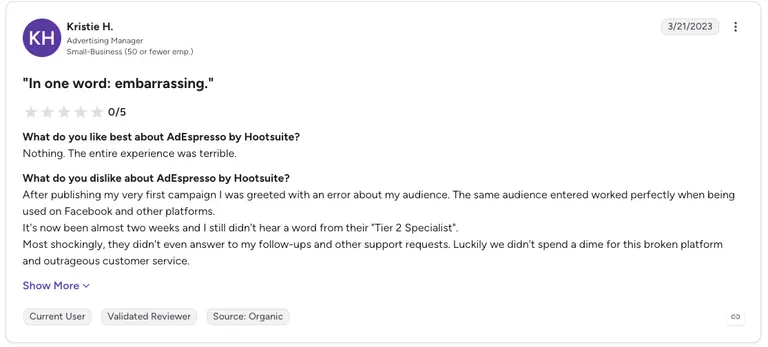
Con: Ran into an audience-targeting error when publishing a first campaign (despite the same audience working fine on Facebook and other platforms), and support was unresponsive. No reply from the escalated specialist or follow-ups for nearly two weeks.
“After publishing my very first campaign I was greeted with an error about my audience.“ (Kristie H., G2 Review, March 21, 2023)
Pricing
AdEspresso has three tiers: Starter ($49/month) for up to $1,000/month ad spend with unlimited ad accounts, Plus ($99/month) for unlimited ad spend plus bulk creation and up to 15 team seats, and Enterprise (from $259/month) with a dedicated Facebook Marketing consultant and API access.
5. Smartly
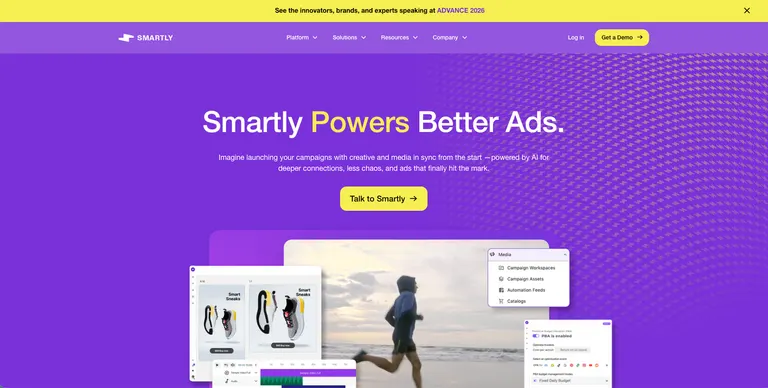 Smartly targets big enterprises.
It's built for enterprise brands that need to generate and test thousands of creative variations across markets and channels. Not for teams looking for an affordable Meta-only upgrade.
Key features
- Dynamic Creative Optimization (DCO): Automatically generate and test creative variations at scale.
- Multi-market, multi-language automation: Scale winning creative across regions without manual rebuilds.
- Enterprise-grade reporting: Cross-channel performance visibility built for large teams.
Pros
- ✅ Unmatched creative production scale for large catalogs and markets
- ✅ Strong cross-channel reporting for enterprise stakeholders
- ✅ Dedicated customer success supportCons
- ❌ Long, sales-led onboarding measured in months
- ❌ High minimum spend requirements make it impractical for smaller teams (check out alternatives here)
Best for
- Fortune 500 brands and large agencies with $50K+ monthly ad budgets
- Teams that need to scale creative templates across dozens of markets
- Organizations with the internal resources to manage an enterprise onboarding process
What users say
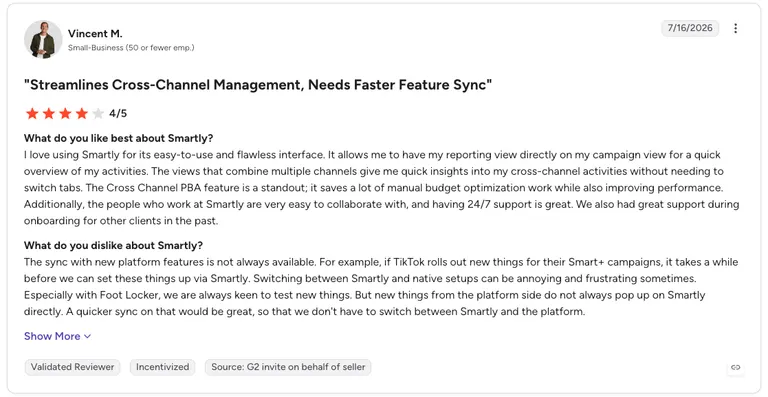
Pro: Offers a wide range of options that go beyond Meta's native Ads Manager and complement user needs well, making it especially valuable for clients managing a high volume of campaigns or markets.
“The number of options it offers. How it allows us to go one step further than BM and how it perfectly complements the needs of users.” (Enrique P., G2 Review, April 7, 2022)
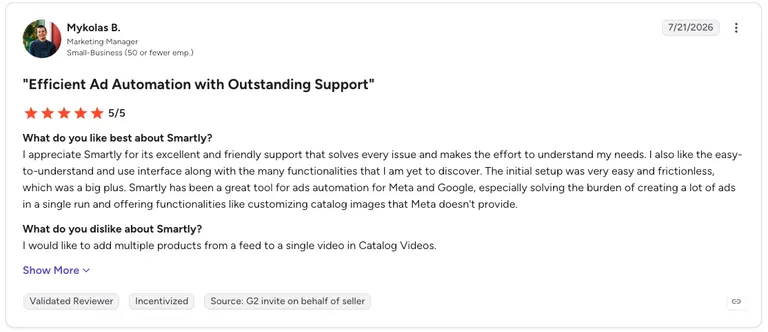
Con: Syncing with new platform features lags. When platforms like TikTok roll out updates (e.g., Smart+ campaigns), it takes time before those features become available in Smartly, forcing frustrating back-and-forth between Smartly and native platform setups.
“The sync with new platform features is not always available.” (Vincent M., G2 Review, July 16, 2026)
Pricing
Smartly is fully custom, quote-based, with fees typically calculated as a percentage of your connected ad spend. You'd need to contact their sales team for a quote.
6. Triple Whale
 Triple Whale replaces Madgicx's Cloud Tracking and attribution dashboard, but not its Meta optimization.
It's built for DTC and e-commerce brands that want attribution tied directly to Shopify data.
Key features
- Shopify-native attribution: See real revenue and order data tied to specific campaigns.
- Multi-touch attribution models: Understand the full customer journey, not just last-click.
- Cross-channel reporting: View Meta, Google, and other channels against actual store performance.
Pros
- ✅ Attribution you can trust against your Shopify revenue
- ✅ Removes reliance on Meta's platform-reported metrics
- ✅ Strong fit for DTC brands scaling paid spend
Cons
- ❌ Doesn't offer Madgicx-style creative or audience automation
- ❌ Primarily valuable for Shopify-based stores. Less relevant outside e-commerce
Best for
- DTC brands that want revenue-based attribution instead of platform metrics
- Teams scaling ad spend and needing to prove real ROI to stakeholders
- E-commerce marketers already using Shopify as their source of truth
What users say
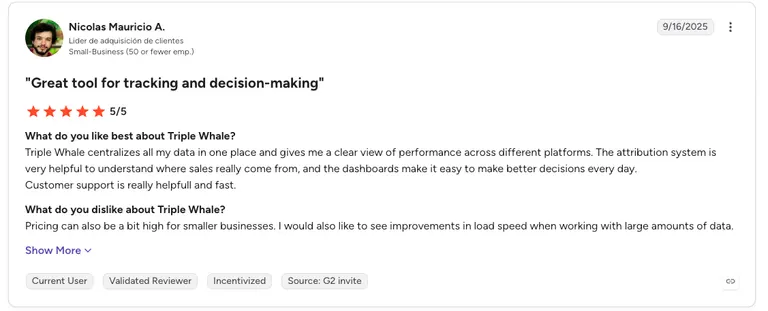
Pro: Centralizes performance data across platforms with a helpful attribution system that clarifies where sales actually come from, backed by dashboards that make daily decision-making easier. Plus fast, helpful customer support.
“Triple Whale centralizes all my data in one place and gives me a clear view of performance across different platforms.” (Nicolas Mauricio A., G2 Review, September 16, 2025)
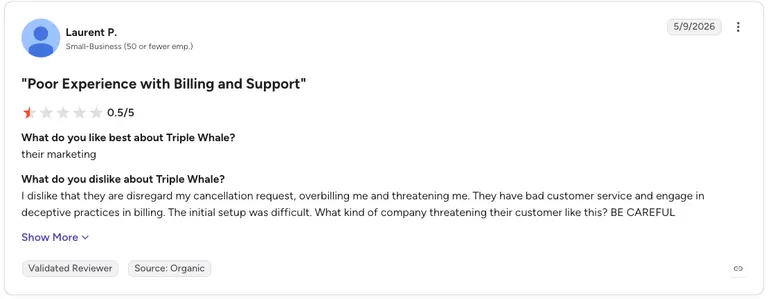
Con: Pricing ends up higher than initially indicated.
“I dislike that they are disregard my cancellation request, overbilling me and threatening me.” (Laurent P., G2 Review, May 9, 2026)
Pricing
Triple Whale has a Free plan ($0/month) with core channel tracking and first/last-click attribution, plus three paid tiers.Foundation ($219/month) adds multi-touch attribution and Moby AI, Automate ($749/month) adds automations and soon Moby Specialists, and Enterprise (custom pricing) comes with unified measurement (MMM, incrementality) and enterprise security.
7. Optmyzr
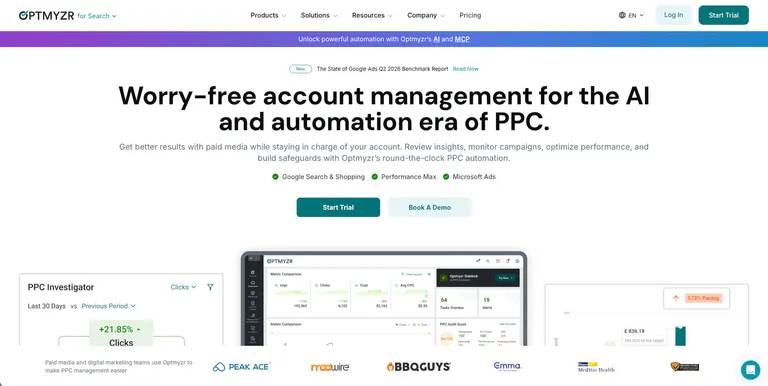 Optmyzr is worth including here because plenty of readers searching for a “Madgicx alternative” are actually running most of their budget through Google Ads and need a comparable AI-driven optimization layer for search and display instead.Key features
- AI-driven optimization suggestions: Get recommendations tailored to search and display campaign structures.
- Advanced A/B testing: Test ad copy, bidding strategies, and account structures systematically.
- Cross-account management: Manage complex, multi-account Google Ads setups from one place.
Pros
- ✅ Built specifically for the complexity of Google Ads
- ✅ Strong automation for search and display specifically
- ✅ Good for agencies managing many Google Ads accountsCons
- ❌ Search-first by design, with Meta and LinkedIn tooling that's thinner than its Google depth.
- ❌ Overkill if your account structure is simple
Best for
- Marketers running complex Google Ads search and display campaigns
- Agencies managing multiple Google Ads accounts
- Teams whose primary channel is search, not social
What users say
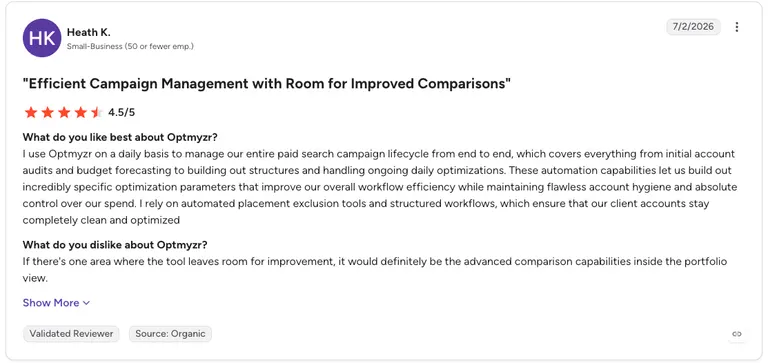
Pro: Supports the entire paid search campaign lifecycle end-to-end. Audits, budget forecasting, structure building, and daily optimizations, with automation like placement exclusion tools that keep client accounts clean, optimized, and under tight spend control.
“I use Optmyzr on a daily basis to manage our entire paid search campaign lifecycle from end to end, which covers everything from initial account audits and budget forecasting to building out structures and handling ongoing daily optimizations.”
(Heath K., G2 Review, July 2, 2026)
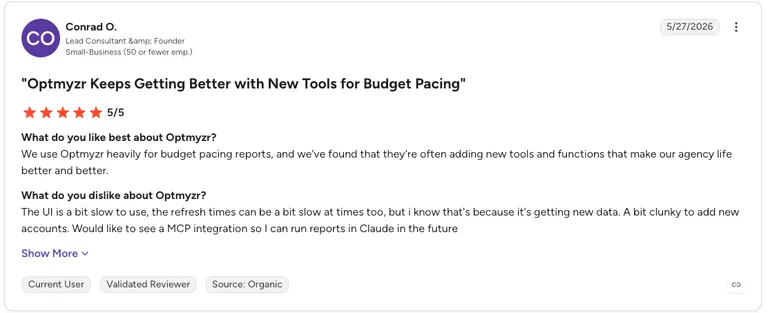
Con: The UI can be slow, with refresh times lagging at times (likely due to new data loading) and a somewhat clunky process for adding new accounts. Also requested MCP integration to run reports directly in Claude.
“The UI is a bit slow to use, the refresh times can be a bit slow at times too, but i know that's because it's getting new data.” (Conrad O., G2 Review, May 27, 2026)
Pricing
Optmyzr has three tiers: Essentials at $299/month ($209/month billed annually) for core PPC optimization tools, Premium at $389/month ($272/month billed annually) adding Shopping/PMax automation and multi-account reporting.
Enterprise (custom pricing) comes with API access and dedicated account management. Pricing scales with monthly ad spend.
8. AdRoll
 AdRoll is built for retargeting and display advertising across the wider web, so it’s not limited to Meta’s platforms.
As a demand-side platform, it buys inventory across thousands of sites and networks.
Key features
- Cross-network retargeting: Reach users across thousands of websites, beyond Meta or Google.
- Audience building: Create and sync audiences across display, social, and email.
- Email marketing integration: Combine retargeting with email campaigns for a fuller funnel.
Pros
- ✅ Broadest reach for retargeting outside of social platforms
- ✅ Combines display, social, and email in one audience strategy
- ✅ Good fit for brands wanting to extend beyond Meta and Google alone
Cons
- ❌ Not a Meta optimization or creative analytics tool
- ❌ Reporting can feel less precise than platform-native tools for social-specific metrics
Best for
- Brands running web-wide display retargeting campaigns
- If you want to combine retargeting with email marketing
- Advertisers looking to extend reach beyond Meta and Google's own inventory
What users say
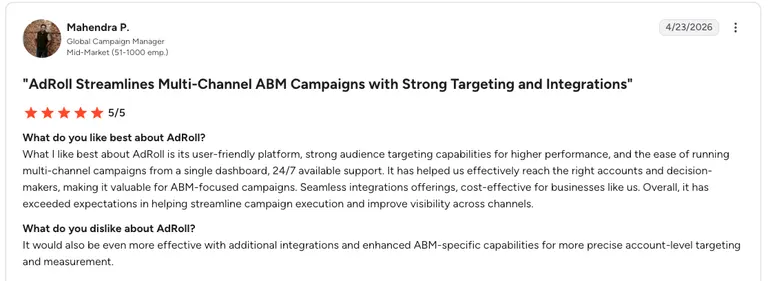
Pro: User-friendly platform with strong audience targeting and multi-channel campaign management from a single dashboard. Makes it especially effective for ABM campaigns reaching the right accounts and decision-makers. Plus easy integrations, 24/7 support, and cost-effectiveness.
“What I like best about AdRoll is its user-friendly platform, strong audience targeting capabilities for higher performance, and the ease of running multi-channel campaigns from a single dashboard, 24/7 available support.” (Mahendra P., G2 Review, April 23, 2026)
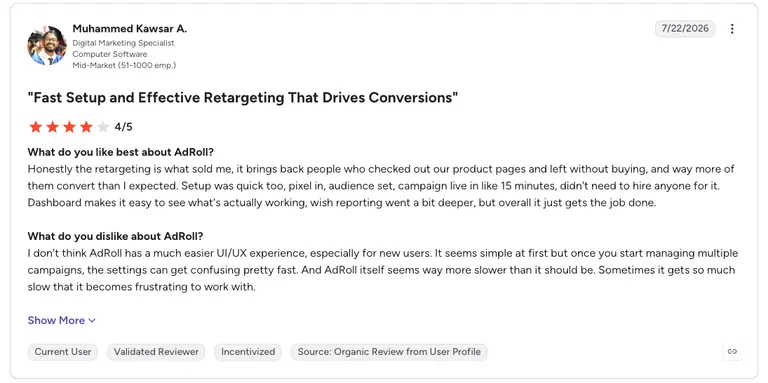
Con: The UI/UX isn't as easy as it first seems. It becomes confusing once managing multiple campaigns, and the platform itself runs slower than expected, sometimes frustratingly so.
“I don't think AdRoll has a much easier UI/UX experience, especially for new users.” (Muhammed Kawsar A., G2 Review, July 22, 2026)
Pricing
AdRoll doesn't have a flat monthly platform fee. Its base Self-Service Ads plan is pay-as-you-go, where you pay only for ad impressions (minimum $2.50/day per campaign).
The Advanced Package (full platform, ad credits, guaranteed services) requires an annual contract with custom/quote-based pricing.
How to evaluate Madgicx alternatives
To decide between alternatives, ask yourself the following questions:
- What's costing you time or money right now? Where's your pain coming from? “Madgicx is too Meta-only" and "I want deeper creative and competitor intelligence" point to completely different tools. The first sends you toward cross-channel platforms, the second toward a creative-intelligence tool like Atria.
- Does it execute, or just recommend? Some tools on this list make decisions and act on them automatically, while others (like Bïrch) run only the rules you build. Others still are pure analytics tools that leave execution to you.
- How steep is the learning curve? A tool that takes your team three weeks to master isn't necessarily worse than one you can pick up in an afternoon. But it needs to earn that time investment. If you're a lean team without a dedicated media buyer, weigh onboarding time as seriously as you'd weigh price.
- What does the pricing look like at your real spend level? Several tools in this category advertise low starting prices that rise quickly once you need core features. Or price as a percentage of ad spend that scales unpredictably as you grow.
- Does it solve creative, targeting, or measurement? Madgicx alternatives split fairly into these three buckets. A tool that's excellent at attribution won't help you if your real problem is creative fatigue, and vice versa. Match the tool to the bottleneck.
- Can you see what's working outside your own account? If creative strategy and competitive analysis are where you're stuck, check whether the tool offers that, since it’s a capability most Madgicx alternatives skip entirely.
Optimizing bids when your real problem is creative fatigue
Most of the tools on this list solve for the same thing Madgicx does, which means better bidding, better targeting, tighter automation. If that's your pain point, Bïrch or Smartly will serve you well.
But a lot of businesses who outgrow Madgicx are short on new creative ideas. No amount of smarter bidding fixes an ad that's already fatigued.
That's what Atria is built for.
It shows you what's currently working for other brands in your category, breaks those winning ads down, and helps you generate new variations grounded in that analysis. That way, you're not guessing at your next creative from scratch.
If your ad performance keeps stalling on the same fatigued creative no matter how you adjust budgets, that's a sign the solution isn't in your bidding tool.
VaynerCommerce, an e-commerce growth agency, doubled their iteration speed and lifted their winning creative hit rate by 30%.
VP of Paid Media, Angelito Tanglao, says,
"We were on Motion plus Foreplay and then went to Atria, and we haven't looked back. Atria had the AI, so we got the same features we wanted in Motion and then some. It's helped us save time, build client trust, visibility, and transparency."
See how Atria helps you grade and generate winning creative.
Frequently asked questions
What is the best Madgicx alternative in 2026?
There isn't one single best Madgicx alternative. It depends on the problem you’re solving. For example, Atria is the strongest option if your bottleneck is creative strategy and competitor intelligence, while Bïrch is the top pick for teams that want rule-based automation,
Is there a free alternative to Madgicx?
There are some free alternatives to Madgicx. Adzooma offers a free entry-level tier, making it the most budget-friendly option on this list. It trades away Madgicx's deeper AI audience and creative tooling for simplicity. It works best for smaller accounts without complex optimization needs.
What's the main limitation of Madgicx?
The main limitations of Madgicx are that it's Meta-only for optimization, its automation can override a custom media-buying strategy, and it has a learning curve that takes most users weeks to master
Is Bïrch better than Madgicx?
Bïrch solves a different problem. Madgicx leans on AI-driven audiences and creative insights. Bïrch gives you full manual control over if-this-then-that automation rules across Meta, Google, TikTok, and Snapchat. Choose Bïrch if you want control over your automation logic.
Do I need a separate tool for competitor ad research?
Not really. Madgicx offers competitor ad research through its Ad Library, that lets you browse competitor and industry ads. But it functions separately from Madgicx's main workflow.
Atria is built specifically around that workflow: seeing what other brands are running, breaking down why it works, and generating new creative directly from those insights.
Can I use Madgicx alongside one of these alternatives?
In many cases, yes. It's common to pair Madgicx with a complementary tool rather than replace it outright, as long as you're not stacking two tools that do the same job.