
The last-click attribution model gives 100% of the credit to the final click before a conversion. And on paid social, that rule hides which creative drove the sale.
Here's how the model works, when it still earns its place, and where it costs you.
What is a last-click attribution model?
Last-click attribution (also called last-touch attribution) is a marketing measurement model that assigns 100% of the credit for a conversion to the final customer interaction before converting.
Every other click, impression, or interaction earlier in the journey (no matter how much it influenced the decision) gets zero credit.
It's a single-touch model, which means it only credits one interaction per conversion.
That's how it differs from multi-touch models like linear or position-based attribution (which spread credit across several touchpoints) and from data-driven attribution, which uses statistical modeling to estimate each touchpoint's contribution.
The “last click” can be almost anything: a paid search ad, a social ad, an email link, or an organic result.
Whatever the customer clicked immediately before they converted is what the model rewards, but it doesn't ask what got them there in the first place.
Last-click has been the default attribution setting across most ad platforms for years, which is part of why it's still so widely used today.
How the last-click attribution model works (with examples)
Whichever click happens right before a conversion gets 100% of the credit, and every click before it gets 0%.
Example 1: Three clicks, one winner
Say a customer clicks three different ads from your brand over the course of a week before finally converting.
- Monday: clicks a display ad, browses, leaves.
- Wednesday: clicks a social ad, adds a product to cart, then leaves.
- Friday: clicks a search ad, completes the purchase.
Under last-click attribution, Friday's search ad gets 100% of the credit for the sale. Monday's display ad and Wednesday's social ad (the two touchpoints that built enough interest to bring the customer back) get nothing.
Example 2: The branded search problem
This pattern appears constantly with branded keywords. A customer discovers your business through a generic, non-brand search term (e.g., “running shoes for flat feet”) but doesn't convert on that visit.
A few days later, now familiar with your brand, they search your brand name directly and buy.
Last-click hands 100% of the credit to that final branded search. The generic keyword that really drove discovery (the one doing the work of bringing in new customers) is adjudged to have contributed nothing.
Last-click attribution can be misleading. It can't distinguish between a keyword (or ad) that closes a sale and one that started the journey that made the sale possible.
Left unchecked, this can push budget toward “closing” keywords and away from the discovery campaigns feeding them.
Why last-click is one of only two models left
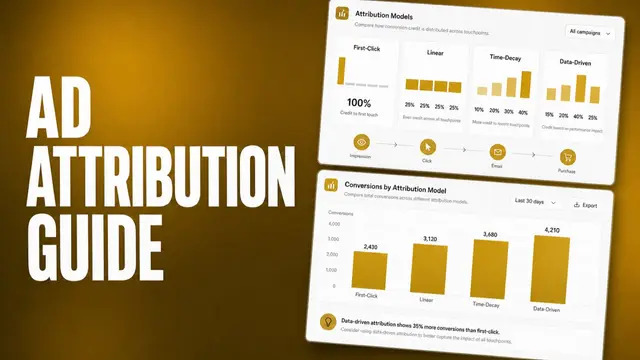
For a long time, marketers had several attribution models to choose from, like first-click, linear, time-decay, position-based, last-click, and data-driven attribution (DDA).
Each one distributed credit differently, and advertisers could pick whichever matched how they thought about their funnel.
That's no longer the case.
Google has deprecated (discontinued) first-click, linear, time-decay, and position-based attribution.
Conversion actions that used to run on those models were upgraded to data-driven attribution. Today, advertisers are left with two options, last-click or DDA.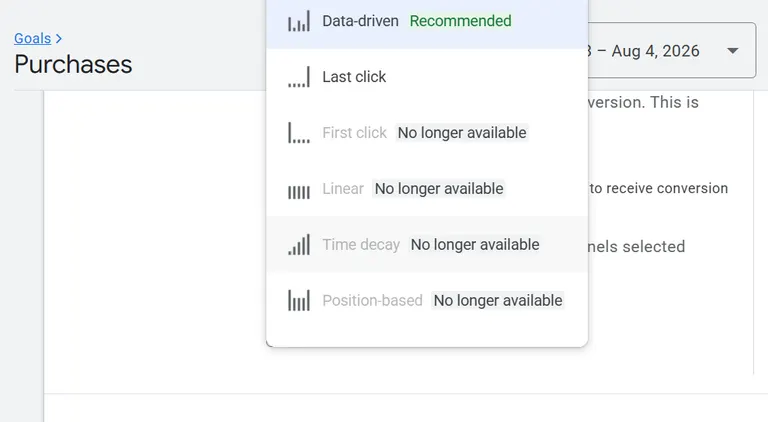
Google Ads attribution-model dropdown, showing only last-click and DDA as available options
This matters for how you should think about last-click in 2026.
You have two options, and one (DDA) comes with a caveat: DDA is available to every account regardless of volume. Google just recommends at least 200 conversions and 2,000 ad interactions in supported networks over 30 days for the model to assign credit precisely.
Below that, the model still runs, but its credit-splitting can be all over the place.
That volume recommendation is why last-click hasn't disappeared.
For smaller accounts, newer campaigns, or lower-conversion-volume advertisers, it's not a straightforward choice between a simple model and a smarter one.
They have to choose between last-click and a model that may not work well if it's not fed enough data.
Advantages of last-click attribution
Last-click attribution has stuck around this long for good reason. It's still the most practical option for a lot of advertisers
- It's simple to set up and interpret: There's no modeling, no statistical estimation, no fractional conversions to explain. One click, one conversion, one line in a report. Anyone on the team can look at the numbers and understand which campaign or keyword gets credit.
- It works well for short sales cycles: If customers typically convert within a day or two of clicking an ad (impulse purchases, flash sales, or low-consideration products), the last click is often the only click that matters. There isn't much of a journey to lose visibility.
- The practical default for smaller or newer accounts: As we saw above, data-driven attribution needs volume; Google recommends 200+ conversions and 2,000+ interactions in a 30-day window. Accounts well below that volume get more reliable reporting from last-click than from a model that doesn't have enough signal yet.
- It supports fast, tactical decisions: Which ad creative converts best? Which keyword is closing sales? Which landing page is working? These are narrow questions where a clear, immediate answer is more useful than a nuanced one. And last-click delivers that answer quickly.
None of this means last-click tells the whole story. Just that, in the right context, it doesn't need to.
Limitations of last-click attribution
The same simplicity that makes last-click easy to use is also what makes it easy to misread.
- Ignore upper-funnel influence entirely: Last-click can't tell the difference between an interaction that closed the sale and one that started the journey toward it.
- Display ads, social content, and early-stage search all risk looking like they “did nothing,” even when they're the reason the customer showed up.
- Doesn't give credit where it's due: A model that rewards only the final step in a multi-step process undervalues everything that came before it. That can push budget toward “closing” channels and starve the campaigns that generate demand.
- Creates a platform double-counting problem: Because last-click logic runs independently inside Meta, Google, LinkedIn, and other platforms, more than one platform can claim 100% credit for the same conversion.
A customer might see a Meta ad, click a Google search ad, and convert. And both platforms' dashboards will report it as their win. Add these numbers up across platforms and your total conversions can be inflated compared to the real value.
- Lacks cross-device and cross-platform accuracy: If a customer clicks an ad on their phone and later converts on a laptop, last-click only sees the final device or session. The broader journey and the channels that shaped it are lost.
- Doesn't account for offline influence: Trade shows, phone calls, in-store visits, and other offline touchpoints are invisible to a click-based model entirely, even when they play a role in the decision to buy.
These limitations don't make last-click useless. It just means the model answers a narrower question, of “what happened right before this specific conversion.”
Last-click vs. data-driven attribution (DDA)
These are the two models left. Let's see how they differ, including how they arrive at that credit.
| Last-click | Data-driven attribution (DDA) | |
|---|---|---|
| How it works | Applies a fixed rule: whichever touchpoint happens last gets 100% of the credit, regardless of what the data shows about the customer's journey. | Uses statistical modeling. DDA compares the paths of customers who convert against the paths of customers who don't, to estimate how much each touchpoint contributed. |
| Volume needed | Works at any volume, including low-conversion accounts. | Needs enough signal to model reliably. Google recommends at least 200 conversions and 2,000 ad interactions in supported networks over 30 days. |
| How credit is split | 100% to the last touchpoint. Every earlier click gets 0%. | Split across multiple touchpoints based on their estimated contribution to the conversion. |
| Who it suits | Small or newer accounts, short sales cycles, or budgets that don't support much remarketing. | Larger accounts with consistent conversion volume across supported networks (Search, Shopping, YouTube, Display, and Demand Gen). |
DDA improves accuracy, but it's not a guarantee that your reporting will suddenly look unrecognizable.
When last-click attribution still makes sense
Last-click, in several situations, is the right call.
- Your account is well below Google's recommended volume: If you're below Google's volume, DDA may not be a better option. Last-click will give you cleaner, more stable reporting at that volume.
- You're running a short sales cycle: If most customers convert within a day or two of their first click, there simply isn't much of a multi-touch journey for a more sophisticated model to untangle. The last click and the meaningful click are often close to the same thing.
- You're a small or newer advertiser: New accounts haven't built up the conversion history that DDA relies on to model contribution accurately. Starting with last-click and moving to DDA once volume justifies it is reasonable.
- Your budget doesn't support much remarketing: Multi-touch and data-driven models lean on having enough retargeting activity to observe how customers respond across multiple touchpoints.
If your budget doesn't stretch to consistent remarketing, there's less of that signal to model to begin with.
Last-click is often the right tool for low-data situations. The mistake is assuming it tells you the whole story once your account has outgrown it.
The blind spot last-click creates for paid social specifically
Everything so far applies to attribution generally. But for brands and agencies running paid social, last-click has a second blind spot that rarely gets mentioned. It hides which channel deserves credit, and one level down, which creative does too.
Think back to the three-touchpoint example. Last-click told you the search ad closed the sale. But inside a single platform like Meta, the same problem repeats at the creative level.
If a customer saw four different creative variations over two weeks before converting on the fourth, last-click gives that one creative 100% of the credit, even if an earlier UGC-style video was what stopped their scroll and built the interest that led to the sale.
That's a real problem for optimization.
Attribution reports can't tell you which specific hook, format, or creative angle inside that campaign is doing the heavy lifting, or merely taking credit for the work of an earlier ad. This causes creative fatigue to go unnoticed until ROAS drops.
Scale ad spend based on last-click alone, and you risk pouring budget into the “closing” creative while cutting the discovery-stage creative that was generating the interest. This is the same mistake as the branded-keyword problem, just one level deeper.
Creative-level analysis comes into play here alongside attribution.
Atria's auto-tagging breaks campaign performance down by the actual creative elements in each ad, like the format, hook, key message, theme, desire, and USP. This way, you can see patterns across dozens of creatives at once instead of guessing from a single conversion path.
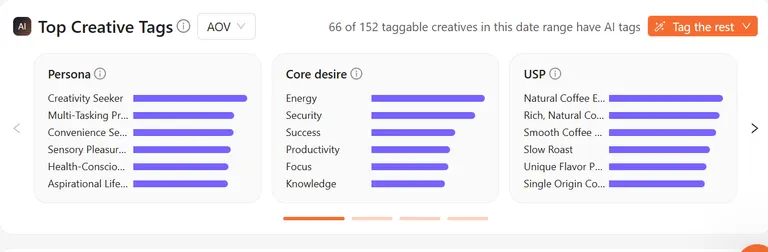
Atria's auto-tagging view, showing creative elements broken out (format, hook, key message, theme, desire, USP)
Then Radar (Atria's ad grader) gives each creative a letter grade with specific fix recommendations, so it's easy to spot which ones are pulling their weight versus which need work.
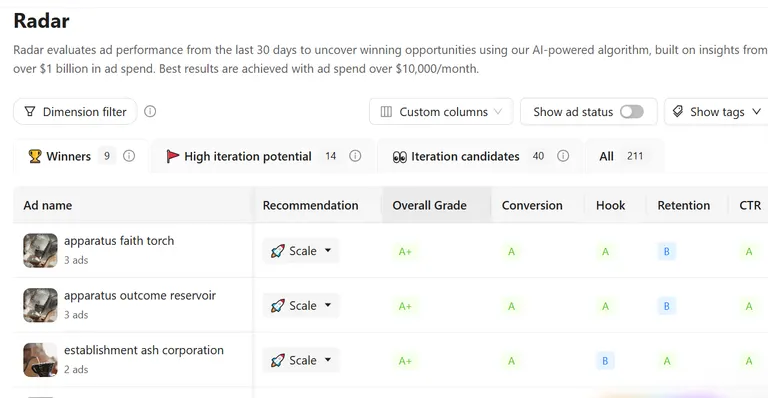
Radar's grading screen, showing letter grades and fix recommendations per creative.
None of this replaces choosing the right attribution model for your account. It tells you which creative earned the credit. For paid social specifically, that's often a more useful question to have answered.
See which creatives are earning their credit
The last-click attribution model tells you which touchpoint closed the sale, but it won't tell you which creative built the interest that got you there.
Atria's auto-tagging and ad grading can show you which creatives are pulling real weight across your account, so your next round of budget goes where it's earning it.
If you run paid social and want to see performance broken down by format, hook, key message, theme, USP, etc, try Atria.
Frequently asked questions
What's the difference between first-click and last-click attribution?
First-click attribution gives 100% of the credit to the first touchpoint in a customer's journey instead of the last one.
Where last-click rewards whichever interaction closed the sale, first-click rewards whichever one started the journey, which means it overvalues top-of-funnel discovery channels and undervalues the touchpoints that convert.
Google deprecated first-click attribution in 2023, so it's no longer a selectable model in Google Ads. Today, last-click and data-driven attribution are the only two options left.
Does GA4 use last-click attribution?
Yes. Google's own GA4 documentation states that “Paid and organic last click” and “Last non-direct click” are two names for the same attribution model. It's one of GA4's rule-based options alongside data-driven attribution, and it credits the last channel a user interacted with before converting.
Is last-click attribution still used in 2026?
Yes. Last-click remains one of two attribution models available in Google Ads, alongside data-driven attribution. It's still widely used by smaller advertisers, newer accounts, and businesses with short sales cycles that don't have the conversion volume to make DDA reliable.
What's the difference between last-click and data-driven attribution?
The difference between last-click and data-driven attribution is that with the last-click model, the final touchpoint before conversion gets 100% of the credit.
Data-driven attribution uses statistical modeling to estimate how much each touchpoint contributed, splitting credit across multiple interactions based on patterns in your account's data.
Does last-click attribution work for Facebook and Meta ads?
Yes, last-touch logic isn't unique to Google Ads. Meta's model menu is standard, incremental, or custom, but the standard setting works similarly.
It credits the most recent qualifying interaction inside your attribution window: a link click within 1 or 7 days, an impression within 1 day, or a non-link engagement within 1 day.
How many conversions do I need for data-driven attribution?
Google recommends at least 200 conversions and 2,000 ad interactions within a 30-day period for DDA to produce reliable results. Below those volumes, the model doesn't have enough data to distinguish between touchpoints accurately. And last-click typically gives more stable reporting.
Should small businesses use last-click attribution?
In most cases, yes, at least until conversion volume grows. Without enough data for DDA to model contribution reliably, last-click gives cleaner, more interpretable reporting. It's a reasonable starting point that can be revisited once volume catches up.