
A script sitting in a doc does nothing for a launch. Somebody still has to turn it into a presenter talking to camera, or a product spinning under studio light. That's exactly why Higgsfield vs Arcads is the question that keeps coming up, but the two tools don't solve the same half of that problem.
I spent two days running a mock skincare-serum launch through both. One job was a talking-head testimonial cut for Meta and TikTok, in English and Spanish. The other was a separate cinematic hero shot of the serum bottle for a landing page.
One tool built the first in minutes, and the other took longer to set up but gave me more granular camera control.
This breaks down what each one does well. It also covers what the pricing pages don't make obvious on their own, and which one to open first for the ad in front of you.
Higgsfield vs Arcads: TL;DR
- Higgsfield and Arcads solve different problems. Arcads builds direct-response, talking-head UGC ads from a script and a large actor library, while Higgsfield is a cinematic, multi-model suite built for camera-controlled product video and URL-to-ad automation.
- Arcads never shows a dollar price until after you sign up. It turns out to start at $110/month ($77 the first month). Higgsfield’s four tiers are public, starting at $9/month.
- Higgsfield gives a free account with access to a limited set of models, no card required. Arcads gives a 72-hour free trial, then bills automatically.
- For a talking-head ad with a realistic AI presenter, Arcads is the faster path. For a cinematic product shot, Higgsfield gives more camera control, though any on-screen text needs a manual check before the ad ships.
Higgsfield vs Arcads: What's the Difference?
Higgsfield is a broad, multi-model production suite built for cinematic range. It covers camera-controlled video, image generation, and a Marketing Studio that builds a finished ad straight from a website URL, all under one account.
Arcads is a focused, actor-led engine. Arcads works by taking a pasted script, matching it to one of more than 1,000 AI actors, and building a talking-head ad meant to run at volume.
Both tools go beyond video, also producing static ads and product imagery. Our wider roundup of AI ad generators also covers image-only picks for a brand that needs static ads too.
Choose Higgsfield if: The job needs camera control, a cinematic look, or a finished ad built straight from a URL.
Choose Arcads if: You already have a script and need a realistic presenter delivering it, fast, across a lot of variations.
How I Tested
My task was based on a skincare-serum launch that needed two different ad assets at once. The first was a 20-second talking-head testimonial for Meta and TikTok, a presenter holding the bottle and speaking in English and Spanish.
The second was a 15-second cinematic product shot of the serum bottle, needed in two aspect-ratio versions, square and vertical, for the brand's different placements.
Here's the brief I gave Arcads for the talking-head cut:
20-second talking-head testimonial for Meta and TikTok, English and Spanish. Presenter holds the bottle in frame for the full clip. Script: "I have to tell you about this. My skin's been so dry the last few months, and I started using this two weeks ago, two drops, morning and night, on clean skin, that's it. By day four my cheeks stopped flaking, and I haven't gone back to my old moisturizer since. If your skin's doing the same dry, tight thing mine was, give this a shot." Deliver it like a real recommendation, not a read-through.
And here's the generation brief I gave Higgsfield's MiniMax H3 Highspeed model:
I need a video for a new skincare serum. Open on the glass bottle on a marble counter in soft morning light, with a slow push-in on the bottle for the first five seconds. Then cut to the same bottle being picked up and tilted so the light catches the liquid inside. I need it to still look like the exact same bottle and label, not a slightly different one. Keep the whole thing under 20 seconds and skip anything that needs a different camera angle mid-shot. I want something simple enough that a small team could use without three rounds of fixes.
I ran the talking-head piece through Arcads and the cinematic piece through Higgsfield, each on its cheapest tier that could deliver that job, over the same two days. The Arcads export came out at 1080p with no watermark and the Higgsfield export ran at 768p.
These three questions decided whether each piece worked:
- Could I get a usable cut without fighting the tool's own workflow?
- Did the stated credits or price cover it?
- And did the finished export look like something a real brand would publish?
Meet Higgsfield: Features & Highlights

Higgsfield is a multi-model creative suite. It covers image, video, and audio generation across dozens of models inside one account.
DoP (Director of Photography) is the camera-control layer, turning an uploaded still and one of its camera-move and effect presets (including a dolly, a 360-degree orbit, a crash zoom, and bullet time) into a directed shot.
This test's cinematic product shot used Higgsfield's Create Video flow, with the MiniMax H3 Highspeed model selected directly and the camera direction written straight into the prompt.
Marketing Studio’s Product Link tool takes a pasted product URL and turns it into a finished ad from a template, no brief needed.
Pricing
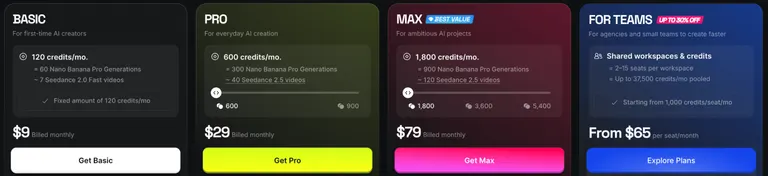
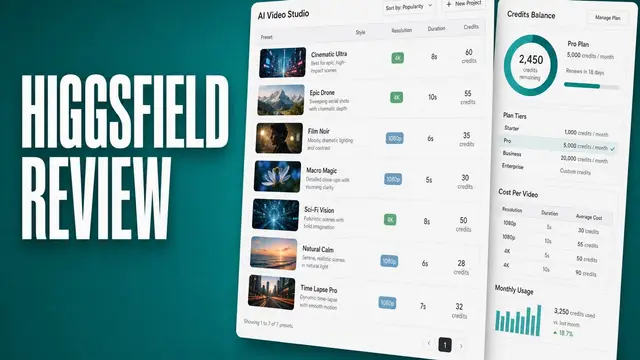
Higgsfield’s individual plans run three tiers. Basic is $9/month for 120 monthly credits, Pro runs $29/month ($23/month billed annually) for 600 credits, and Max runs $79/month ($59/month billed annually) for 1,800 credits.
There's also a free account with access to a limited set of models and no card required to start.
How It Performed
Higgsfield sets the aspect ratio per generation, so the square and vertical cuts were two separate renders, at 768p for 30 credits each on MiniMax H3 Highspeed. The vertical version came out with slightly different framing on the first pass, even though nothing else had changed; a rerun fixed that.
The serum bottle kept its shape, and the label stayed in place across both cuts, but the label's text rendered as gibberish in both versions, and a second rerun didn't fix it.
Higgsfield's camera control gives you real direction over the shot, but the output still needs a close check before it ships.
Higgsfield is built for a team that wants a cinematic product spot, a template-based ad from a product URL, and an AI-influencer clip, all living in one account, though any text in frame needs a manual fix pass budgeted in.
Meet Arcads: Features & Highlights
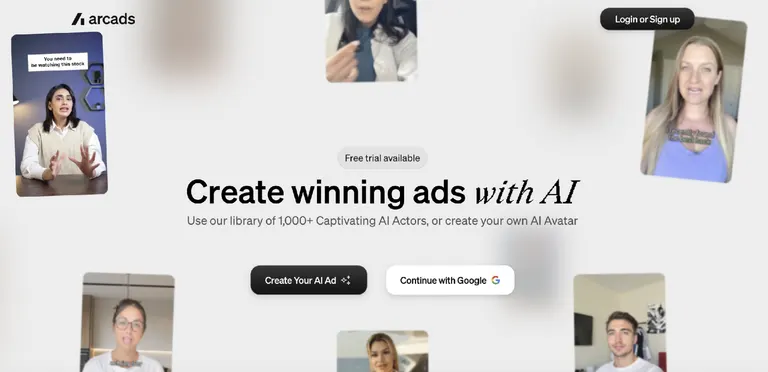
Arcads is built around AI actors that read a script to camera for talking-head ads, though it also supports product videos and static ads.
Its library runs past 1,000 actors on Creator and up (Starter includes 300), with custom avatars for a brand that wants a consistent face across campaigns, and a product-holding feature that keeps the actor's hands on the bottle or box for the full clip.
Its translation feature covers 176 language and accent options, so the same script can ship as a Spanish cut and an English cut from one upload.
A brand running the same presenter across Meta, TikTok, and a landing page would lean on the custom-avatar option so every placement uses one consistent face.
Arcads 1.0 (the model used for this test) tops out at two minutes per video, which is long enough for a testimonial cut but short of a full explainer. Other talking-actor models on the platform allow longer clips.
The dollar figure stays hidden until signup, but the trial itself lasts for 72 hours after entering card details, with 1,000 credits to spend inside that window.
Arcads prices the Starter plan at 8,000 credits a month, enough for about 10 standard talking-head videos at roughly 800 credits each. Translation costs 240 credits per started 30 seconds, per language, so the Spanish version of a 20-second ad adds 240 credits.
A brand can weigh that allotment against a day of booking a human presenter before signing up for Starter.
Pricing
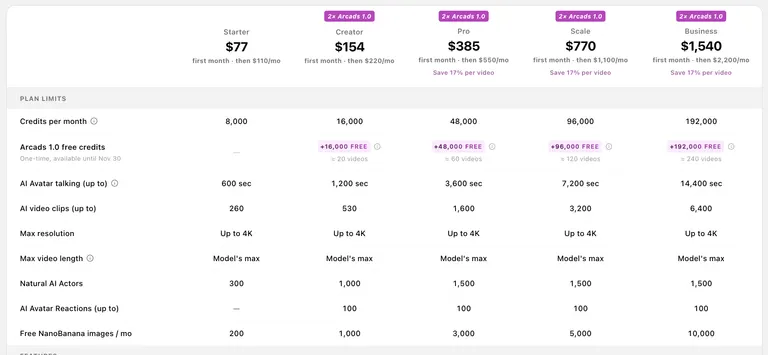
These plans only become visible after you sign up and log in. Arcads' tier structure runs five plans. Starter is $110/month for 8,000 credits, Creator runs $220/month for 16,000 credits, and Pro runs $550/month for 48,000 credits.
Scale and Business climb further, to $1,100/month and $2,200/month, for 96,000 and 192,000 credits. Every plan also carries a reduced first-month rate, $77 on Starter, before the listed price kicks in.
How It Performed
The talking-head testimonial for this test came back in minutes once the script and the brief were in, with the actor holding the bottle in frame for the entire clip and delivering both language versions on the first take.
Getting there does take one extra step. Arcads first generates an image of the actor holding the product, then turns that into the talking-head video.
Arcads is the faster path specifically when the ad already has a written script and the job is producing a high volume of talking-head variations across languages.
Higgsfield vs Arcads: At a Glance
Here’s how Higgsfield and Arcads stack up by job:
| Feature | Higgsfield | Arcads |
|---|---|---|
| Core Use | Cinematic, multi-model video | Actor-led, talking-head ads |
| Actors/Avatars | AI Influencer builder, plus a ready-avatar gallery | 1,000-plus actor library |
| Video Models | 30-plus models | Own model, plus Veo, Seedance, Kling |
| URL-to-Ad | Yes, via Marketing Studio | Yes, via Mark the AI agent |
| Starting Price | From $9/month | $110/month, shown only after signup |
| Free Plan | Free account, free generations | No free plan, 72-hour trial |
| Languages | 18 languages (Translate mode) | 176 language and accent options |
| Output Length | Varies by model | Arcads 1.0: two min; other models: set by each model |
Higgsfield's Basic tier shows no annual discount, so its table price is the same either way. Pro and Max both drop to a lower per-month rate when billed annually.
Arcads' starting figure, $110/month, only shows up after signup, and its annual rate ($88/month for Starter) isn't broken out in this table.
Higgsfield vs Arcads: Feature-by-Feature Comparison
Core Use and Output Type
Higgsfield and Arcads take different approaches to ad production. Higgsfield covers a cinematic hero shot, a static ad, and an AI-influencer clip inside one multi-model account.
Arcads specializes in talking-head ads at volume, but it also supports static ads and product videos.
The talking-head cut went to Arcads and came back in minutes. The cinematic product shot went to Higgsfield's MiniMax H3 Highspeed model and took two separate renders for the two aspect ratios, with a rerun needed to fix framing on one. The label text still came out as gibberish on both.
Winner: Arcads
Actors and Avatars
Arcads' actor library is the deeper one, with more than 1,000 AI actors, custom avatars, and a feature built specifically to make an actor hold a product on screen. The talking-head cut came back with the bottle gripped in the actor's hand from first frame to last.
Higgsfield's answer is its own AI Influencer builder, plus an avatar option inside Marketing Studio. I built a custom character with the AI Influencer builder, then ran the character and the serum bottle through Higgsfield Genjutsu's Object Swap, using one of Higgsfield's own preset clips.
The swap cost 220 credits and landed on the first try. The bottle kept its shape, but the label text distorted again, the same failure as the cinematic product shot.
The preset clip had no dialogue, so the character appeared silent in the scene. For a believable, speaking presenter, Arcads is still the stronger starting point.
Winner: Arcads
URL-to-Ad and Brand Automation
Higgsfield's Marketing Studio has its own URL step: its Product Link tool turns a pasted product link into a finished ad from a template, no separate brief to write.
Arcads has its own URL step through Mark, its AI agent. Mark reads a website's brand overview, products, brand voice, and audience into a brand memory, then builds the ad from a short brief.
Going straight from a URL to a finished ad with no brief at all is still Higgsfield’s edge.
Winner: Higgsfield
Pricing and Free Access
Higgsfield's four tiers are public, starting at $9/month, and a free account gets you generations with no card required. Its Basic tier’s 120 monthly credits cover about 7 Seedance 2.0 Fast videos.
Running past that allowance means generation pauses until the next monthly reset. Higgsfield doesn't bill overage automatically. A one-time Credit Pack is the only way to keep a Basic project moving, since Auto-Refill isn't available on this tier.
Higgsfield's own billing guide notes the real cost of a clip is the price of one generation times how many attempts it takes to land it, so drafting on a lighter model before the final run is the cheaper way to stay under that Basic-tier cap.
Arcads never shows a dollar figure until after signup. Instead, it offers a 72-hour free trial, card on file but not charged, before the Starter monthly plan bills automatically at $110/month ($77 the first month, or $88/month billed annually).
Arcads prices a Starter-tier talking-head video at about 800 credits, one of roughly 10 single-language videos the monthly allotment covers. Translation and other generation steps use additional credits.
Hitting that 8,000-credit Starter cap mid-month doesn't trigger a bill from Arcads either. Generation stops and opens an upgrade prompt instead, while only higher-tier plans, Pro ($550/month) and up, bill extra usage on the next invoice.
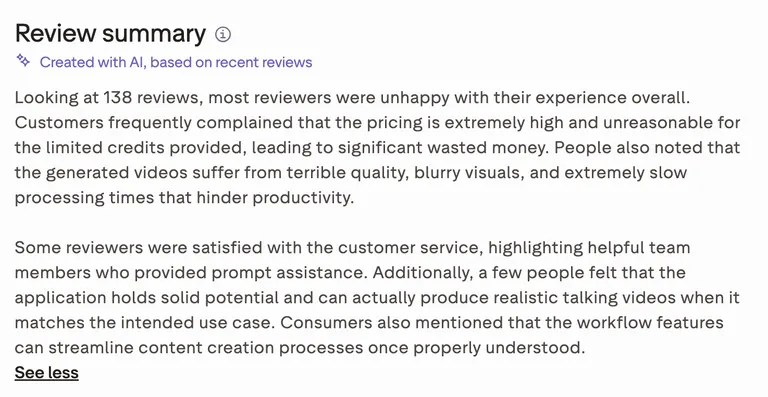
Trustpilot reviews repeatedly flag the credit economy itself, with several reviewers reporting they burned through credits faster than expected for the number of finished videos they got back.
Winner: Higgsfield
Languages and Output Length
Arcads publishes 176 language and accent options for translation. Arcads 1.0 videos top out at two minutes, but other talking-actor models allow longer clips.
Higgsfield's Translate mode covers 18 languages, fewer than Arcads, and output length depends on which of its 30-plus models is doing the generating. For a multilingual UGC rollout specifically, Arcads gives a clearer answer up front.
Winner: Arcads
What Real Users Are Saying
Higgsfield
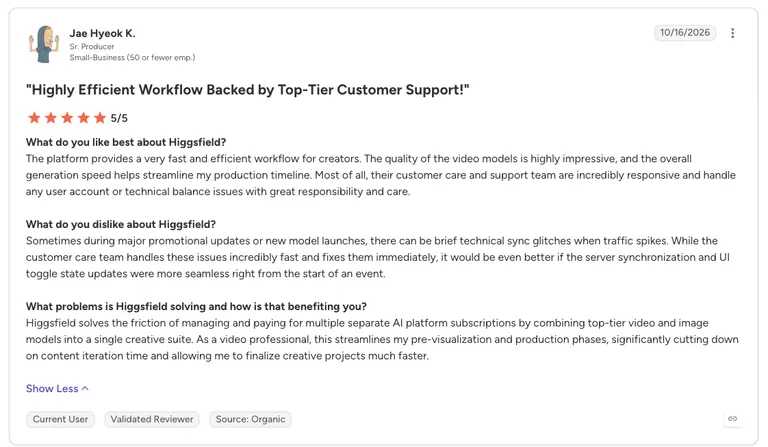
"The platform provides a very fast and efficient workflow for creators. The quality of the video models is highly impressive, and the overall generation speed helps streamline my production timeline.": Jae Hyeok K., G2
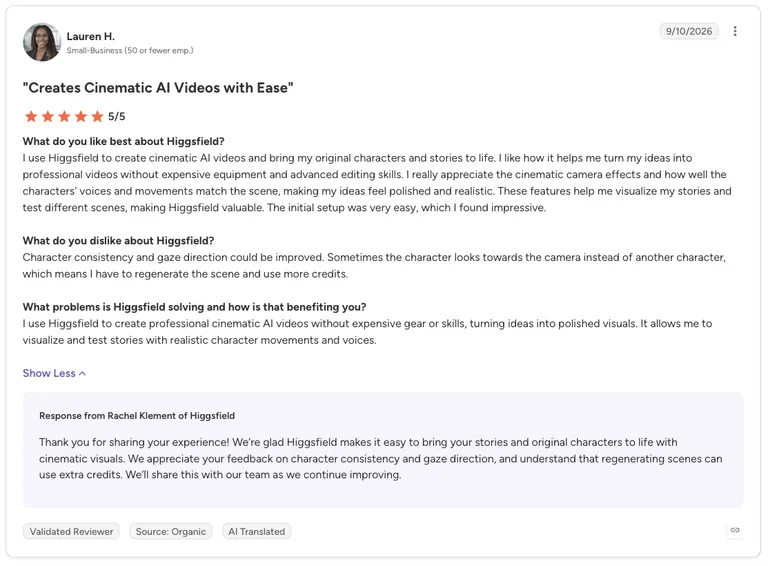
"Character consistency and gaze direction could be improved. Sometimes the character looks towards the camera instead of another character, which means I have to regenerate the scene and use more credits.": Lauren H., G2
Arcads
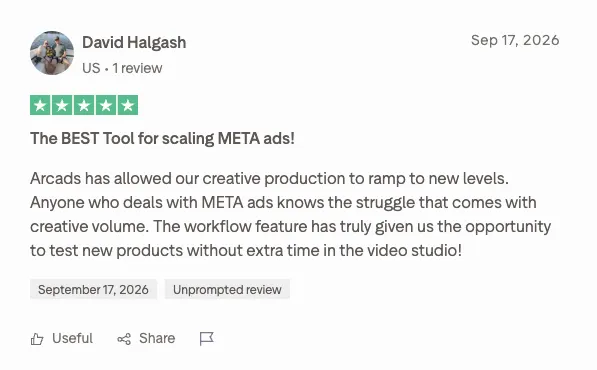
"Arcads has allowed our creative production to ramp to new levels. Anyone who deals with META ads knows the struggle that comes with creative volume.": David Halgash, Trustpilot
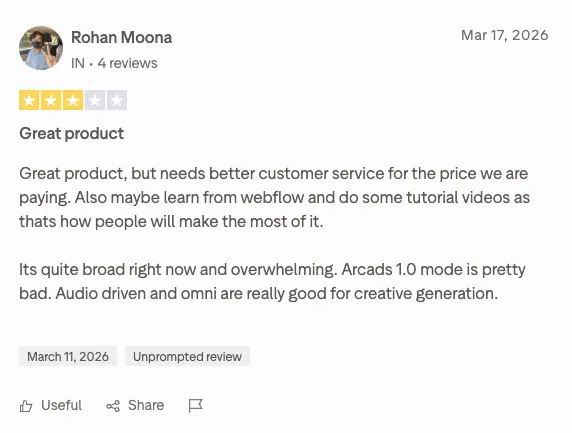
"Its quite broad right now and overwhelming.": Rohan Moona, Trustpilot
How to Make Your Choice
Neither tool wins outright, because they're answering different questions. Arcads wins when the script is already written, and the job is a believable presenter at volume. Higgsfield wins for a brand that needs camera control, a cinematic finish, or a fast, template-based ad from a URL.
Creative testing tools pick up where both of these stop, once you're past generation and into comparing finished variants against each other.
Higgsfield Is Better For
Higgsfield fits a brand that needs camera control and a fast ad-from-URL workflow in one account:
- A cinematic hero shot or product spot that needs real camera control.
- Brands that want a finished ad built straight from a product URL, no brief needed.
- Teams that want image, video, and audio generation bundled into one account.
Arcads Is Better For
Arcads fits a brand that needs a convincing presenter at volume:
- A talking-head testimonial ad built from a finished script.
- Brands that need a lot of actor-led variations, fast.
- Teams that want to hold a product on screen convincingly.
My Verdict
If a finished script lands on my desk, Arcads gets opened first. Its actor library and product-holding feature are the right tools for that exact job.
If the launch needs a finished ad built straight from a URL with no brief to write, Higgsfield's Marketing Studio and its camera control are worth the longer setup.
Next Steps: Bring Atria Into the Workflow
Higgsfield and Arcads both support ad creation, so the Higgsfield vs Arcads question doesn't end there. Arcads' Mark can also study competitor ads to find winning creative angles. Atria's layer is creative intelligence. It grades existing ads, flags weak hooks, and helps teams decide what to make next.
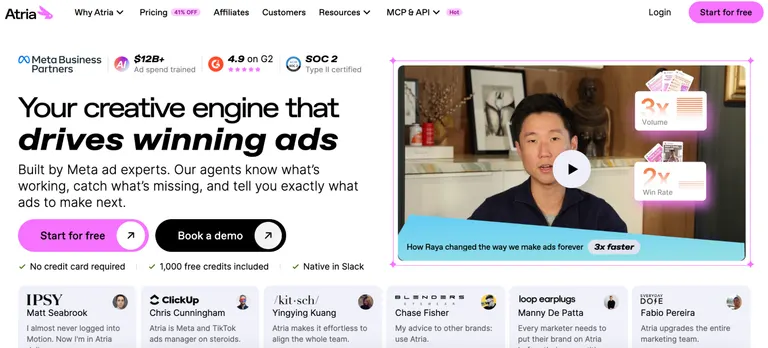
Atria fits here as the research-and-strategy layer that feeds both Higgsfield and Arcads. Raya, Atria's AI creative strategist, pulls competitor ads and customer reviews to write the hooks and ad copy that Higgsfield or Arcads then turns into a finished cut.
Radar, Atria's always-on ad-grading engine, grades the Meta and TikTok ads already running within its 30-day review window, to discover a losing angle before it drains more budget.
Start a brief with Raya before your next launch, so the script and the hook are decided before you open either video tool. Atria includes 1,000 free credits, no credit card required.
Frequently Asked Questions
Is Arcads AI free?
No, Arcads doesn't have a free plan, but it does give a 72-hour, 1,000-credit trial. A card is required at signup but isn't charged during the trial, and the Starter monthly plan starts automatically once the 72 hours end, at $110/month ($77 for the first month).
Is Higgsfield free?
Yes, to start, but not for ads. Higgsfield’s free account gives access to a limited set of models with no card required, and it doesn’t allow commercial use.
Its paid tiers begin at $9/month once you need more models or credits than the free tier includes.
Which is better for UGC ads, Higgsfield or Arcads?
Arcads is better for UGC ads, specifically for talking-head UGC built from a script. Its actor library and product-holding feature are built for that one job, while Higgsfield works better for cinematic and template-driven ads.
For Meta placements specifically, this breakdown of Facebook ad generation takes a closer look at ad-generation options.
What's the main difference between Higgsfield and Arcads?
The main difference between Higgsfield and Arcads is that Higgsfield is the cinematic, multi-model suite, and Arcads is the focused, actor-led engine for talking-head ads.
That holds for either search order, Arcads vs Higgsfield or Higgsfield vs Arcads. The real answer depends on whether you're starting from a script or a bare product URL.