
Facebook ad mistakes often hide inside a rising CPA, a stalled ROAS, or an account that stops improving for no clear reason.
I've audited enough ad accounts to know that the same 11 mistakes keep showing up, even among marketers who've been running Meta ads for years.
This list covers what these mistakes cost you, starting with the mistake many accounts get wrong on day one.
11 Facebook ad mistakes to avoid
Stay aware of these mistakes so you don’t run into the same problems with your Facebook ads.
1. You don't give Meta's algorithm time to learn before making changes
Meta needs about 50 optimization events within a rolling 7-day window before an ad set's delivery stabilizes.
Below that number, the algorithm is still testing audience segments, placements, and timing, so a rough day two doesn't necessarily mean a bad audience or weak creative. It usually just means the data hasn't caught up yet.
The edits that reset this clock can be varied:
- A new optimization event: This changes what Meta's algorithm is trying to predict, which restarts the model from scratch.
- A creative swap: This counts as a significant edit even when the offer and audience stay exactly the same.
- An audience change: This resets learning right away, no matter how small the adjustment.
- A large bid or budget change: This can trigger the same reset, depending on how big the jump is.
I've pulled an ad set after two rough days more than once, only to watch a version I left alone for a full week settle into a solid cost per acquisition (CPA) on its own. Impatience costs more here than many advertisers account for.
That's why I batch plan changes into a single weekly update now. It keeps daily swings that don't mean anything yet from tempting me into action, and it protects whatever progress the ad set has already made.
💡 Tip: Check the delivery status column in Ads Manager before judging results. If it says "learning limited," waiting won't fix it. That status means your budget, audience, or optimization event is too small to hit 50 events at all, so the ad set needs a structural change.
2. You manage budget at the ad level and skip Meta's automatic optimization across ad sets
Advantage+ campaign budget sets one budget for the whole campaign. Meta then shifts spend in real time toward whichever ad set is producing the best results.
A manual ad-level budget locks in a fixed amount per ad set no matter how it performs, so you're deciding the split up front instead of letting live data drive it.
Meta's own data, based on a controlled study across tens of thousands of campaigns, puts the average CPA improvement from switching to Advantage+ campaign budget at 4.6%. Meta frames this as an estimate as opposed to a guarantee, but even a modest average gain compounds fast across a full account.
Manual budgets still make sense in a few specific cases:
- A new audience needs a guaranteed minimum spend to gather enough data before Meta can judge it fairly.
- A test requires equal delivery across ad sets so the results are actually comparable.
- Ad sets target segments with very different customer value that Meta's algorithm might otherwise treat as interchangeable.
The mistake shows up when manual budgets stick around long after a campaign has enough data to know which ad sets deserve more.
That's almost always leftover setup from an earlier test that nobody revisited, worth fixing before you scale your ads, since a split that worked at a smaller budget can quietly cap results once spend grows.
I switched most of my active campaigns to Advantage+ campaign budget a while back. The shift away from an underperforming ad set now happens faster than I could manage by hand.
That said, I still set minimums and maximums first. Giving Meta full control with no guardrails can starve a smaller audience of budget before it's had a fair shot.
3. Your audience exclusions and funnel structure aren't stopping wasted spend
Wasted spend here rarely comes from an audience being too broad or too narrow. It usually comes from two campaigns competing for the same person in the same auction, or a warm lead still seeing a cold prospecting ad after they've already converted.
Overlapping audiences aren't automatically a problem, but they can hurt delivery. When ad sets target the same people, only one ad enters the auction for that person, and the other ad set gets passed over for that auction.
That can stop it from spending its budget or ever collecting enough data to exit the learning phase.
In my experience, the accounts losing the most money have prospecting and retargeting campaigns running at the same time, with no exclusions between them. Both campaigns end up competing for the same warm lead, and one of them loses that auction every time.
Funnel structure fixes most of this:
- Cold audiences shouldn't see a hard offer: They haven't built enough trust in your brand for that yet.
- Warm audiences don't need prospecting creative: They've already seen the introduction.
- Converted customers should drop out of prospecting entirely: Paying to reach someone again as a "new" customer wastes budget twice.
💡 Tip: Build a custom audience of past converters and exclude it from every active prospecting campaign. This one exclusion catches a surprising amount of the waste that funnel-stage confusion can cause.
4. You test too many things, or the wrong things, at once
A test only tells you something if you can trace the result back to one specific change. Testing five audiences and three ad formats in the same wave makes it impossible to tell which one actually drove the result.
Meta's own testing guidance backs this up: ad sets need to be identical except for one variable to produce a result you can trust. Change more than one thing between ad sets, and a "winning" result can't tell you which change actually caused it.
I made this exact mistake with a placement test once. I used five audiences and three formats, and launched them all together. The winner could have been the audience, the format, or some combination I'll never untangle now.
Where you run the test matters just as much as what you test. Creative variations belong at the ad level, since ads inside the same ad set can differ by headline, image, or copy without changing who sees them.
Audience or placement changes need their own ad set instead, because those variables decide who sees the ad in the first place, not just which version of it they see.
5. You're not feeding the algorithm enough creative variety
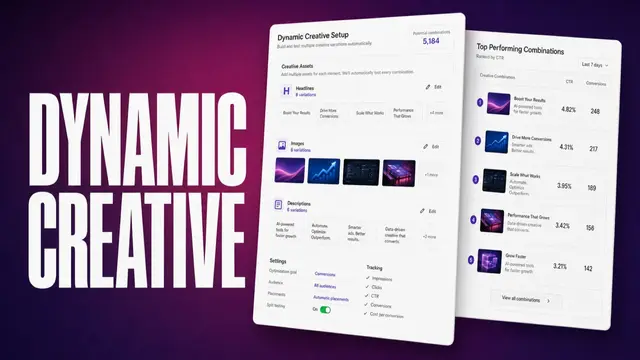
Meta's Andromeda update changed how the algorithm evaluates creative. Running the same 3 or 4 ad variations no longer gives it enough to work with.
Before Andromeda, Meta capped its own guidance at 6 ads per ad set. That guidance disappeared around Andromeda's rollout. Around the same time, Andromeda started reading the creative itself: the hooks, format, and tone. That reading now decides who sees an ad more than the targeting does.
At Atria, we now recommend going as high as 10 to 20 distinct concepts per ad set, though not every practitioner agrees.
Meta ads consultant Jon Loomer has cautioned against treating Meta's removal of the old 6-ad guideline as permission to run 20 to 50 ads in an ad set.
For accounts with modest budgets, he says he'd still lean toward a 6-ad ceiling as a starting point, since spreading spend too thin can leave individual ads without enough data to read results at all.
💡 Tip: Build each new concept around a different angle, persona, or emotional trigger. A surface-level change to an existing concept doesn't create real variety in Andromeda's eyes.
6. You miss the early signals of creative fatigue
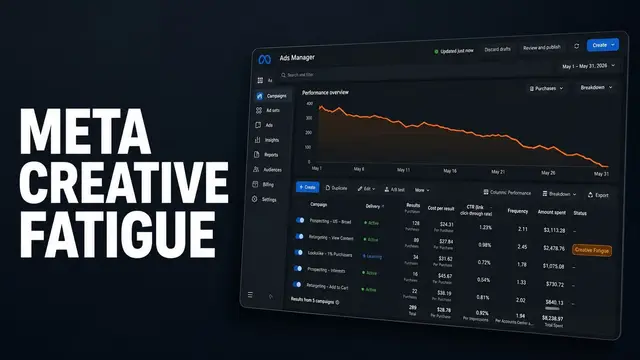
Creative fatigue rarely shows up as one obvious signal. It's more like 3 subtle ones moving at once, like frequency creeping past 2.5 to 3.0 for a top-funnel campaign, CTR trending down for a full week, and CPA drifting upward with nothing else in the account changed.
Waiting for Meta's delivery column to flag "Creative Fatigue" outright means the damage already happened by then, since that label only appears once cost per result has roughly doubled. The early warning signs show up well before that status does.
I check frequency and CTR together now instead of waiting on either one alone. A frequency spike with flat CTR usually means the audience is fine and the creative just needs a refresh. A CTR drop with normal frequency points somewhere else entirely, often a landing page or offer problem instead of a creative one.
💡 Tip: Isolate the fatigued asset before touching anything else. Pause that one ad on its own, since pausing the whole ad set resets the learning progress you've already earned.
7. Your ad and landing page experience don't match
Meta tracks whether your ad and your landing page match through a metric called Conversion Rate Ranking, which compares your ad's expected conversion rate to other ads targeting the same people.
A low ranking here points to something specific. People click your ad, then leave your landing page without converting, because the page doesn't deliver what the ad promised.
Meta actually splits this into three separate scores: Quality Ranking, Engagement Rate Ranking, and Conversion Rate Ranking. When the first two look fine, but Conversion Rate Ranking is low, look at your landing page first.
I see this mistake often, usually when an ad promises a specific sale or discount but the landing page shows a generic product page instead.
The visitor expected one thing, found something else, and left before converting. Many of these visitors are on a phone too, so a slow-loading or cluttered page loses them before the mismatch even registers.
8. You track ROAS alone instead of MER
Meta's return on ad spend (ROAS) comes from an attribution window, the time period Meta uses to decide which purchases count toward an ad.
Meta changed its attribution rules in early 2026. It dropped the longer view-through windows and narrowed what counts as a click to actual link clicks.
The current default is 7-day click, 1-day engage-through, and 1-day view. Engage-through is Meta's new bucket for likes, saves, and other non-link interactions, so a purchase can still count toward an ad even when no one clicked the link.
That 1-day view-through credit is where ROAS can get inflated. A customer who saw an ad, closed the app, and bought within 24 hours anyway still counts as a Meta-driven sale. Your in-platform ROAS looks strong, but it's counting some purchases your ads may not have actually caused.
MER, or marketing efficiency ratio, sidesteps this problem entirely. MER divides total revenue by total ad spend across every channel without asking which platform gets credit for a sale.
It can't tell you which specific ad drove a specific sale, but it also can't get inflated by attribution modeling, since it doesn't depend on attribution at all.
I check both together. A rising in-platform ROAS next to a flat or falling MER usually means attribution is doing more of the work than the ads are. A rising MER alongside a rising ROAS is the stronger signal that a spend increase is actually working.
9. You choose a campaign objective that doesn't match your actual goal
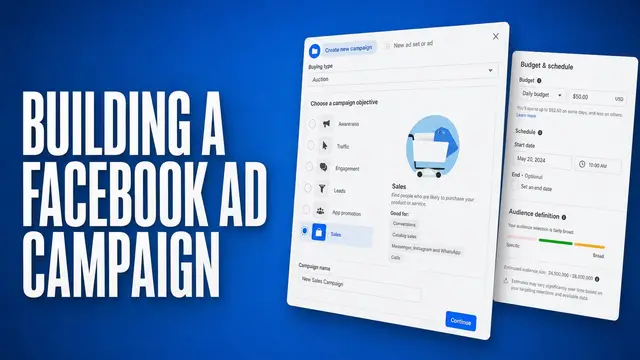
A campaign objective tells Meta what to optimize for, and Meta only optimizes for that one thing. Choosing an objective like Traffic when your actual goal is purchases means Meta optimizes for the wrong outcome entirely.
The Traffic objective optimizes for link clicks or landing page views. Whether that click or page load turns into a paying customer isn't part of the equation.
A cheap click and a qualified buyer are different things, so an account running Traffic can show a low cost per click and a high CPA at the same time, since the two numbers measure entirely separate outcomes.
My recommendation? Match the objective to the number that actually matters for the business. For example, revenue-focused campaigns should run Sales, the objective built to find people likely to complete a purchase.
10. You lean on automated rules without knowing why performance moved
An automated rule checks specific numbers against thresholds you set, then takes one action. It pauses an ad, adjusts a budget, or sends a notification when a condition is met, and that's the entire job it does.
A rule can pause a fatigued ad, but it can't tell you why that ad fatigued.
Meta's own guidance backs this up: automated rules can cut down the time needed to manage ads, but you still need to monitor overall performance to confirm your ads are meeting your actual marketing goals.
I only trust rules for guardrail work now, like capping spend and catching a CPA that's clearly out of bounds. Anything beyond that, like figuring out why a number moved, still needs a human looking at the actual creative.
💡 Tip: If you're relying on rules to catch problems but still guessing at the cause, check out our guide to tools for Facebook ads optimization.
11. You skip competitor and customer data as a source of new creative angles
New ad ideas often come from inside the account. It could be a past winner, a hunch, or whatever performed last quarter. But that leaves out two of the richest sources available:
- Competitor ads: The Meta Ad Library is free and public. Anyone can search a competitor's Facebook Page and see every ad they're currently running, no login required. A competitor wouldn't keep an ad live if it were losing money, so an active ad is already a signal worth studying.
- Customer reviews: The specific words customers use to describe a problem or a result usually outperform whatever a copywriter invents from scratch, since that language already resonates with a real buyer.
I check both before writing a single new hook now. It takes maybe 20 minutes, and it consistently produces new angles I wouldn't have thought of staring at my own account alone.
Rubix, a performance marketing agency, ran into this exact wall doing it by hand. Their founder wanted creative insight built into the team's workflow itself, so good ideas weren't left to chance. Adding Atria's research tools got them to 40% faster creative analysis and a 15% ROAS lift.
See what's actually causing your Facebook ad mistakes
Facebook ad mistakes rarely show up as a single obvious signal. A rising CPA or a stalled ROAS could trace back to any one of the 11 issues above, and Ads Manager's combined reporting often can't tell you which one you're actually dealing with.
Atria is a creative intelligence platform built to solve that problem. It looks past the aggregate numbers Ads Manager shows and points to which creative, audience, or budget decision is actually driving a shift in performance, so you know exactly which mistake to fix first.
Here's how Atria helps you catch these specific mistakes before they compound:
- Creative-level grading: Every ad gets a plain-English grade, so you can see exactly which hook, image, or headline is holding back performance.
- Continuous fatigue monitoring: Atria's Radar tracks every live ad and flags fatigue as it starts, so a declining creative gets caught before it drags down the rest of the ad set.
- Competitor and customer research: Raya pulls hooks, angles, and personas from a library of over 100 million ads, and mines customer reviews for the language your buyers already use, giving your next test a stronger starting point than your own account data alone.
- Automatic budget shifts: Set spend to move toward winning ad sets and pause underperforming ones on its own, so a test doesn't lose ground between manual check-ins.
- Native in Slack: Raya drops grading updates and next-step recommendations straight into Slack, so your team doesn't need a separate dashboard to catch a mistake early.
Ready to find out which mistake is costing your account the most? Try Atria for free today.
Frequently asked questions
How often should you change your Facebook ad creative?
Refresh Facebook ad creative every 1 to 2 weeks for direct response campaigns and every 3 to 4 weeks for brand awareness campaigns. A frequency above 2.5 to 3.0, a declining CTR, or a rising CPM signals a specific ad needs replacing sooner.
How long should you wait before judging a new Facebook ad campaign?
Wait at least 3 to 7 days, or until the ad set exits the learning phase, before judging a new Facebook ad campaign.
Meta needs about 50 optimization events within a 7-day window to stabilize delivery, so early results often look worse than they actually are. Check the delivery status column in Ads Manager to confirm the ad set isn't learning limited first.
Is testing multiple things at once on Facebook ads a bad idea?
Yes, testing multiple things at once makes it impossible to know which change drove the result. Meta recommends keeping ad sets identical except for the one variable being tested. Test audience or placement changes in separate ad sets, and creative variations within a single ad set.