
Software for automating Meta ads production is any platform that removes manual work from the Meta ad lifecycle: creative production, campaign setup, budget management, performance monitoring, and reporting.
In 2026, these tools aren't optional anymore.
Meta's Andromeda algorithm, which completed its global rollout in October 2025, evaluates creative quality as the primary delivery signal. The result is that performance teams need far more ad creatives per campaign than any team can produce manually, at a refresh cadence no manual process can keep up with.
This guide compares the five best platforms for automating Meta ads production: Atria, Birch (Revealbot), AdStellar, AdAmigo, and Pencil. You'll get verified pricing, G2 ratings, and a straight breakdown of what each tool does well and where it falls short.
Book a demo with Atria to see how the full workflow looks in practice.
Why Ads Automation Matters for Meta and Ads Manager
Manual Meta ads management doesn't scale. A skilled media buyer can realistically handle 10-15 campaigns; with ads automation, that same person can oversee 100 or more.
The gap widened when Meta's Andromeda update changed how ads are delivered, shifting from audience-first targeting to creative-first delivery. The algorithm reads your creative now to decide who sees your ad.
The creative fatigue window shrank to 2-3 weeks, down from six or more weeks. A team refreshing creative monthly runs three weeks behind the algorithm's appetite.
Meta ads automation fixes this by detecting creative fatigue through frequency and CTR signals before performance drops, then triggering fresh ad creatives automatically.
That's why software for automating Meta ads production has become infrastructure, not a luxury.
How AI Tools Power Meta Ad Campaigns and AI Ads Production
The most important distinction in 2026 is between AI tools and rule-based platforms.
Rule-based tools react to conditions you define: if CPA exceeds a threshold, pause the ad set. AI tools detect patterns across your historical performance data and act without a human writing every rule first.
How Andromeda evaluates ad creatives in real time has made the "what to create" problem as important as the "how to create" problem. Most AI tools only address production speed. The better platforms also tell you which ads to make, and why.
Check out our list for a deeper breakdown of the top Meta ads AI tools by category.
Types of Automation Platforms and Automation Tools
Not every platform in the Meta Ads automation software category solves the same problem. Understanding which type you need before buying saves time and budget.
| Type | What it automates |
|---|---|
| Rule-based automation platform | Campaign rules, bid optimization, budget pausing, and alerts triggered by thresholds you define |
| AI agent platform | Campaign creation, daily optimization, and audience management driven by AI, not manual rules |
| Creative automation tool | Ad production, brief generation, ad variation testing, and batch launch to Meta |
| Multi-account management platform | Cross-client reporting, managing campaigns, and client-facing dashboards |
Most teams use more than one type. Rule-based automation handles governance. AI agents handle dynamic optimization. Creative tools handle production volume.
Selection Criteria: How to Pick Meta Ads Automation Platforms
Before you evaluate any specific platform, clarify four things:
- Budget level. Monthly ad spend determines which pricing tiers are cost-effective. Per-account pricing gets expensive for agencies managing multiple client accounts at scale.
- Channel scope. Meta-only or cross-platform support? A Meta-specific tool goes deeper on Facebook and Instagram. A multichannel tool reduces switching costs if you also run Google Ads or TikTok.
- Creative need. Do you need ad creation help, or do you already have a production system and just need campaign optimization and automation rules?
- Automation depth. Rule-based logic works for stable campaigns. AI agents are necessary when you need dynamic optimization at scale without writing every decision rule yourself.
See also: the best AI for FB ad generation in 2026 for a focused look at the creative production side of this decision.
Quick Comparison: Top Software for Automating Meta Ads Production
| Tool | G2 Rating | Best For | Top Feature | Starting Price |
|---|---|---|---|---|
| Atria | 5.0 | DTC brands and agencies needing creative intelligence + AI production | Raya AI creative strategist trained on $9B+ in real ad spend | $159/mo ($129/mo annual) |
| Birch (Revealbot) | 4.6 | Performance teams needing rule-based automation across platforms | Automated rules engine with 20+ actions and nested conditions | $49/mo (up to $10K spend) |
| AdStellar | Not on G2 | Media buyers needing fast AI campaign building | Launch-ready campaigns in under 60 seconds | $49/mo (Hobby) |
| AdAmigo | 4.9 | Agencies wanting full Meta autopilot with daily AI actions | AI Action Agent with dual-approval workflow | $99/mo (per ad account) |
| Pencil | Not on G2 | Enterprise teams needing a cross-platform GenAI creative OS | Brief-to-ad workflow with brand governance and multi-platform launch | $14/mo (Core) |
The 5 Best Software for Automating Meta Ads Production
Each tool below uses the same criteria: what it is, who it suits, key features, and pricing. Compare them on equal footing before you commit.
1. Atria: Creative intelligence + full-stack Meta production
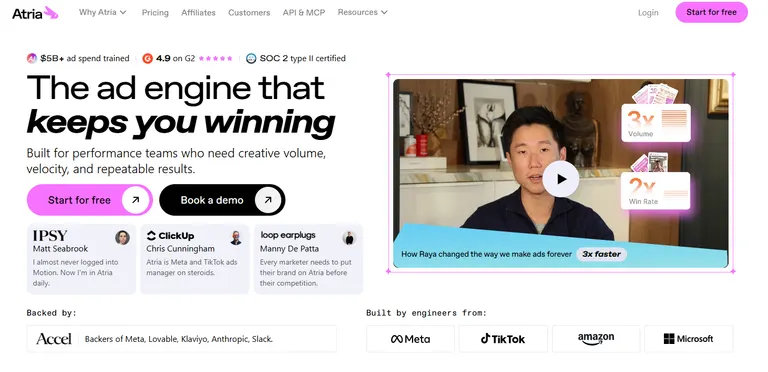
Atria is an AI-powered ad creative intelligence and workflow platform built for performance marketers running Meta and TikTok campaigns.
Its Raya AI covers competitor research, performance analytics, customer insight extraction, and ad creation in one connected workflow.
What makes it different is that it solves the intelligence problem, identifying what to create and why, alongside the production problem. Atria also makes it straightforward to run a systematic Facebook ads competitor analysis from the same dashboard.
Channel focus: Meta-specific (also TikTok).
Best for
DTC e-commerce brands and performance agencies that need both strategic creative direction and production volume. It's strong for creative teams that want data-backed direction on which ads to build next, not just faster output.
Key features
- Raya AI creative strategist: Analyzes your account and competitors, finds winning patterns, generates creative briefs, and handles writing ad copy grounded in real performance data.
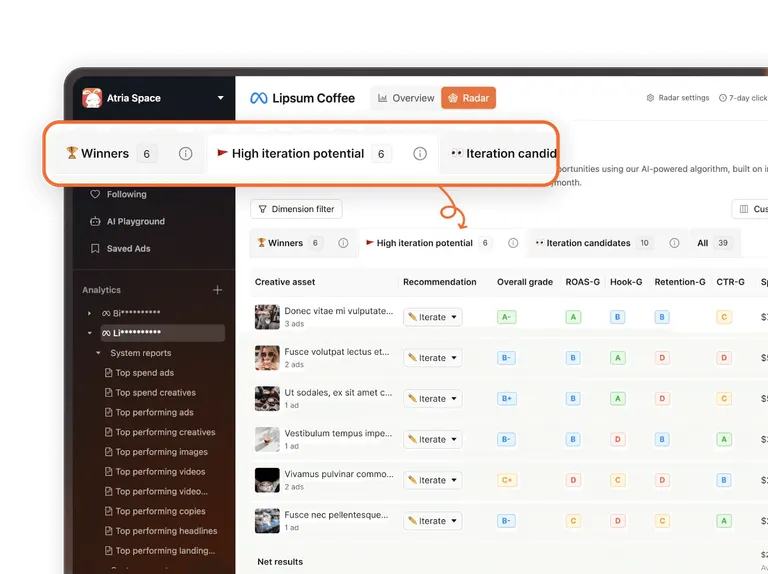
- Radar performance intelligence: Assigns letter grades (Conversion, Hook, Retention, CTR) to every ad and pinpoints what to change in underperformers, removing guesswork for the creative team.
- 100M+ tagged ad library: Search competitor ads by brand, hook type, or creative formats to inform ad creation from what's already working in the market.
- Review mining: Extracts language from customer reviews so ad copy uses the words real customers use rather than marketing assumptions.
- Meta batch upload: Pushes approved creative variations directly to your Meta ad account in bulk, removing repetitive tasks from the ad production workflow.
Pricing
Subscription. Core plan at $159/month ($129/month billed annually), with five seats, 4,000 AI credits, and 50 brand tracking slots.
Book a demo with Atria and see how Raya handles the full workflow.
2. Birch (Revealbot): Rule-based automation across platforms
Birch, formerly Revealbot, is a multichannel ad automation platform built around a powerful rules engine, a creative management hub called Stage, and a performance analytics layer called Hub.
Its rule-builder depth sets it apart: 20+ actions, nested AND/OR conditions, and integrations with Slack, Google Sheets, AppsFlyer, and Hyros.
Channel focus: Multichannel (Meta, Google, TikTok, Snapchat)
Best for
Performance teams managing $10K-$200K/month across multiple platforms who have a documented optimization playbook and need third-party tools to execute it automatically, without tool-switching.
Key features
- Automated rules engine: Build complex if/then rules with 20+ available actions: pause campaigns, scale budgets, send Slack alerts, or adjust automated bidding using real-time performance data and nested conditions.
- Stage (creative management): Upload, organize, and launch ad creatives from a central library with top-performer identification across multiple ad accounts.
- Hub (cross-account analytics): View performance trends across multiple ad accounts in a single workspace-organized dashboard with wasted-spend flagging.
- Post boosting automation: Boost organic posts automatically when they exceed a defined engagement or reach threshold.
- Multi-account management: Manage multiple client accounts from one login with workspace organization, advertising workflows, and automated reporting across clients.
Pricing
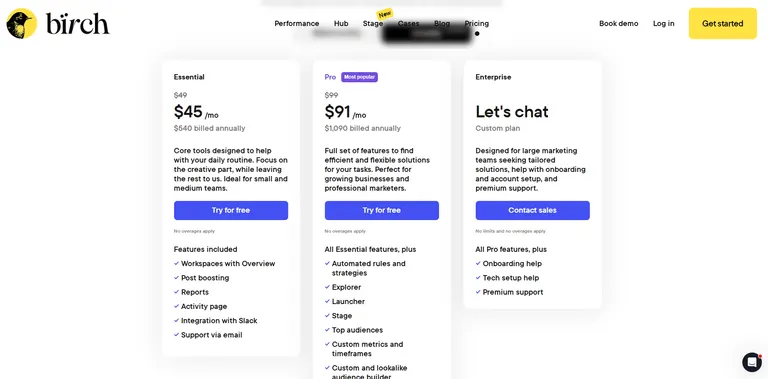
Ad spend-based. Essential plan at $49/month for up to $10K monthly ad spend. Pro at $99/month includes automated rules and the complete feature set. Overages apply when spending exceeds the plan limit.
3. AdStellar: AI campaign builder for Meta ads
AdStellar is a Meta-focused AI campaign builder that uses seven specialized AI agents to plan, build, and launch complete ad campaigns in under 60 seconds. Every audience selection, ad copy recommendation, and budget allocation comes with a written rationale before anything goes live. You're not handing your ad spend to a black box.
Channel focus: Meta-specific
Best for
Media buyers and small-to-mid agencies who lose significant time to campaign creation and want to cut those repetitive tasks without giving up control over account structure or creative strategy.
Key features
- Specialized AI agents: Director, Page Analyzer, Structure Architect, Targeting Strategist, Creative Curator, Copywriter, and Budget Allocator each own a distinct stage of campaign building, covering all major campaign objectives.
- AI Creative Hub: Generates image ads, video ads, AI avatar ads, and UGC-style ads from product URLs or uploaded assets across multiple creative formats.
- Bulk ad launch: Creates and deploys hundreds of creative variations across multiple campaigns in minutes with batch editing and multi-account support.
- AI insights: Finds performance trends across active ad campaigns to identify which creative elements and audience segments, based on your data, produce the strongest results.
- Transparent AI reasoning: Every recommendation includes a written explanation, reviewable and overridable before launch, so teams stay in control.
Pricing
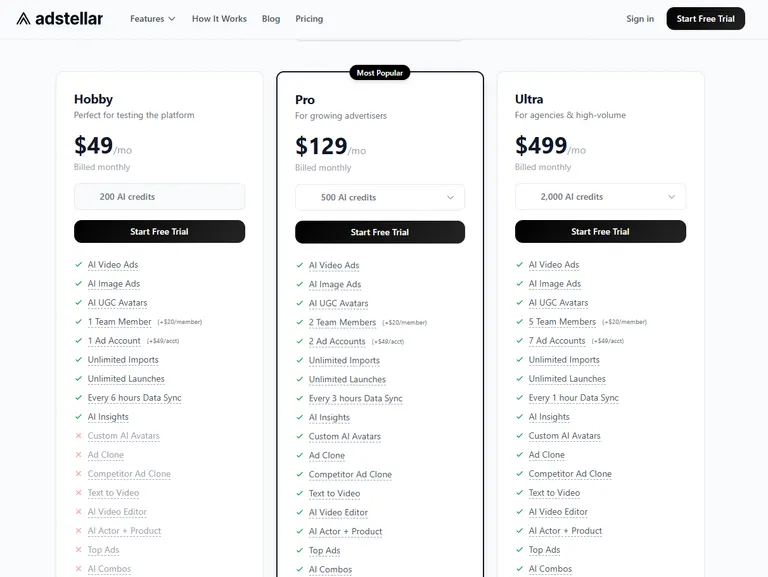
Flat-rate tiers. Hobby at $49/month (five launches). Pro at $129/month (unlimited launches). Ultra at $499/month (five team member seats).
4. AdAmigo: AI media buyer for Meta autopilot

AdAmigo is a Meta-focused AI media buyer that manages the full campaign lifecycle: creative development, audience strategy, daily campaign optimization, and scaling, through three specialized AI agents.
The platform reviews campaigns daily, generates pre-written optimization actions, and queues them for one-click approval before anything executes. It's the closest thing to a continuously monitoring senior media buyer available as software.
Channel focus: Meta-specific (Facebook and Instagram only)
Best for
Agencies managing multiple client accounts and DTC brands at $10K-$100K/month who want near-full Meta autopilot on daily ad management while keeping a human in the approval loop.
Key features
- AI Action Agent: Reviews campaigns daily, generates pre-written actions to scale winners, pause underperformers, and launch new creatives, then queues them for one-click approval to cut manual campaign management overhead.
- AI Ads Agent: Handles ad creation on-brand from product information and brand guidelines, supporting new audience segments and shopping campaigns, with bulk launch to Meta built in.
- Dual-approval workflow: Separates AI-generated suggestions from live execution, a critical governance layer for agencies managing campaigns across multiple clients.
- Audience automation: Builds custom audiences, lookalike audiences, and high-value audience segments from CRM data with predictive budget allocation across top-performing groups.
- AI Chat Agent: Answers questions about campaign performance in plain language, including diagnostics for ad optimization decisions when results shift unexpectedly.
Pricing
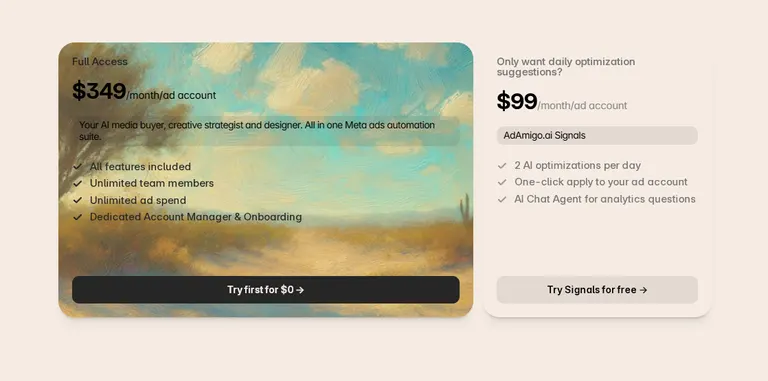
Per-ad-account pricing. Signals plan at $99/month per ad account. Full Access at $349/month per account, with unlimited team members, no ad spend cap, and dedicated onboarding.
5. Pencil: Enterprise GenAI operating system for ad production
Pencil is an enterprise-grade AI operating system that covers the full ad production workflow from creative brief to live campaign.
It handles idea generation, image and video ad creation, in-browser editing tools, brand governance, approval workflows, and direct publishing to Meta, Google, and other advertising platforms.
For organizations where brand compliance and legal review aren't optional, Pencil's governance architecture is what sets it apart.
Channel focus: Multichannel (Meta, Google, TikTok, YouTube, LinkedIn, DV360, and more)
Best for
Enterprise marketing teams and large agencies running multi-market campaigns across multiple advertising platforms that need AI-powered creative production with full cross-platform support without bypassing compliance requirements.
Key features
- Brief-to-ad workflow: Converts a creative brief into finished ad creatives through AI agents that handle generation, editing, and format adaptation in sequence, from one starting point.
- Brand governance guardrails: Enforces brand guidelines during creative generation, with approval workflows and audit trails so compliance teams have visibility before publication.
- Multi-platform launch: Publishes directly to Meta, Google, TikTok, YouTube, LinkedIn, and DV360 from a single advertising workflow, cutting platform-by-platform manual uploading.
- Bulk variation generation: Produces thousands of creative variations from one brief by varying audiences, markets, products, and messaging angles, built for catalog and shopping campaigns at scale.
- In-browser editing tools: Pixel-perfect editing inside the platform with version history and comment-based collaboration. No export to an external design tool required.
Pricing
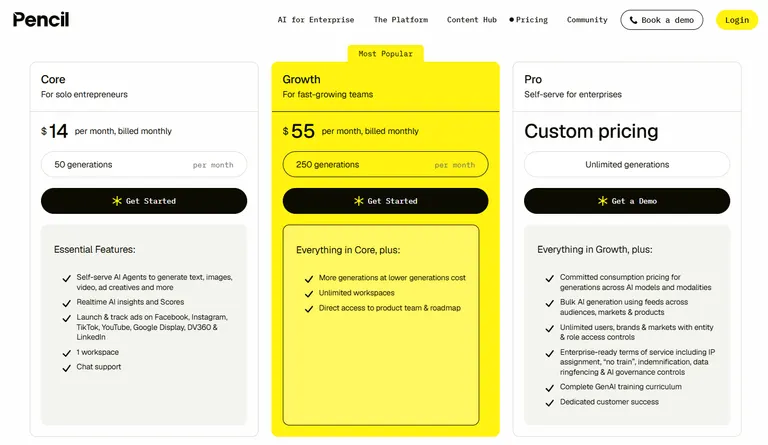
Tiered by generation volume. Core at $14/month (50 generations). Growth at $55/month (250 generations). Pro and Enterprise offer unlimited generations at custom pricing.
Why Choose Atria
Every tool on this list solves a specific piece of the Meta ads puzzle. Birch handles rule-based campaign governance. AdStellar cuts the time it takes to build and launch campaigns. AdAmigo automates the daily media-buying decisions that eat up hours each week. Pencil handles enterprise-scale creative production across channels.
Atria solves a different problem: the gap between having performance data and knowing what to do with it.
Most performance teams can see what's happening in their ad account. What they can't easily see is which creative to build next, which angle to test, and which competitor strategies to respond to. That's what Raya fixes.
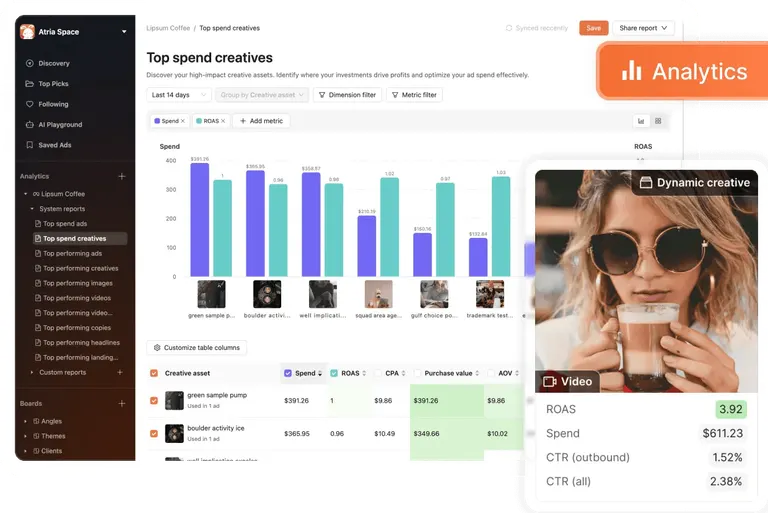
As Atria's AI creative strategist, Raya monitors your campaigns, analyzes competitors' ad libraries, mines customer reviews for high-converting language, and shows a prioritized list of what to create before your creative team opens a brief document.
From there, Atria handles the full production workflow.
- Radar grades every ad and tells you specifically what to change in underperformers.
- The 100M+ ad library lets your team research winning creative formats without leaving the platform.
- Automated reporting keeps everyone aligned on campaign performance without manual exports or dashboard-hopping.
- When creatives are ready, batch upload pushes them directly to Meta.
The result is a closed loop: insight to brief to ad to launch to analysis, all in one place. For teams managing multiple client accounts or running high-volume ad campaigns, that consolidation replaces three to four separate tools.
Atria is rated 5/5 on G2 and trusted by more than 20,000 teams.
Book a demo and see how the full workflow runs.
Managing Ad Creatives With Automation Tools
Your creative team shouldn't find out that a creative is fatigued after performance drops. They should know before it happens. That's the core value of creative automation.
Here's what it handles.
First, it tags and organizes ad visuals automatically by hook type, creative formats, and performance tier, so your best AI ad tools for creative analysis have structured data to work with rather than a library of unlabeled files.
Second, real-time fatigue monitoring detects the frequency-and-CTR saturation signal before it hits ROAS and triggers a refresh automatically.
Third, batch operations replace the manual work of uploading individual ad variations to Meta one at a time.
What stays with the human: the brief, the brand direction, the creative concept. Automation handles execution.
Ad Management, Governance, and Automation Rules
Good ad management means optimization and control running in parallel.
Automation rules define a condition and an action. If ad spend exceeds a threshold with no conversions, pause the ad set. Rule-based platforms like Birch build this governance layer through a configurable rules engine you control. That's sufficient for stable accounts with a documented playbook.
AI agent platforms go further: they reason about patterns in your performance data and suggest actions your rules didn't anticipate. AdAmigo does this through its daily AI Action Agent, which shows pre-written optimization actions for one-click approval.
AdStellar handles it at the campaign creation stage, explaining every AI decision before anything goes live. Atria approaches it differently: Radar grades every ad in your account and tells you specifically what to change, so your team acts on data rather than gut feel.
At the agency level, approval workflows ensure no AI-generated action executes on a client account without a human sign-off first. This protects client relationships and prevents automated bidding errors from compounding before anyone notices.
Enterprise plans in AdAmigo and Pencil include these controls by default. Pencil adds audit trails and IP ownership controls on top, built for organizations where legal review is part of the process.
Implementing Software for Automating Meta Ads Production: Step-by-Step
Connect a new platform and immediately change everything, and you'll create more problems than you solve. These steps are ordered to avoid that.
- Audit your current advertising workflows. Identify the three highest time-cost tasks: usually ad creation, campaign setup, and performance reporting.
- Connect your Meta ad accounts via the Marketing API. Every platform on this list uses Meta's official API. Stabilize the connection before restructuring any live campaigns.
- Upload brand guidelines, creative assets, and product information. AI output quality depends directly on the quality of the input. A complete brand profile produces significantly better results from day one.
- Set up your first three automation rules. Start with budget protection (pause ad sets with zero conversions after a defined spend threshold), creative fatigue detection, and a scaling rule for campaigns hitting your ROAS target.
- Define your creative testing cadence. Target 5-15 new creative variations per week for campaigns at $5K-$20K/month, scaling up from there as ad spend grows.
- Monitor the first 14 days without structural changes. Let the platform ingest your historical performance data and establish baselines before making ad optimization decisions.
- Scale winners and rotate fatigued creatives using automation. After two weeks of data, your automation rules have enough signal to act reliably on creative rotation and budget scaling.
Core Automation Workflows to Build First
Four workflows deliver the fastest return. Get these running before you build anything more complex.
- Budget protection. Pause ad sets that exceed your CPA target without a conversion. This catches underperformers before they drain the overnight budget and creates the foundation for every other workflow.
- Creative fatigue detection. Monitor frequency and CTR daily and queue a refresh when saturation signals appear. AI tools built specifically for Facebook ads optimization can run this automatically across all active campaigns.
- Scaling. When a campaign beats your target for three consecutive days, increase the budget at the campaign level, not the ad set level, to preserve the algorithm's learning signal.
- Weekly creative production. Pull the previous week's top-performing hooks, generate creative variations using your AI tool, and push approved creatives to Meta via batch upload to keep new audience segments fed on a consistent cycle.
Common Mistakes to Avoid With Meta Ads Automation

Image source: Pexels
Most teams make the same errors when they first roll out Meta ads automation. Here are the four that cause the most wasted spend.
Setting rules without revisiting them
Baselines shift with seasonality, audience changes, and platform updates. A CPA threshold that was correct in January can be badly miscalibrated by June. Build a monthly rule review into your workflow: not a full audit, just a quick check to verify that thresholds still reflect current account performance.
Automating production before solving strategy
More ad creation faster only compounds the problem if you don't know which angles are winning. Automation amplifies whatever direction you point it in. Use a platform with a performance intelligence layer, like Atria's Radar or AdAmigo's AI Chat Agent, to understand what's working before scaling production volume.
Over-fragmenting ad sets before the learning phase exits
Automated edits in the first seven days of a campaign reset Meta's learning phase. The platform needs time to gather enough conversion signals before optimization can begin. Consolidate your campaign structure and hold off on automation rules until the learning phase has exited on each campaign.
Optimizing Meta in isolation from your other ad campaigns
If you run campaigns on Meta and Google Ads simultaneously, optimizing one platform in isolation leads to a misallocated budget at the portfolio level. Ensure your automated reporting consolidates both before acting on either. Most automation tools operate per-platform by design, so a unified reporting layer needs to sit above them.
Migration and Scaling Plan for Ad Management Teams
Switching automation platforms mid-flight is one of the most common causes of unexplained performance drops. This four-phase plan prevents that.
Phase 1 (Week 1-2): Connect and observe
Link your Meta ad accounts to the new platform and import historical performance data. Don't touch live campaigns. The goal is to verify data syncs accurately before you act on anything.
Phase 2 (Week 3-4): Parallel reporting
Run your existing reporting workflow alongside the new platform's reports. Resolve any tracking discrepancies, particularly CAPI deduplication, before relying on the new data layer for decisions.
Phase 3 (Month 2): Migrate automation for lower-stakes campaigns first
Apply automation rules or activate AI agents on non-critical campaigns with smaller budgets. Build confidence in the automation logic with real data before moving top-performing accounts over.
Phase 4 (Month 3+): Full migration
With automation validated, migrate the full campaign portfolio and integrate the creative production workflow: brief generation, creative testing, and Meta batch upload, through a single platform. Never migrate everything simultaneously.
Staggering the transition preserves campaign learning signals and limits the impact of any configuration error.
Conclusion About Software for Automating Meta Ads Production
Meta ads automation is a competitive requirement in 2026, not a productivity upgrade. Meta's creative-first delivery model, compressed fatigue windows, and the volume of ad variations the algorithm needs to optimize all mean that manual campaign management leaves measurable performance on the table every week.
The five tools in this guide cover every primary automation need: creative intelligence and production (Atria), rule-based governance (Birch), fast campaign creation (AdStellar), AI-driven daily ad management (AdAmigo), and enterprise-scale GenAI creative workflows (Pencil).
The right fit depends on your team size, budget, channel mix, and how much of the creative strategy problem you've already solved.
If you need the intelligence layer and the production layer in one place, Atria is built for that. Book a demo with Atria and see how Raya automates your Meta ad production.
FAQs About Software for Automating Meta Ads Production
How to automate Meta ads?
Connect your ad accounts to a Meta Ads automation software platform via Meta's Marketing API, configure automation rules or activate AI agents for Facebook ad automation and creative rotation, then set a weekly ad creation cadence. Most platforms here are fully configured within one to two weeks. Start with budget protection and creative fatigue rules before adding anything else.
Is $10 a day enough for Facebook ads?
Ten dollars per day is above Meta's technical minimum but not enough to generate useful ad optimization data. Meta's algorithm needs sufficient conversions per week to exit the learning phase. A practical floor is $50-$100 per day per ad set. Automation tools become cost-effective once monthly ad spend reaches a level where the management time saved exceeds the subscription cost.
What are the top 5 automation tools for Meta ads?
The top five are Atria (creative intelligence and full-stack production), Birch/Revealbot (rule-based multichannel automation), AdStellar (fast AI campaign creation), AdAmigo (Meta autopilot with daily AI actions), and Pencil (enterprise GenAI creative production with cross-platform support). The comparison table above summarizes each tool side-by-side with G2 rating, best use case, top feature, and pricing.
Which AI tool is best for Meta ads?
For most performance teams, Atria is the strongest all-around AI tool for Meta ads because it combines creative intelligence with automated production and direct Meta launch. Teams wanting full campaign management automation will get more from AdAmigo. Teams prioritizing ad creation speed will prefer AdStellar. Enterprise teams running multi-market campaigns across multiple advertising platforms should evaluate Pencil.