
TL;DR: the results
- Dollar Shave Club: 12,000 orders in 48 hours, later a $1B acquisition
- Blendtec: roughly 700% sales increase within two years
- Orabrush: zero retail distribution to 3,500 Walmart stores
- Gymshark: 16.4 million people reached at a 6:1 return on ad spend
- Duolingo: 25,560% single-day spike in mentions
- Oreo: nearly 15,000 retweets and a Cannes Lion Award for a single tweet
- Metro Trains: 20% reduction in near-miss train accidents
- Dove: 21% increase in brand affinity, 11.9% increase in sales
- Lenovo: 63% increase in click-through rate, 6x higher engagement
- Mercedes-Benz: 35% more efficient cost-per-click than similar advertisers
We dug through dozens of famous campaigns to put together this list of ads to analyze, keeping only the ones with a disclosed, sourced result you can point to. Here are 10 that actually moved a number, and what to copy from each.
10 Great Ads to Analyze (With Proof They Worked)
How we picked these: every ad below has a disclosed, sourced result behind it, whether that's a sales lift, a cost cut, an accident reduction, or a return on ad spend.
1. Dollar Shave Club: “Our blades are f***ing great” (2012)
Michael Dubin made this ninety-second video for $4,500. Shot in one take, it shows him walking through a warehouse saying things like “your handsome-ass grandfather had one blade... and polio.” There’s no agency or actors. Just the founder, a bear costume, and a script written by a guy who used to do improv comedy.
The result: 12,000 orders in the first 48 hours. The video went on to help build a company that Unilever bought for roughly $1 billion in 2016.
What to learn: the low budget was the idea. A slick, expensive-looking razor ad would have weakened the pitch (stop overpaying for razors you don’t need).
If you’re selling “no-frills,” your ad has to look no-frills too. Otherwise people notice the mismatch before they even hear the message.
2. Blendtec: “Will it blend?” (2006–ongoing)
Blendtec was a small, unknown blender company until CEO Tom Dickson put on a lab coat and started feeding things into his own blenders on camera: marbles, a rake handle, a $600 iPhone.
There’s no script. He just says "will it blend? That is the question,” and then you hear the thing get destroyed.
The result: sales went up roughly 700% within two years. The ad won multiple awards and Dickson became an Internet celebrity.
What to learn: the format is what matters. Once “will it blend?” became a simple idea they could repeat, every new gadget launch was an excuse for a new episode.
If you’re building paid social creative, ask whether you’re making one ad, or building a format you can reuse again and again.
3. Orabrush: “Bad breath test” (2009)
Dr. Bob Wagstaff invented a tongue scraper, then spent almost a decade failing to sell it. Stores wouldn’t stock it. A $40,000 infomercial only brought in fewer than 100 sales.
A BYU marketing class studying his case even concluded that 92% of the market would never buy it. One student, Jeffrey Harmon, asked about the other 8% instead, and spent less than $500 testing a YouTube video.
The result: the video helped take Orabrush from zero retail distribution to 3,500 Walmart stores.
What to learn: Harmon leaned into how awkward the category already was, instead of trying to hide it. If your product is a little embarrassing, you’re often better off accepting that than trying to dress it up.
4. Gymshark: Blackout campaign (2018)
Every Black Friday, most apparel brands turn the volume up. In 2018, Gymshark did the opposite. Working with Facebook’s Creative Shop, they wiped their Meta feed down to blacked-out creative. They backed it up with Stories, carousel ads, and fans reposting their own guesses about what was coming.
The result: reached 16.4 million people at a 6:1 return on ad spend.
What to learn: cutting back on content can build anticipation. But that only worked because Gymshark already had a well-known look to break away from.
5. Duolingo: “Death of duo” (2025)
Duolingo's Duo the Owl: A Tribute to Its Legacy | TikTok
On February 11, 2025, Duolingo users opened the app and found their mascot’s logo replaced with a dead-eyed version of Duo. There was no warning. Over the next two weeks, the story kept building.
First a fake press release, then a TikTok funeral set to Sarah McLachlan’s “Angel,” then a mystery over how he actually died (turned out to be a Cybertruck), then a reward for whoever found the driver.
At one point Dua Lipa, who’s been Duo’s fake celebrity crush for years, posted her condolences. And that single post alone pulled in hundreds of thousands of reactions.
The result: 169,000 mentions of Duo in two weeks, with a 25,560% single-day spike in mentions, and #ripduo used more than 45,000 times.
What to learn: the team built the campaign live, off audience reaction. It started as three planned posts. It only grew into more because the team watched engagement in real time and kept extending the bit.
6. Oreo: "Dunk in the dark” (2013)
During Super Bowl XLVII, the power went out in the Superdome for 34 minutes. Oreo’s agency, 360i, had a live “war room”, and at 8:48pm tweeted an image of an Oreo in dim light: “Power out? No problem. You can still dunk in the dark.”
The result: it got retweeted nearly 15,000 times, picked up about 20,000 Facebook likes, and pushed Oreo’s Instagram following from 2,000 to 36,000. It also won a Cannes Lion Award.
Oreo also ran a paid Super Bowl commercial that year: “Whisper Fight,” its first big-game spot. It’s barely remembered today.
As Marketing Dive’s retrospective puts it: “Oreo’s standout moment of the night had nothing to do with its pre-planned TV campaign.”
What to learn: the free tweet outlasted the paid ad because the real investment was the setup behind the ad. Oreo had a team sitting in the room, already cleared to approve things fast, right at the one moment when the whole country had nothing else to watch.
7. Metro Trains: “Dumb ways to die” (2012)
A rail safety public service announcement shouldn’t be catchy, but this one is. It’s a cheerful, singable song paired with cartoon “beans” dying in absurd, unrelated ways. And it builds to the real message: getting hit by a train is one of the dumbest ways to die of all.
The result: a 20% reduction in near-miss train accidents compared to the same period the year before. The video has over 356 million views.
What to learn: the safety message worked because it wasn’t the point for the first 95% of the video. The entertainment earned attention first. The warning only landed once people were already hooked.
8. Dove: “Reverse selfie” (2021)
The film starts on a finished, glamorous selfie racking up likes, then plays in reverse. You watch the filters disappear one at a time (the fuller hair, the reshaped nose and chin, the smoothed skin, the plumped lips) until what’s left is a 13-year-old girl.
Dove built the whole campaign around research showing that 80% of girls distort their appearance online by that age.
The result: brand affinity went up 21%, and sales across Dove’s product categories rose by 11.9%.
What to learn: the insight came before the concept. Dove started with research on what was actually hurting girls’ self-esteem. Then they found the format (reverse footage) that made that one point hit hard, in under a minute.
9. Lenovo: Thought leader ads (2024)
Lenovo's social media team tested something unconventional. Instead of only boosting official company posts, they started boosting individual employees' organic LinkedIn posts, from the CEO down to product specialists, as paid ads. The idea was that people trust people more than corporate accounts.
The result: a 63% increase in campaign click-through rates and 6x higher engagement rates versus LinkedIn's own historical benchmarks.
Some individual examples were even stronger. Three posts from a Gartner event hit an engagement rate 15x over benchmark, and a single CEO post hit a 7.79% engagement rate.
What to learn: the marketing team didn't write the ad. It was a real employee's genuine post, boosted after the fact once it showed signs of working organically.
That's the opposite of how most paid social gets made (write the ad first, then run it). Here, the best-performing organic content became the media buy.
10. Mercedes-Benz: GLB launch campaign on LinkedIn (2019)
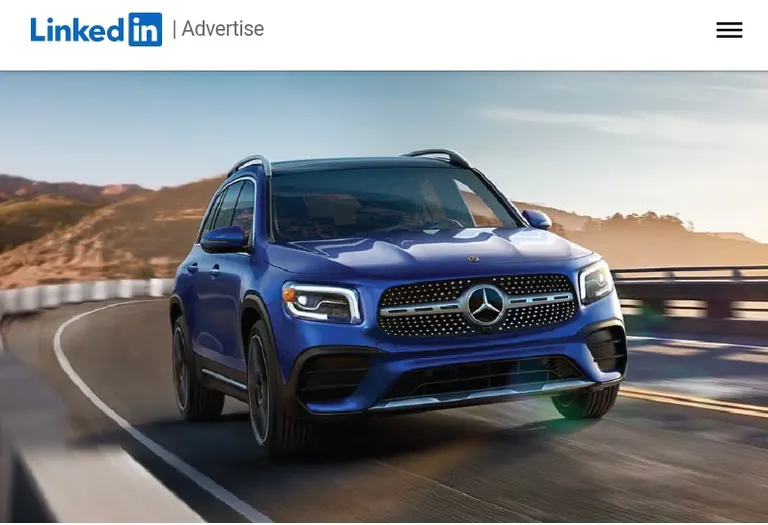 Launching the GLB (a three-row SUV priced for young families) without watering down a brand built on “ultra-affluent” was a real challenge. Mercedes and agency Merkley + Partners chose LinkedIn on purpose.
Their reasoning was that upwardly-mobile professionals were sitting right there, in a premium feed that felt safe for the brand.
The result: their cost-per-click came in 35% more efficient than similar advertisers, and over 80% of clicks came from senior-level job titles. The highest engagement came from people with titles like “Owner,” “CEO,” and “Founder.”
What to learn: the creative broke from Mercedes’ usual look on purpose (bright, bold color instead of moody luxury photos) to stand out against LinkedIn’s light, plain feed. They changed the colors to fit the platform.
How to read an ad like these
You don't need all ten lessons memorized. Just ask the same four questions every time, in this order:
Goal: what was this ad trying to change? Sales, awareness, behavior, leads. If you can't name it, you can't grade it later.
Hook: what happens in the first few seconds, or the first line? Is it built to stop a scroll, answer a question, or start an argument?
Format: why this format and not another? A demo video, a static image, a tweet, a stunt all cost different amounts of time and money to make. Ask what the format bought them.
Targeting: who was this built for, and does the platform match that person? Mercedes on LinkedIn only makes sense when you know who they were trying to reach.
Once you can answer all four for someone else's ad, you can answer them for your own before you shoot it.
What these 10 ads have in common
Everything above breaks down into one of these four:
Emotion over information: Ads that lead with a feeling get more attention than ads leading with a feature. Duolingo's mascot funeral and Oreo's blackout tweet worked because they reacted to a moment.
Build a repeatable format, not one ad: “Will It Blend?” worked because Blendtec could reuse it for every gadget launch. Lenovo did the same with employee posts.
Meta's Andromeda retrieval engine surfaces a wider spread of creatives, so a steady stream of distinct ads gives it more to pull from.
Insight before concept: Dove started with research on what was hurting girls' self-esteem, then found the format that made that point land. The best creative idea is usually the first version.
Match the creative to the platform: Mercedes changed its color palette to stand out on LinkedIn's plain feed. Dollar Shave Club matched its low production value to a low-frills pitch. Same principle either way. The creative has to fit the room it's showing up in.
Generate briefs and grade ads with Atria
Every one of these ads to analyze teaches a specific lesson. Pick the one that fits your brief, and set the number it needs to hit before you shoot anything.
Once it's live, grade it the same way: did it move that number, and if not, was it the idea, the execution, or the targeting?
Raya, Atria's strategist, lives in Slack and pulls real competitor and category ads to brief against.
Once the ad is live, Radar grades it against those benchmarks and tracks your own ad's performance while the campaign is still running rather than weeks later. That's the same creative analysis loop behind every ad on this list.
Rubix, a performance marketing agency, made creative analysis 40% faster and lifted ROAS 15% (and cut CPA 20%) using Atria's tagging and reporting.
Founder and CEO, Alex Realmuto, says, "Atria is phenomenal, especially from a reporting standpoint. It's going to make your life easier, and it's an easy decision when you look at ROI."
Want to see your best performing creative? Try Atria for free.
Frequently Asked Questions
What makes an advertisement successful?
What makes an advertisement successful is whether it did what it set out to do. That could be to drive sales, cut costs, or change behavior. For example, did it achieve a 700% sales increase or a 20% drop in accidents? The awards are just a bonus.
How do you analyze an advertisement?
You analyze an advertisement by starting with the goal (sales, awareness, behavior, leads) and checking whether it did that. Then look at how it was built: the hook, the format, the targeting, the call to action. Ask which of those choices caused the result.
What is the most successful ad campaign of all time?
The most successful ad campaign of all time depends on how you define "successful." It could mean sales, cultural staying power, or return on ad spend, and the answer changes depending on which one you pick.
What makes an ad go viral?
Ads go viral when they lead with emotion. Nielsen's neuroscience study of 100 ads found the ones with the strongest emotional response drove a 23% sales lift over an average ad, while flat, feature-led ads pulled sales down.
But virality and sales results don't always overlap, so the focus should be on what moves the needle as well as what gets shared.
Do funny or entertaining ads sell better than straightforward ones?
Funny or entertaining ads don't always sell better than straightforward ones, but several of the best-performing ads here use humor to get a plain or awkward product noticed. The humor earns attention. It isn't the point on its own, so treat it as a deliberate creative choice.