
White label Facebook ads let you sell Meta media buying under your own brand, but the money's in the backend mechanics most agencies get wrong. Here's how ownership, partner access, and true ROAS decide whether the model holds.
What white label Facebook ads means
White label Facebook ads means running Meta campaigns for a client while another company does the practical work behind the scenes.
The term covers two very different setups:
- Outsourced fulfillment: You hire a third-party agency or contractor to handle strategy, creative, and campaign management. The client sees your logo while someone else does the work.
- In-house delivery with tooling: Your team runs strategy and execution, using software to automate campaign builds, creative generation, or client reporting.
Outsourcing trades away control and margin, while tooling lets you handle more accounts and still keep control in-house.
The mechanics, permissions, and diagnostic checks below apply to both paths.
How the Business Manager and ad account work
You need to get Meta's account architecture right. One misstep in permissions or asset assignment can trigger security flags, compliance issues, or a locked account.
Who owns the ad account, page, and pixel data
The client should always own the Meta Business Manager (now called Business Portfolio), the Facebook Page, the Instagram account, and the Meta Pixel.
Creating a client's ad account inside your own Business Portfolio binds their historical data, custom audiences, and pixel optimization to your business entity. If the relationship ends, moving that account out is difficult, sometimes impossible.
The client keeps primary ownership of every asset and grants you access through Business Portfolio's Partner settings.
Partner access, and why you can't chain white label providers
A Business Portfolio shares assets with a Partner using that Partner's ID.
Here's how access flows in a standard setup:
- Client grants Partner access to Agency A (your brand).
- Agency A assigns specific assets (Ad Account, Page, Pixel) to its internal team.
You may run into difficulties if you outsource fulfillment to Provider B: Meta's own policy says you can't share a partner's legal entity with a third business. That's what a nested billing chain would require.
Agencies work around this in two ways, without exposing Provider B to the client:
- Direct System User/Individual Access (reported practice): Provider B's media buyers join Agency A's Business Portfolio as individual employees or contractors, invited by email. Provider B's name never appears. Meta hasn't documented this as an official workflow, so treat it as a reported practice.
- Direct Partner Request with Custom Branding (reported practice): Provider B requests direct Partner access from the client, using a Business Portfolio name that mirrors your agency's branding. Again, Meta hasn't confirmed this works, so verify before you rely on it.
Billing: Who pays Meta?
Meta charges the payment method attached directly to the ad account.
Use one of two billing structures to keep this clean:
- Direct Client Billing (Recommended): The client attaches their card or credit line inside their own ad account billing settings. Meta bills them directly for ad spend while you invoice them separately for management fees.
- Agency Sequential Billing: You attach a corporate card to the client's ad account and invoice them for spend plus fees, but you're exposed to cash-flow risk in the event of late payment.
Avoid letting a provider attach their own card to a client's account. It kills spend transparency and turns any cost spike into a dispute.
How reporting and branding get white-labeled
With white-labeling, third-party branding has to disappear from every touchpoint your client sees.
A real white-label setup covers three things:
- Live dashboards and automated reports: Reporting tools route performance data through your own custom domain (think reports.youragency.com). Clients see live metrics, ad previews, and spend, never an outside logo or URL.
- Ad creative and proofing links: Preview links let clients review, comment on, and approve creative variations. Strip the software's branding out and swap in your agency's logo, colors, and favicon.
- Meta Business Portfolio communications: Meta's notification emails, partner requests, asset invites, and pixel prompts should show your agency name or a branded Business Portfolio handle. Your fulfillment provider stays invisible.
This is because white-label reporting makes your agency the single source of truth for performance, strategy, and creative, and that's what builds client trust.
The two ways agencies deliver this
Selling white label Facebook ads means picking one of two fulfillment models. That choice decides your margins, your stress levels, and your long-term results.
Outsourced fulfillment
The traditional model: hire a white label agency, vendor, or offshore team to run the campaigns for you.
- How it works: Your team handles account management. You hand off client goals, and their media buyers handle setup, targeting, copy, creative, and optimization.
- The economics: Providers typically charge $1,000 to $2,000 per client as a flat retainer, or 10% to 15% of ad spend. Mark that up by 50% to 100%, and your client retainer lands around $1,500 to $4,000.
- The risk: You give up quality control. Outdated tactics, high turnover, or weak creative on their end become your problem, and your margin shrinks right along with the relationship.
In-house delivery powered by ad intelligence tools
The alternative is keeping media buying in-house and using ad intelligence software to clear the bottlenecks, like creative research, briefing, and variation building, that used to eat into your week.
- How it works: A lean internal team uses tooling to analyze competitor creative, generate hooks, and automate launches.
- The economics: Your software cost stays flat no matter how many accounts you add. One buyer can handle noticeably more accounts without burning out, since the tooling absorbs the repetitive work manual management can't scale past.
- The payoff: You keep full control, the direct client relationship, and a much fatter margin per account.
What determines whether white label Facebook ads work
Don't judge a white label setup by how smooth communication feels, as client retention hinges on revenue.
Here are three signals that tell you your ads are working.
Vanity metrics vs. ROAS (the dashboard that lies)
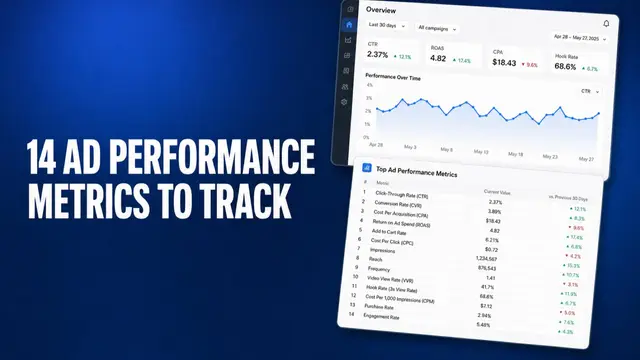
Weak providers hide behind top-of-funnel numbers like impressions, click-through rate, and a low cost-per-click.
Those numbers show engagement, but don't prove revenue. Meta's own attribution tends to over-report conversions, claiming credit across overlapping user journeys that never converted because of that ad.
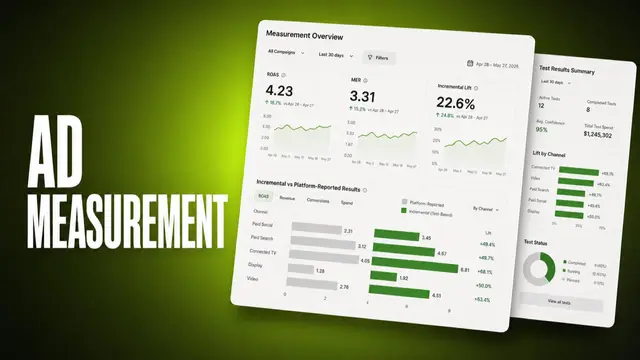
Strong providers tie performance to blended ROAS and Customer Acquisition Cost (CAC). They pull real backend revenue from Shopify or your CRM.
Creative testing volume
Meta's ad retrieval engine, Andromeda, leans on your creative to decide which ads even get shown to the right buyers.
Running two polished videos and tweaking targeting isn't enough. A good provider tests multiple creative angles fast, including:
- Dynamic hooks (the first 3 seconds of video).
- Varying visual formats (UGC, static image stat-callouts, comparison charts, press quotes).
- Distinct messaging angles (problem-aware vs. solution-aware copy).
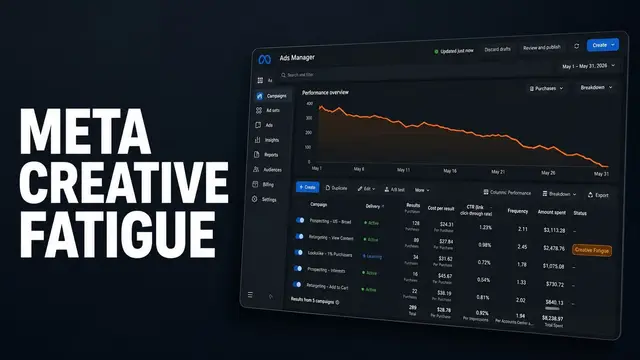
No fresh creative weekly means fatigue sets in, and acquisition costs climb.
Garbage brief in, garbage results out
Performance suffers when you hand off a vague client description and expect the provider to guess your strategy. A strong brief covers:
- Core customer pain points and specific buying triggers
- Proven angles from past email marketing or organic social campaigns
- Direct competitor ad analysis and offer breakdowns
The best white label relationships run on tight feedback loops that turn customer data into sharper briefs, every cycle.
What white label Facebook ads cost
What you pay depends on whether you outsource fulfillment to a vendor, or power an in-house team with software.
Know standard market rates to protect your margin.
| Model | Typical Provider Cost | Recommended Client Markup/Pricing |
|---|---|---|
| Outsourced: Flat Retainer | $1,000 to $2,000 per account/month | $1,500 to $4,000 per account/month |
| Outsourced: Spend Percentage | 10% to 15% of ad spend ($500/month minimum) | 15% to 25% of ad spend ($1,500/month minimum) |
| Outsourced: Onboarding Fee | $500 to $1,500 one-time setup | $1,500 to $3,000 one-time setup |
| In-House: Software Tooling | $150 to $500 flat monthly subscription | Bill standard agency retainers ($2,500+/month) while keeping software overhead fixed |
Outsourced vendors charge a flat retainer or a cut of ad spend. Mark that up 50% to 100%, or outsourcing stops being worth it.
In-house tooling flips the math. One software subscription covers automation across every account you run. Your cost stays flat, but your retainer revenue climbs with every account you add.
Mistakes and risks to watch for
Outsourcing fulfillment brings risks that go beyond a bad ROAS month. If you get the setup wrong, you can lose account ownership, break compliance, or tank performance outright.
Losing account ownership when a provider relationship ends
The most common trap starts at setup. A partner holds all the power if they create the Business Portfolio, Page, or Ad Account under their own umbrella.
When you terminate the partnership, you risk losing:
- Years of historical pixel conversion data and custom audience lists
- Active ad accounts and established campaign history
- Access to client Facebook pages and Instagram assets
Build every asset inside the client's Business Portfolio, always. You and your fulfillment partners access it through Partner permissions, nothing more.
Compliance and disclosure questions
Meta polices automated actions, asset sharing, and access logs closely.
Handing offshore teams or contractors direct employee logins can trigger security flags. A sudden shift in login location reads as suspicious to Meta, and locked accounts or disabled payment profiles follow.
Keep access logging clean. Use dedicated system user profiles or verified Partner connections, never shared passwords or personal logins.
Quality control blind spots
Outsourcing puts a wall between your media buyers and your clients. Without direct oversight, small errors slip through and can harm your reputation:
- Broken tracking URLs and missing UTM parameters
- Unapproved ad copy or off-brand creative variations
- Bidding errors that burn through client daily budgets
Skip hands-off management, and build in approval checkpoints for new creative, tracking setups, and budget changes, before anything goes live.
How Atria fits into a white label workflow
Scaling white label Facebook ads in-house comes with a challenge: media buyers burning hours on metrics, competitor swipe files, and creative briefs.
Atria closes that gap. Competitive intelligence, performance diagnostics, and data-backed creative execution live in one platform.
This way, you skip the high agency fees and the extra headcount. Atria's built-in AI tools let your team manage more accounts while protecting your margin:
- Radar (AI Performance Intelligence): Plain-English ad grades with specific fixes. Radar flags a declining creative before it spikes your client's acquisition costs.
- Raya (AI Creative Strategist): Trained on billions in ad spend data. Raya analyzes what's worked, shows buyer triggers you'd miss, and writes ad copy and video scripts in seconds.
- Competitor Inspo and Batch Launching: Search over 100 million ads from Meta and TikTok, spot what's winning, generate fresh variations, and launch straight to Meta in a few clicks.
Agencies using the tool see this in practice. As Matt Seabrook at Ipsy shared, "I almost never logged into Motion. It was pretty infrequent. And now I'm in Atria fairly frequently, mainly because it's picking a lot of the subjective info and making it more objective with data."
Swap manual research and guesswork for data-backed workflows, and you get full campaign control, higher ROAS, and room to scale.
Start free with 1,000 credits included, no credit card required.
Frequently Asked Questions
Is white label Facebook ads management legal?
Yes, white label Facebook Ads management is legal. You act as an authorized agent managing ads on your client's behalf, and your client keeps ownership of their Business Portfolio, ad account, and pixel for compliance.
Do clients know a white label provider is running their ads?
Clients don't usually know a white label provider is running their account. Set up partner access correctly, and every report, proofing link, and account update shows your agency's branding, not the provider's.
How much do agencies typically mark up white label Facebook ads?
Agencies typically mark up outsourced white label fees by 50% to 100%. On a $1,000 provider retainer, price your service at $1,500 to $2,000 to protect margin. With in-house tools, you keep the same retainer, $2,500 or more, while paying a flat software fee, which is where the real margin is.
Can I switch providers without losing my ad account?
Yes, you can switch providers without losing your ad account, as long as the client owns the primary Business Portfolio and ad account.
How many ad creatives should a white label partner be testing per ad set?
A white label partner may test 3 to 5 distinct creative variations per ad set, every week. Skip minor tweaks to one image. Test across formats, UGC, static callout cards, comparison tables, and short-form video hooks to stay ahead of creative fatigue and keep acquisition costs down.